🚀 We would love your feedback. How's SpaceTime travelling...love it or hate it, we need to hear it all. Take the 1-minute survey and let us know what you think:Click Here
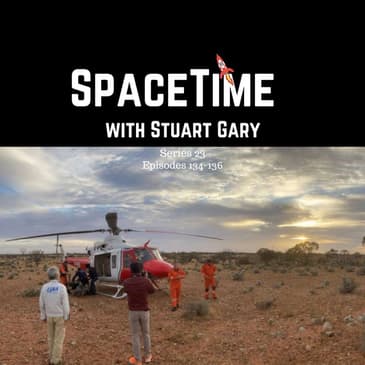
The Astronomy, Technology and Space Science News Podcast.SpaceTime with Stuart Gary Series 23 Episode 134*Hayabusa2 lands at WoomeraThe first pristine subsurface samples of an asteroid have been safely returned to Earth with the Japan Aerospace Exploration Agency’s Hayabusa2 re-entry capsule parachuting down onto the Woomera Rocket range in outback South Australia.*Hints of new physics in polarized light from the big bangScientists have glimpsed hints of new physics in Planck data from the cosmic microwave background radiation.*SpaceX’s starship prototype explodes during landingA prototype of the new SpaceX starship has exploded in a spectacular fireball following a test launch in south Texas.*The Science ReportThe major breakthrough in science which is destined to change everything.Less than half of the world’s forests still in their natural state.Confirmation that Havana syndrome is consistent with the effects of directed microwave energy.Paleontologists have discovered a new species of sauropod dinosaur in Argentina.Skeptic's guide to Science: growing concerns about the Therapeutic Goods Administration.SpaceTime with Stuart Gary Series 23 Episode 135*New evidence of how dark matter behavesAstronomers have discovered new characteristics about mysterious dark matter after watching a galaxy being eaten by another bigger galaxy.*New discoveries about how planetary nebulae are madeAstronomers have discovered that the mesmerising spiral structures seen in planetary nebulae are generated by companion stars or planets orbiting around the dying star.*Cape Canaveral renamedOne of the most famous places on Earth – the Cape Canaveral Air Force station – has officially been re-named the Cape Canaveral Space Force station.*The Science ReportWarnings that climate change could lead to irreversible sea level rise as temperatures increase.A new study warns there could be fewer than 300 swift parrots left in the wild.Scientists sequence the genome of the wild progenitor of the modern day tomato.The only dinosaur bones ever found in Ireland have been formally confirmed for the first time.Alex on Tech: Robot vacuum cleaners that spy on private conversations.SpaceTime with Stuart Gary Series 23 Episode 136*A Total Solar Eclipse Over South AmericaThe good citizenry of Chile and Argentina have experienced a total solar eclipse.*The space station gets a new air lockA new Air lock has arrived aboard the International Space Station. The equipment was flown up on a SpaceX Dragon spacecraft on the latest resupply mission to the orbiting outpost.*Golden Wattles fly into orbitThe latest Dragon cargo mission to the space station also took on a bit of Australian flavour with Australian Golden Wattle seeds included in the payload.*The stunning images of Earth seen from spaceNASA’s Earth Science and Remote Sensing Unit guide the astronauts as they observe and document changes on Earth -- then make those photographs accessible to scientists and the public.*Chuck Yeager dies at 97The first man to break the sound barrier Chuck Yeager has passed away aged 97.*The Science ReportAustralia’s threatened native plant species suffer catastrophic 70 percent decline in population numbers.Restricting meat consumption linked to greater cardio benefits than a traditional Mediterranean diet.Being obese for longer periods of time is associated with a higher risk of disease.Echidnas, wombats and bilbies join platypus in having biofluorescent fur.Skeptic's guide to Science: The World Health Organisation trashing what’s left of its reputation.For more SpaceTime visit https://spacetimewithstuartgary.com (mobile friendly).For enhanced Show Notes including photos to accompany this episode, visit: http://www.bitesz.com/spacetimewithstuartgaryRSS feed: https://rss.acast.com/spacetimeEmail: SpaceTime@bitesz.comTo receive the Astronomy Daily Newsletter free, direct to your inbox...just join our mailing list at www.bitesz.com/mailinglist or visit https://www.bitesz.com/astronomy-daily