
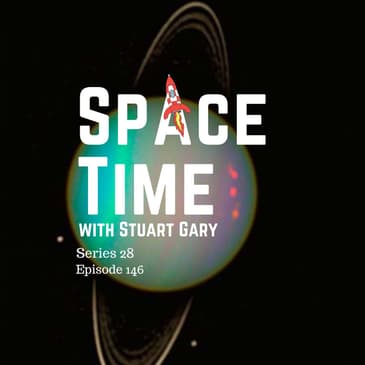



Unraveling Uranus: The Mystery of Its Radiation Belts
For 39 years, the intense electron radiation belts surrounding Uranus have puzzled scientists since NASA's Voyager 2 flyby in 1986 revealed unexpectedly high levels of radiation. New analyses suggest these findings may be explained by a solar wind structure interacting with the Uranian system during Voyager 2's visit. This research opens up new questions about the fundamental physics governing these extreme energy levels and the unique characteristics of Uranus itself.
Mapping Martian River Systems: A Historic First
A groundbreaking study has mapped ancient river systems on Mars, identifying 16 large drainage basins that could have supported life billions of years ago. By synthesizing previous data on Martian river valleys, lakes, and canyons, scientists have outlined how these systems could have formed a global network, similar to Earth's most biodiverse river basins. This research enhances our understanding of Mars' geological history and its potential for past life.
2026 Australasian Sky Guide Released
The 2026 Australasian Sky Guide has officially been released, offering skywatchers a detailed monthly map of celestial events. Highlights include supermoons, planetary alignments, and eclipses, providing an exciting year ahead for astronomy enthusiasts. Dr. Nick Glom shares insights into the guide's features and the astronomical events to look forward to in the coming year.
www.spacetimewithstuartgary.com
✍️ Episode References
Proceedings of the National Academy of Sciences
Communications Earth and Environment
Become a supporter of this podcast: https://www.spreaker.com/podcast/spacetime-your-guide-to-space-astronomy--2458531/support.
(00:00:00) Scientists may have finally resolved 39 year old mystery about Uranus radiation belts
(00:03:55) A new study has begun the task of mapping ancient river systems on Mars
(00:08:06) The 2026 Australasian Sky Guide has just been released
(00:10:23) The book tells readers what's up in the sky for each month
(00:11:39) Total eclipse of the moon in March is spectacular and easy to photograph
(00:14:22) A new study suggests volcanic activity may have paved the way for the Black Death
(00:15:37) A new study claims people who want children are more likely to find older faces attractive
(00:17:33) Tim Mendham warns about the dangers of taking medical advice on social media
(00:20:08) Spacetime is available through bitesz.com and other podcasting platforms
This is Spacetime Series twenty eight, Episode one hundred and forty six, for broadcast on the turth of December twenty twenty five. Coming up on space Time, the mystery of Uranus's radiation belts, mapping Martian river systems for the first time, and the official release of the twenty twenty six Australation Sky Guide. All that and more coming up on space Time. Welcome to space Time with Stuart Gary. Scientists believe they may have finally resolved a thirty nine year old mystery about the radiation belts around the planet Uranus. Back in nineteen eighty six, when NASA's Voyager to spacecraft made the first and only fly by of the ice giant, it measured a surpriseingly strong electron radiation belt at significantly higher levels than have been anticipated based on extrapolations from other planetary systems, Uranus's electron radiation belt was way off the charts. Since then, scientists have wondered how the Urinous system could support such an intense trapped electron radiation belt, especially considering the planets Unlike anything else in our Solar System. You see Urinus orbits the Sun virtually on its side with its poles always pointing to the same part of space. It has a marked axi or tild of eighty two point two to three degrees with the retrograde rotational period of seventeen hours and fourteen minutes. That means that during its eighty four earthy orbital period around the Sun, its poles get around forty two years of continual sunlight each followed by forty two years of continuous darkness. Now, based on the new analysis, scientists theorized that the Voiager to observations may have more in common with processes at Earth driven by large solar windstorm. Astronomers now think a solar wind structure known as a co rotating interaction region was likely passing through the Uranian system, and this could explain the extreme energy levels which Voyager two observed. The studies lead author Robert Allen from the Southwest Research Institute says science has come a long way since the Voyager two's fly by, and so he decided to undertake a comprehensive approach looking at the Voyager two data and comparing it to Earth observations made in the decades since. And this new study indicates that the Uranian system may have experienced a space whether event during the Voyager two visit, and that event that the powerful high frequency waves, which were the most intense observed over the entirety of the Voyager two mission. Back in nineteen eighty six, astronomers thought that these waves would scatter electrons to be lost in Urinus's atmosphere, But since then astronomers have learned that those same waves, under certain conditions can also excelerate electrons, feeding additionally energy interplanetary systems. In twenty nineteen, Earth experienced one of these events, which caused an immense amount of radiation built electronic acceleration. If a similar mechanism interacted with the Urinous system, it would explain why Voyager to saw this unexpected additional energy. But the thing is these findings also raise a lot of additional questions abo the fundamental physics and sequence of events that would enable these intense way of emissions to occur. This is space time still to come. Mapping the Martian River system for the first time and the twenty twenty six Australas Skyguide finally released. All that and more still to come on space time, a new study has begun the task of mapping ancient river systems across the surface of the red planet Mars. Billions of years ago it rained on Mars, the water collected in valleys and streams, creating rivers, which filled and spilled over the rims of craters and was funneled into canyons, perhaps even making its way onto a large marsh and ocean. Here on Earth, areas around large river systems are among the most ecologically diverse regions on the planet. Just think of the Amazon and Congo basins, each of which contained tens of thousands of known species. Scientists now think similar systems on Mars could have also been potential cradles for life if it ever formed there when water was flowing across the Red planet. Now, a report in the Proceedings of the National Academy of Sciences has defined large river draining systems on the Red planet for the first time. The research outlined sixteen large river basin catchment areas where life would have been most likely to thrive had it ever existed on the Red planet. One of the sturdies author's Timothy Gards from the Universe of Texas at Austin, So Scientists have known for a long time that there were rivers on Mars, but they really didn't know the extent to which the rivers were organized into large drainage systems on a global scale. So Gucci colleagues brought together previously published individual data sets of Martian river valley networks, lakes, and streams, then outlined the combined drainage systems that determine their total area. They identified nineteen big clusters of river valley network, streams, lakes, canyons, and sedimentary deposits, sixteen of which were connected together into watersheds of one hundred thousand square kilometers or larger. Now that's the threshold for what's considered a large drainage basin here on Earth. The author's work is the first to provide a systematic planet wide identification of large river basins on Mars. On Earth, large watersheds spanning at least one hundred thousand square kilometers are much more common than what they are on Mars. Here on Earth there are ninety one of them, the Amazon River Basins system, who is the largest on the planet, some six point two million square kilometers. And where these large river basins sit, life follows, as a general rule, the larger the river, the more nutrients are transported throughout the system. That's why the most diverse ecosystems on Earth exist in the largest drainage basins. The most sprawling of these watersheds, such as the Indus River basin, are often considered the cradles of human civilization on Earth. Tectonic activity is built mountains, valleys, and other diverse topography which directs waterway to flow and connects it into other systems, and this varying topography is part of what makes the large drainage system. Because the Red planet lacks tectonic activity, Mars has far fewer large drainage systems. Nevertheless, although the large drainage systems only make up five percent of the planet's ancient terrain, the authors found they still represent around forty two percent of the total material eroded by rivers on Mars, and since sediments contain nutrients, these are the best places to look for signs of past life. The longer the distance, the more you have water interacting with rocks, so there's a higher chance of chemical reactions that could provide nutrients for any life forms that might have existed there by. And large Mars is covered by what the authors describe as a mosaic of smaller drainage systems, while each one represented a potential habitable environment. Gourgeon colleagues say that the sixteen large drainage areas could be the most worthwhile areas for future studies for Mars' habitability. This is space time still to come. The twenty twenty six Australasian Skyguide has been released, providing sky watchers with a monthly tour of the night skies and later in the science report, could volcanic activity have contributed to the spread of the Black Death? All that and more still to come on space time. The twenty twenty six Australasian Skyguide has just been released, providing sky watches with a monthly map of the night skies. The astronomical highlights of twenty twenty six begin with a supermoon on January the third. Jupiter will be the opposition on January the tenth, when the gas giant appears to be at its closest open position to the Earth and hence will appear at its brightest in the night sky. In February, there will be a rare planetary alignment of Mercury Venus Mars, Jupiter, and Saturn. There'll also be an annulous solar eclipse on February seventeenth that'll be visible from Southern Africa and South America. A total lunar eclipse will take place on March the third, which will be visible across eastern Europe, Asia, Australia, and both North and South America. I. Meanwhile, the planet's mercury, Mars and Venus will be bunching up in April, and there's a blue moon on May the thirty first, marking the third full moon in a season which for full moons. There will be a total solar eclipse on August the twelfth, visible across Europe, North Asia, and parts of North and western Africa, and there'll be a partial lunar eclipse on August the twenty eighth that'll be visible in Europe, Western Asia, Africa, North and South America. The planet Neptune will be at opposition on September the twenty fifth. That's when the ice giant will be at its closest orbital position to the Earth and fully illuminated by the Sun, allowing it to appear brighter than at any other time of the year. Right now, Satin is at equinox, meaning its usually majestic rings have temporarily appeared to vanish. It's because they're being seen exactly side on. But on October the fourth next year, Saturn will be in opposition, when it will be at its brightest and closest orbital position to the Earth. There will be another peritury full moon or supermoon on November the twenty fourth, and the planet Uranus will be at opposition the next day, November the twenty fifth. Finally, another supermoon will take place on Christmas Eve. Doctor Nick Long is a consultant curator of astronomy at the Powers Museum, Sydney Observatory, and he is the author of the annual Oscillation Skyguide. The Skyguide two Double twenty six is the thirty sixth edition, so it's been coming for quite a number of years. I think it's getting batter each year. The certainly we try very hard to improve it. What's in the book? What does the book do? What the book does readers what's up in the sky for each month? It describes as the starback for each month, and as a description of what constellations, what planets are visible, and all the interesting features a night sky for that month. The sky mats are designed so that they're very easy to use. You can hold up the book one way and you'll see what's up in the Boden sky. And you hold the book up the other way and you see what's up in the sudden sky, and in each case the writing is the way around. So the idea is you lie on your back on the ground and you hold the book above you, and there you are. You can work out by transposing what's on the paper, So what's in the heavens? Yeah, I find that extremely uncomfortable stuke. I'd rather be standing up facing say naws and then try and match what's in the northern sky with what's on the map. And then if you want to see what's in the southern sky, you turn around, turn the book around and then you see what's in the circles kite. I just find that much more comfortable than you're trying halt that. Yeah, could be. Any more anyway. Yeah, what are some of the highlights that are coming up in twenty twenty six? Main highlights is a total liquids at the Moon in March, and that's happening in the late evening. That was a total liquipse in September share but that was in the early morning two to four am, and I suspect most people, including myself miss out. But the one in March twodounk twenty six is a lady need certainly worth watching and dotalks of the moon a save to watch spectacular as the moon turns red, so it's certainly worth watching, easy to photograph as well. In contrast, there is a blue moon on the thirty first of May. Of course the moon doesn't actually turn blue. It's just a term with that second if for the second four moon in a month, so May, there is full moon early in May, and there is one right at the end of the end of May, and that's a blue moon. Talking about the moon, there's also super moon when the moon is just a little bit brighter and larger than usual, and that that's place of Christmas Eve. Also in July, there's a matter riki that I pronounced that right. Yes, every year we have an essay from the First Nations person about First Nations astronomy, so it's been about the Nations in Australia, but this is us a mortar person from New Zealand and the Mata Riki, which is two Europeans that played East Cluster, is of great significance to more people, especially it's herely ech or Rise. That's when it first becomes visible before sunrise. That is a great importance to how they look at the sky, their calendar and it has become a public holiday MU Zealand and in twenty twenty six it will be on the tenth of July. We use Yassulasian Skyguide on SkyWatch here on Space Time. If people want to get a copy, where do they go? Well, I think you get it from all good bookstores. It's available online. It's available from the Bahouse Museum. It's available at Sydney Observatory, which wasn't the case for a year or two because the observation is closed for restoration. But it's easily available suddenly look online. Let's doctor Nick Long, consultant Curator of Astronomy at the Powers Museum, Sydney Observatory. And this Space Time. And time out of take another brief look at some of the other stories making news in science this week with a science report, A new study suggests that widespread famine in Europe as a result of volcanic activity may have paved the way for the Black Death to take hold. In the region. The plague killed up to sixty percent of the entire European population between thirteen forty seven and thirteen fifty three. It was likely caused by the bacteria Yucinia pestis, which was spread by fleas on rats that came to Europe aboard trading vessels from the East. Now, a report in the General Communications Earth and Environment has looked at a combination of trees, ring data, ice core samples, and written records to show evidence of volcanic activity in the tropics around the year thirteen forty seven, which resulted in wet and cold conditions throughout southern Europe and the Mediterranean. This in turn led to crop failures and famine. The authors say it meant coastal Italian cities such as Venice and Genoa began importing large amounts of grain from around the Black Sea in order to stay fed. But the timing suggest that this scrain and the rodents that came with it could have come with fleas infected with the Black Death bacterium, kicking off the spread of plague across the continents. A new steady claims people of what I have children are more likely to find older faces attractive. A report of the general plus one of the possible reasons why men often find younger features more attractive, which they thought might be related to a woman's reproductive potential. So they asked one hundred and forty nine men and one hundred and fifty one women around the age of thirty to rate the attractiveness of fifty headship and fill out a survey on their desire to have kids. Surprisingly, the authors found that both men and women with a strong desire to have children were less likely the show of preference for younger faces. However, in a separate similar study, authors say people will not necessarily likely to read older faces as more wealthy or more capable parents, so that means they may not be clear mitigating reasons for the different preferences. A new study claims the traditional cream fermented food kimchi, enhances the function of human immune cells and maintains the balance of the immune system. The findings, reported in the journal NPJA Science for Food, are based on a short, twelve week trial involving some thirty nine overweight participants divided into three groups who consumed either a placebo kimchi powder made from naturally fermented kimchi, or kim chi powder made from kimchi fermented with a stater culture. After the twelve week trial, peripheral blood mononnuclear cells were collected and single cell transcriptomics analysis was conducted, tracking changes in the gene expression of each cell. The authors claim that kimchi consuming groups had better immune response in the function of their antigen presenting cells, which recognize external invaders such as bacteria and viruses. They say the results suggest that kimchi might be stimulating the immune system while also acting as a regulator suppressing unnecessary and excessive responses. Now it's important to point out that this study was supported by the word Institute of Kimchi. There's an important reminder out today about the dangers of taking medical advice from self proclaimed so called experts ontificating on social media skeptics, Tim Mendum says, as well as the usual pseudo scientific miracle cures for everything from warts to cancer, now influences on places like tech talk are sputting force claims against birth control medications, discrediting their efficacy and safety in lieu of perverting their own so called natural contraceptive alternatives. TikTok is because a fond of wonderful information and a lot of it's not true. There's a lot of dietary information. Take this fun herb and you will lose so many kilograms off your weight within five days sort of thing, and all that sort of stuff. Every diet can be promoted on TikTok, every sort of weird claim, etcetera. There's nose people who actually stop them saying it everything like that, and unfortunately what they do say can be dangerous. And this is the particular cases currently people offering birth control advice or fertility advice in TikTok. TikTok's like a two or three minute videoclip and it's not exactly known for being in depth and what they might be proposing. The influences as they call them online, whether it's TikTok or other social media, is simple answers to complicated question and they're not necessarily good answers. There's a study that by people who analyzed a lot of TikTok videos on contraception methods and fertility issues with saying that the advice they're giving is actually dangerous. It often doesn't work, It often can lead to unwanted pregnancies. A lot of them revolve around natural country reception methods as opposed to pregnancy prevention methods rather through pharmaceuticals or devices, et cetera. And half the time the natural is about tracking your cycles. Apparently one in five young women rely on social media for contraception advice. That's a scary thought that you're relying on someone you don't know, has no qualifications, have a nice smile, telling you how to have or not to have babies. It's a pretty dangerous thing to do. A lot of that. Again, parents as well, shouldn't they. It would help. It would help a lot of the time that parents don't know. And if they're young women living away from home, that's that they're not necessarily got some of their concerns for advice. It's a problem, obviously. It's not not just with fertility and contraception. It's is with a lot of medical advice on TikTok, which is not worth the papers written on why should you believe them? Believed you and carry your stetoscope. And it's the funniest thing to people wearing white coats and setuscope when they're psychiatrists and you think, what you know, Yeah, the medical image of someone with a white coat a sepiscope. It's just strange that. Yeah, people fall for a smile and influencers. Some of those influential, and obviously the better ones make more money out of it. So I'd be very careful about taking provide for anything on something like Picktop. That's the skeptics timendum, and this is Spacetime, and that's the show for now. Spacetime is available every Monday, Wednesday and Friday through bites dot com, SoundCloud, YouTube, your favorite podcast download provider, and from space Time with Stuart Gary dot com. Space Time's also broadcast through the National Science Foundation, on Science Own Radio and on both iHeartRadio and tune In Radio. And you can help to support our show by visiting the space Time Store for a range of promotional merchandising goodies, or by becoming a Spacetime Patron, which gives you access to triple episode commercial free versions of the show, as well as lots of burnus audio content which doesn't go to wear, access to our exclusive Facebook group, and other rewards. Just go to space Time with Stewart Gary dot com for full details. You've been listening to Space Time with Stuart Gary. This has been another quality podcast production from bytes dot com