
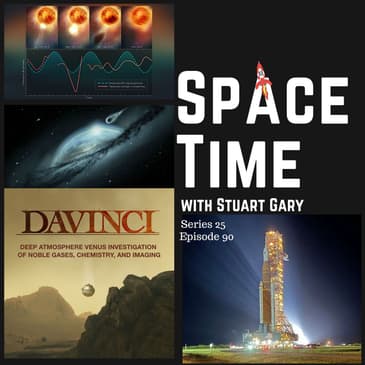



SpaceTime Series 25 Episode 90
*The red supergiant Betelgeuse blows it top
Astronomers say the sudden dimming of the semi-regular variable red supergiant star Betelgeuse back in 2019 and 2020 was caused by it blowing away a massive chunk of its stellar surface.
*Could Earth’s continents have come from outer space?
A new study suggests Earth’s continents were formed by material delivered in giant meteor impacts.
*NASA’s DAVINCI mission to Venus
NASA has released details of its proposed new DAVINCI mission to the planet Venus.
*Artemis 1 Moon rocket on the launch pad
NASA’s Artemis 1 SLS Moon rocket is back on Space launch Complex 39B at the Kennedy Space Centre in Florida in preparation for lift off later this month.
*South Korean Moon probe launched
SpaceX have launched a new Moon probe for South Korea.
*Russia launches Iranian spy satellite
Russia has launched an Iranian spy satellite into orbit further cementing a new axis of evil between the two despotic nations.
*The Science Report
Antarctica's ice shelves may be melting at an accelerated rate, up to 40 percent faster than thought.
Trying to bring back the Tasmanian Tiger or thylacine from extinction.
One in 20 who contract COVID-19 end up with long-term damage.
A new design for hydrogen storage which could reduce solid-state hydrogen fuel cell charging times.
Study shows different diets provide different results.
Urgent security updates from Apple.
Alex on Tech reviews the new MacBook air M2
Skeptic's guide to psychiatry
Listen to SpaceTime on your favorite podcast app with our universal listen link: https://spacetimewithstuartgary.com/listen
For more SpaceTime and show links: https://linktr.ee/biteszHQ
If you love this podcast, please get someone else to listen to. Thank you…
To become a SpaceTime supporter and unlock commercial free editions of the show, gain early access and bonus content, please visit https://bitesz.supercast.com/ . Premium version now available via Spotify and Apple Podcasts.
For more podcasts visit our HQ at https://biteszhq.com
Sponsor Details:
This episode of SpaceTime is brought to you with the support of NordVPN…The world’s leading VPN provider. Making your online data unreadable to others.
Get our Complete Security discount offer, plus four months free, plus you get to help support SpaceTime… visit www.nordvpn.com/stuartgary or use the coupon code STUARTGARY at checkout. Thank you…
To receive the Astronomy Daily Newsletter free, direct to your inbox...just join our mailing list. Details at https://astronomydaily.io
#space #science #astronomy #podcast #nordvpn
S25E90 AI Transcript
Stuart: This is Spacetime series 25, episode 90. Coming up on Space Time the red supergiant Betelgurs blows its top. Could Earth's continents have come from outer space and bound for the Moon? NASA's Artemis One rocket rolls out under the launch pad. All that and more, coming up on Space Time.
Booth Announcer: Welcome to spacetime with Stewart gary.
Stuart: Astronomers have now concluded that the sudden dimming of the semiregular variable red supergiant star Bettlegirz back in 2019 and 2020 was caused by blowing away a massive chunk of its stellar surface. You may recall back then, the event sent alarm bells ringing around the astronomical community. Suddenly, the 9th brightest star in the night sky had dimmed down the 20th and speculation abounded where the battlegirz was about to go supernova. Uh, initially, astronomers were unable to explain the strange event. Metal goes regularly pulsates, but not to this extent. This was completely unprecedented. Eventually, astronomers discovered the dimming was caused by a massive cloud of dust blocking out much of the star's light. But where was the dust from? And if it was from battlegirls, how could there be so much? Now analyzing data from NASA's Hubble Space Telescope together with several other observatories astronomers have concluded that battlegirls quite literally blew its top off in 2019, losing a substantial part of its visible surface and producing what they're now calling a gigantic surface mass ejection. This is something that's never been seen before. Of course, the sun routinely blows off parts of its tenuous outer atmosphere, the corona, in events known as coronal mass ejections. But that's quite different to the betalgir's surface mass ejection event which blasted off some 400 billion times as much mass as a typical coronal mass ejection. The monster star is still only slowly recovering from this catastrophic upheaval. Her studies lead author, uh, Andrea Dupree from the Harvard Smithsonian Center for Astrophysics says Bettelgurz is continuing to do some very unusual things with its interior sort of bouncing around. These new observations are yielding fresh clues as to how red supergiants lose mass late in their lives as their nuclear fusion furnaces start to burn out. In the countdown before they explode is called collapse supernovae. The amount of mass loss significantly affects their fate. However, Betelguz's surprisingly petulant behavior isn't evidence that it's about to blow up anytime soon. So the mass loss event isn't necessarily a signal of an imminent explosion. depri is now pulling all the data pieces she can gather together, looking at what she can from before, during, and after the eruption placing it all into a coherent story of this never before seen titanic convulsion of an aging star. The data includes new spectroscopic and imaging observations from NASA's Hubble Space Telescope the Strela Robotic Observatory the Fred L. Whipple Observatory's tress spectrograph, and NASA's Stereo A spacecraft debris says Hubble's data was pivotal in helping to sort out the mystery. She says astronomers have never before seen such a huge mass ejection event from the surface of a star, and they don't really understand what's going on. It's all a totally new phenomenon that's being observed for the first time that Hubble is allowing astronomers to observe battle Gers'surface details at its evolution in real time. It's thought that titanic outburst in 2019 could have been caused by a convective plume some 2 million km across, which bubbled up from deep inside the star. It produced shocks and pulsations that blasted off a chunk of the photosphere, leaving the star with a large, cool surface area under the dust cloud that was produced by the cooling pieces of photosphere. Pedal Gers is now struggling to recover from this injury. Weighing roughly several times as much as the Earth's Moon, this fractured piece of photosphere sped off into space and cooled to form a massive dust cloud big enough to block light from the star. As seen by Earth observers. The dimming, which began in late 2019 and lasted for several months, was easily noticeable by backyard observers watching the star change brightness. Even more spectacular. The red supergiant's 400 day pulsation rate, one of its key characteristics, is now gone, possibly only temporarily. But who knows? This is all new territory. For almost 200 years, astronomers have been measuring the rhythm of this pulsation as evident in changes in betalgurse's brightness, variations and surface motions. depri thinks the star's interior convection cells, which normally drive this regular pulsation event, may be sloshing around inside the star like an unbalanced washing machine tub. Um, the Treads and Hubble spectra suggest that the outer layers of the star may not be back to normal, but the surface is still bouncing around like jelly as the photosphere rebuilds itself. Though the sun has coronal mass ejections that blow up small pieces of the outer atmosphere, astronoms have simply never witnessed anything this large before. And so they're fairly convinced that surface mass ejections and coronal mass ejections may be very different events. Betelgurs is the brightest star in the constellation of Orion, representing the Scorpion Sting on Orion's shoulder. Located somewhere between 530 and 643 light years away. Depending on whose measurement you prefer. It's one of the largest and most luminous stars visible with the unaided eye from Earth. Commonly called beetlejuice don't say it three times its original name before centuries of tortured mispronunciations started out as Ebdal yaza. Meaning the right hand of the big man in Arabic. The big man being a Ryan the hunter. Betel Gose began its life around 10 million years ago as a spectral type OB. Uh, blue star calculations at Betel Ger's mass range from slightly under ten to a little bit over 20 times that of the sun, with around 100,000 times the Sun's brightness and around 1100 times its diameter. Uh, in fact, that will go so big we're at place where the sun is at the center of our solar system. Its visible surface would extend out beyond the orbit of Jupiter, engulfing the orbits of Mercury venus, Earth, Mars and the main asteroid belt. Red supergiants are the largest stars in the universe in terms of their volume, although they're not necessarily the most massive or luminous. After spending millions of years fusing a hydrogen into helium in their cores, a star's core hydrogen supply eventually runs out. And the balancing act between the nuclear fusion process pushing out and gravity pushing inwards stops and gravity wins. Now, the huge mass of the star crashing down onto its core and return gravity causes a dramatic increase in core pressure and consequently, temperature. Eventually, things get hot enough that it triggers what's called a helium flash, which causes the helium in the core to start fusing into carbon and oxygen. Now, at the same time, the contraction of the core means the hydrogen rich region around the stellar core has moved down into the area where temperatures and pressures are hot enough for hydrogen fusion into helium to commence, creating a shell of burning hydrogen around the core. Meanwhile, the increasing core temperature results in an increasing level of luminosity. And the resulting radiation pressure from the shell burning causes the outer diffuse gaseous envelope of the star to expand hundreds of times beyond its previous radius. As the now bloated star's chromosphere, or visible surface, moves further away from its core, it cools down, turning redder. Uh, and hence, the star has become a red giant. Stars like our sun will eventually lose their outer envelopes, which continue expanding outwards as planetary nebulae. This ultimately exposes the star's white heart, uh, stellar core as a white dwarf. However, stars like battlegirls with masses more than eight times that of our sun experience a very different fate. Unlike our sun, because they have so much more mass, their fusion cycle doesn't end with helium fusing into carbon and oxygen. They have enough mass to fuse the carbon and oxygen in their core to progressively heavier and heavier elements through a different process. While shell burning around the core also fuses progressively heavier and heavier elements. So we have carbon, nitrogen, oxygen, neon, magnesium, silicon, sulfur, nickel and eventually, iron. These stars have become super giants. But no matter how big a star is, it can't fuse iron into heavier elements. And at this point, the star reaches the end of the line once again. That balancing act between nuclear pressure pushing outwards and gravity pushing inwards ceases, and gravity wins, and the star quickly collapses in on itself. If, uh, they're between, say, eight and 20 times the mass of our sun, they'll produce a spectacular event called a Corco collapse supernova and they'll end up as a neutron star. However, if they're more than 20 times the mass of the sun, chances are, uh, the collapse will continue beyond the neutron star stage and they'll form a stellar mass black hole a point of singularity, of infinite density in zero volume a place where the laws of physics science understands that no longer apply. As for battlegrounds. Well, it's expected to explode as a core collapse supernova sometime soon. When she'd astronomical terms could mean tomorrow or it could mean a million years from now. Whenever it happens, we'll notice, assuming the human race is still around it'll temporarily outshine all the other stars in the galaxy and it will be clearly visible in the day sky from Earth. Ah, the last star to be seen by humans to go supernova in our galaxy was Taiko star Ah. That was back in 72 and that was before the invention of the telescope. This is space time. Still to come could Earth's continents have come from outer space? And NASA's DA Vinci mission to explore the atmosphere of Venus. All that and more still to come of space time. A new study suggests that Earth's continents could have been formed by material delivered in giant meteor impacts. The findings, reported in the journal Nature, are, uh, based on detailed studies examining the composition of oxygen isotopes in circumcrist stalls found in the western Australian Pilbara region, which contains some of planet Earth's oldest continental crusts. The studies lead author, Tim Johnson from Curtin University says the Earth suffered a high number of asteroid and meteor impacts during the first billion years of the planet's 4.6 billion year history. Johnson says the idea that continents originally formed at sites of giant meteoroid impacts has been around for decades. But until now, there has been little solid evidence to support the hypothesis. By examining tiny crystals in the mineral zircon in rocks from the Pilbara crate on which represent Earth's best preserved remnant of ancient crust the authors found evidence for these giant meteorite impacts. Johnson says stating the composition of oxygen isotopes in these circum.
Speaker C: Uh.
Stuart: Crystals revealed a top down process starting with the melting of the rocks near the surface and progressing deeper consistent with the geological effect of a giant meteoroid impact. He says the research provides the first solid evidence that the processes which ultimately form the continent began with giant meteorite impacts similar to those responsible for the extinction of the dinosaurs, but which occurred billions of years earlier. Johnson says understanding the formation and ongoing evolution of Earth's continents was crucial given that these landmasses host the majority of Earth's biomass all humans and almost all of the planet's most important mineral deposits. These mineral deposits are the end result of a process known as crystal differentiation which began with the formation of the earliest landmasses of which the Pilbara Crater is one example. Data related to other areas of ancient continental crust on the Earth appear to show patents similar to those recognized in Western Australia. Johnson says he wants to test his findings on these ancient rocks to see if the model holds out there.
Guest: We know continental crust, which is mainly made up of granite. These pale colored rocks, many of us have got kitchen work surfaces. We know they've been around for 4 billion years or so and some of that evidence is right here in WA. However, exactly how the continent came to be, how they first form, is very poorly understood. Now, most people, I would wager, would say that there are competing models for how the continents personal, but most people would favor internal processes. So as you and your listeners will know, the Earth, uh, is very hot in its middle. And like any other bodies that have accrued, I started with lots of heat. And that heat has got to go somewhere. So it makes its way out from the core to the surface. And that's what we think is driving plate tectonics, which is operating today. And, um, pretty much any active process that we can see operating on Earth earthquakes and volcanoes and stuff. Now, some people would believe that the first continents formed by subduction so much in the same way as they do today, where you have these rigid plates of, uh, oceanic crust in places, diving underneath one another. As they get very deep, they get hot and they melt. And then they produce these granites, the continental crust. The other sort of end member internal model would be so called mantle plumes where you've got these blobs of heat that come from the core mental boundary the layer in between the core and the crust on which we live. So the mental clean is a bit like a lava lamp if you're old enough like me to remember lava lamps. But you're getting these blobs of heat making their way to the surface. And when they get close to the surface, they cause massive amounts of melting and the production of a show so called, uh, oceanic plateau. So the sort of thing that we know is present in the Hawaii, Iceland and other things like that. However, it always seemed pretty plausible to me that we could be looking at external origin for the continents. And people have, uh, been proposing this since at least the 19th, 60s. That's the first paper that I could find. But I'm sure the idea has been around longer than longer than that. But it's not really been taken up by the scientific community because of the lack of any concrete evidence. And I think in this research we found some evidence that might suggest that actually this giant impact theory is actually right.
Stuart: So this is different from material floating on the surface, which is sort of what we think of when we think of grading material. The continental crust.
Guest: No, it absolutely is. But to actually make continental crust is a bit more involved, you need a two stage process. First. So we know that the primitive sodium rich granites that we find absolutely everywhere around the planet in the really ancient rocks we know that they were formed by partial melting of basaltic rocks but basaltic rocks that have been hydrated. So again, basalts are these dark volcanic rocks that come out of places like Hawaii and iceland and other places as well. And if providing you can add water to those things, you melt them to make these granites. And the granites are much less dense. And as you say, they flow. But the question is, how do you make those really big blobs of saltik volcanic rocks that can then evolve into becoming the continental crust? And that's really what we are looking at. We think we found evidence this very first massive input of energy that gets everything kick started.
Stuart: And this is where zircons come in. They're so important, aren't they just starting really ancient geology?
Guest: Absolutely, they are. So zircon is a beautiful mineral. It occurs in many of these granites that make up the continental crust. They're very small, the grains. They're about the width of a human hair or so. But they're incredibly robust physically and chemically robust. So the earliest material we know about on Earth are the so called Jack Hills zircons. And they are getting close to 4.4 billion years old. So that's an awful long time for a mineral to hang around. They are robust record or our only record of really what was going on in the Earth. Uh, now, the great thing about Jerk on, one of the great things is that when it grows, it incorporates lots of uranium into its structure. And as we all know, uranium is a very heavy element. It's unstable, so it decays to various isotopes of lead. Now, with instrumentation, we've got a curtain. We can fire various beams of these tiny circuit grains and we can measure those isotopes and we can get a really quite precise age on those grains.
Stuart: That's because the uranium is decaying into lead at a set rate.
Guest: That's right, yes. So there's actually two decay schemes where uranium decays to two different isotopes of lead. So two different isotopes of uranium decay to two different isotopes of lead which gives us a check on our sums, basically. And if both of these things get the same age both of these decay schemes give the same age. You can be pretty confident that your age is right and not some artifact. So if you analyze lots of zircon grains, as we did, you've got a beautiful timeline of the processes that they record. Now, another thing that Zerk On and most other minerals contains is lots of oxygen. And we can measure two of the isotopes of oxygen oxygen 18 and oxygen 16. Oxygen 16 is the common form of oxygen. And without getting into too much detail, that isotopic ratio tells us something about the environment in which those zircons originally crystallized. Now, in the pilbara, there is a very oldest zircon grains we've got which is the earliest record of what could have formed the pilbara in the first place. They have about a third of the circles, uh, have what we say isotopically light compositions. And the only way of forming them, at least the only way we think, uh, the most plausible way of forming them is that they represent to get these isotopes like compositions, you have to be melting something close to the surface. So within the uppermost few kilometers of the, uh, Earth now, anybody walking around on the Earth now and then would notice it's not particularly hot. So to actually melt the surface to cause this extensive surface melting and then the pattern becomes successively deeper thereafter is entirely consistent with this giant impact theory. So the first thing that's happening is you're smashing, uh, an asteroid into the surface of the Earth. So you're causing massive amounts of melting at the surface. And then as the whole system revolves, it becomes deeper and deeper. And that's entirely what the pattern of the pilbara data is showing. And tantalizing, it looks like that similar pattern you can see elsewhere. So it's this top down pattern where you're starting from shallow to deep, which really gives us some confidence that the giant impact theory might be right because the main alternative, which is the mantle plume model, would start from very deep within the Earth and get progressively shallower. So it's the opposite of the trend we actually see in the data.
Stuart: And this giant impact model, it matches up with things like the light heavy bombardment.
Guest: It does, yeah. When you look at the pill procrastination in detail, as other people have done, you can find these layers that we call spiral layers. So they are uh, high energy impact deposits and we can take those deposits as well. And for the Pilbara, we would argue that we had this giant impact around 3.5 or 3.55 eventually went on to become the pilbara. But we can also see in the data these departures to isotopic light zircon and they coincide beautifully with the age of the spiral bed. So we've got a direct link between the data and what it might m.
Stuart: Mean is that also helps explain why the pilbara is so iron rich.
Guest: That's another interesting aspect. Yes. So not all, but in most of the samples that we're finding, these really light isotopic compositions, the rocks in which they occur are very iron rich, as you say. And exactly why, that is unknown. But we would argue that it's exactly what you would predict if you were crystallizing a terrestrial, uh, magma ocean. So again, as your viewers will be more expert than I have, many of them, the Earth is, uh, thought to have collided with a massive object there to form the Moon four, 5 billion years ago. So the Moon would have formed from that entirely molten mass and the Earth would, uh, also have been completely molten to some depth. Whether it's right the way to the core, who knows? But a significant amount of the Earth would have been entirely molten. And then if you slowly cool that, it crystallizes from the inside out. So it's basically a salted composition and you start crystallizing things like olivine and then the residual melts what's left over, as it calls, get successively richer in, uh, iron. So that's a nice little bit of a side story, really that we might be impacting the results of the crystallization of the terrestrial magma ocean that would form when the Moon.
Stuart: So the key now, I guess, is.
Guest: Looking for, well, the next stage, what we'd really like to do. So we've written some proposals to go and look at ancient rocks from elsewhere on the planet. So Pilbara is the most pristine example of this really ancient continental cross we have. But you can find fragments of absolutely everywhere in Canada and Greenland and Europe and South America and wherever in South Africa too. Precisely. South Africa. Barbara is a beautiful place. So what we would like to do is go and recollect some of those samples and apply the same filters to the analysis, uh, that we've done for the pilgrimage data. See if, as the data seems to hint at elsewhere there is evidence of giant impact model elsewhere. And perhaps, who knows? The giant impact model might be applicable to all continents.
Stuart: That's associate Professor Tim Johnson from the School of Earth and Planetary Sciences at Curtin University. And this is spacetime. Still to come, NASA releases details of its new DA Vinci mission to Venus. And bound for the Moon NASA's massive Artemis One rocket rolls out onto the launchpad in preparation for its maiden flight. All that and more still to come on space time NASA has released details of its proposed new DA Vinci mission to the planet Venus. Slated for flight on a United Launch Alliance Vulcan rocket in June 2029. The Deep Atmosphere Venus Investigation of Noble Gas Chemistry and Imaging, or DaVinci mission will be the first to study Venus using both spacecraft flybys and a descent probe. A NASA report in the Planetary Science Journal describes how the DA Vinci descent probe was slowly dropped through the late Venezuelan atmosphere in mid 2031 recording changes in atmospheric chemical composition and environmental conditions all the way down to the planet's surface. It will also provide the first to set imaging of the mountainous highlands of Venus or mapping their rock composition and surface topography at scale simply not possible from orbit. The mission will measure undiscovered trace gasses in the deepest atmosphere including key ratios of hydrogen isotopes components of water that will help reveal the history of water either as liquid water oceans or as steam within the early atmosphere. The mission's flyby probe, called the Carrier Relay and Imaging Spacecraft or Chris has two onboard instruments that will study the planet's clouds and map its highland regions. During flybys, DA Vinci will paint a picture of the late Venusian atmosphere and how it interacts with the surface of the mountains of Alpha Reggio which is as big as the state of New South Wales around twice the size of the state of Texas. DaVinci's principal investigator, Jim garvin from NASA's Goddard Space Flight Center in Greenbelt, Maryland says these measurements will allow scientists to evaluate historical aspects of the atmosphere, uh, as well as detect special rock types of the surface, such as granites, while also looking for telete landscape features that could show evidence of erosion or other formation processes. DA Vinci will make use of three Venusian gravity assists which will save fuel by using the planet's gravity to change speed and direction. The first two gravity assists will set Chris up for a Venus flyby performing remote sensing in the ultraviolet near infrared. The third Venus gravity assist will set the spacecraft up to release the probe for entry, descent, science and touchdown plus any follow up transmissions to Earth. Scientists estimate the first flyby of Venus will be about six and a half months after launch and it will take two years to get the probiotic position for entry into the atmosphere for Alpha Regia under ideal lighting conditions with the goal of measuring the landscape of Venus at scales ranging from hundreds of meters down to less than 1 meter. Uh, such scales will enable lander type geologic studies of the mountains of Venus without actually requiring a landing. Once the crew system is about two days away from Venus the probe flight system will be released along with a two meter wide titanium probe. Safely encased inside, the probe will begin to interact with the Venusian upper atmosphere at an altitude of around 120 surface. But it won't commence its science observations until after jettisoning its heat shield. That will be at about 67 surface. With the heat shield removed, the probe will then begin ingesting atmospheric gas samples providing detailed chemistry measurements of the salt that had been made on Mars with a Curiosity rover. During its slow hourlong descent down to the surface. The probe will also acquire hundreds of images as soon as it emerges from under the clouds. It should be at around 30 0 meter, 30 local surface. If all goes according to plan and the winds don't blow it off course the probe will touch down somewhere in the Alpha Riccio Mountains. If, uh, it survives the touchdown, it will be hitting the ground at around 12 meters/second. There could be up to around 18 minutes of bonus operations and measurements of the Venusian surface. Of course, the problem is no spacecraft has survived long in the Venusian atmosphere or, for that matter, on the surface. The Russians have tried setting back tantalizing images of the surface and readings lasting a few minutes before systems all failed. The problem is, while Earth and Venus are considered sister planets both, uh, roughly the same size, the same mass, made out of the same material and formed in the same part of the solar system under similar conditions venus and Earth have turned out very differently. Temperatures in the Venusian surface are hot enough to melt lead more than 460 degrees Celsius. Atmospheric pressure at the surface is 100 times greater than at sea level on Earth and it's an atmosphere heavily dominated by carbon dioxide. When it does rain on Venus, it rains sulfuric acid and the snow on the mountaintops is metallic. So anything landing on Venus will get crushed, cooked, broiled, uh, boiled and burnt. This report from NASA TV.
Speaker D: Launching in 2029, the DA Vinci Mission, named after Leonardo DA Vinci is designed to address fundamental questions about the origin, evolution and composition of Venus. During two gravity assist flybys DaVinci will study the cloud tops in ultraviolet light tracking cloud patterns as they change with time and analyzing signatures of mysterious chemicals that absorb ultraviolet light. Both flybys will also examine heat emanating from the Venus surface on the planet's night sight. We will look for geological clues of this planet's mysterious past to paint a global picture of surface composition and the evolution of the planet's ancient highlands. Seven months after our second flyby DA Vinci will release its Atmospheric Descent probe. The spacecraft will watch its probe enter Venus's atmosphere over the course of two days. The probe will take about an hour to fall through the atmosphere taking measurements and snapping images down to the surface. These measurements include profiles of composition, winds, temperature, pressure, and acceleration. Tea gases will be measured to help us understand how Venus formed and evolved. Some of these measurements may reveal chemical signatures of ancient water. With our suite of measurements DaVinci will provide new insights into Venus's atmosphere's complex composition, structure and chemistry. As the probe nears the surface, its descent camera will capture breathtaking bird's eye views of the mysterious terrain known as the alpharegio tessera possibly revealing evidence in the rocks that water once flowed across the Venusian surface. These up close images of the surface will provide new insights into geologic processes and will help us to understand what it might be like to stand on the Venus surface. An oxygen sensing student collaboration experiment will shed light on the role of this gas in the Venus atmosphere. The discoveries that emerged from this diverse data set will tell us whether Venus was truly habitable. And the story we reveal at Venus will reach even beyond the solar system to analog exoplanets. So we'll be observed with the James Webb Space Telescope.
Stuart: This is space time. Still to come, NASA's Artemis One Moon mission rolls out onto the launch pad. And later in the Science Report a new effort using cloning to try and bring the Tasmanian tiger, or PHYLACINE, back from extinction. All that and more still to come on, um, space time. NASA's Artemis one SLS moon rocket is back at Space Launch Complex 39 b at the Kennedy Space Center in Florida as preparations continue for its historic maiden flight. Later this month, crowds began building up around Cape Canaveral as the massive 98 meters tall rocket undertook its historic seven kilometer, ten hour overnight uh, rollout from the massive Vehicle Assembly Building out to the. Launch pad arriving at dawn. The first of three launch windows for a flight this year will be on August 29. The ironman test flight, which will last some 42 days will travel beyond the moon deploying a number of microsatellites and CubeSats along the way. Replacing the crew will be three mannequins loaded with sensors to measure radiation and vibrations. The mission's Ryan capsule will then return to Earth entering the atmosphere faster than any other human rated spacecraft ever eventually splashing down in the North Pacific Ocean. Now, if successful, it'll be followed by the Artemis II mission slated for May 2024. And that will be the first man flight carrying a crew of four around the moon and back. That, in turn, will be followed in 2025 or possibly 2026 with the Artemis Three mission the first manned flight to the lunar surface since Apollo 17 back in 1972, more than half a century ago. Once in lunar orbit, the Artemis Three Orion capsule will dock with a prepositioned SpaceX starship, HLS Lander. Two of the Orion crew members will then transfer to the lander and travel down to the lunar surface touching down near the South Pole for a weeklong stay undertaking science observations and collecting samples. Scientific equipment and supplies will be prepositioned at the landing site. And NASA assures this time humans will be back to the moon to stay an orbiting lunar space station. The Gateway will be positioned in the second half of the decade and eventually the experiences learnt by working on the moon will be used for the first man missions to Mars and they'll take place sometime the 2030s. This report from NASA TV.
Speaker E: Through Artemis, the twin sister of Apollo. We are returning to the moon. Though Orion the only humanrated spacecraft in the world capable of deep space travel. And now the Space Launch System NASA's most powerful rocket since the Apollo era stands ready. Having undergone and passed numerous tests, the time has come to complete the journey. With hardware originating from every state in the nation and from partners around the world artemis One will be the first flight test of each of these components. Now assembled together two solid rocket boosters will provide more than 75% of the thrust necessary to leave Earth. Each booster stands 17 stories tall a full segment more powerful than the SRBs of shuttle. Together these boosters are capable of £7.2 million of thrust and will burn for the first two minutes of flight. The core stage, at 212ft is the tallest rocket stage NASA has ever built with the rocket's flight computer secured inside. The core stage is designed to hold two £3 million of fuel. The 1960 gallons of liquid oxygen and the 5370 gallons of liquid hydrogen will combine to provide eight and a half minutes of propellant to the four massive Rs 25 engines mounted below. As proven workhorses of the shuttle fleet each Rs 25 engine has a legacy all its own. Together, these four engines provide £2 million of thrust and um with the SRBs are capable of pushing Orion to a speed of 17 0. Interim cryogenic propulsion stage is a 45 foot tall upper stage that offers Orion nearly 25 £0 of thrust. Performing two separate burns, the ICPS will first raise Orion's orbit and then later propel it out on a trajectory to the moon. The ICPS is powered by a single RL Ten engine that will perform these two burns. This storied engine has propelled robotic missions to every planet in the solar system, including Voyager One and Voyager Two, the first space probes to reach interstellar space. Orion service module, um, provided by the European Space Agency, is the powerhouse that fuels and propels Orion in space. It stores the spacecraft's propulsion, thermal control, electrical power, and critical life support systems such as water, oxygen and nitrogen. Orion's crew module is the pressurized segment of the spacecraft where future crews will live and work on journeys to the moon. Capable of accommodating four crew members for up to 21 days, this capsule includes StateoftheART avionics, innovative crew systems and the largest heat shield of its kind for entry back into the Earth's atmosphere. Positioned at the top of Orion is the Launch Abort system designed to pull the crew to safety in the event of an emergency on the pad or during launch. Three solid rocket motors can activate in milliseconds, accelerating from zero to 500 mph in 2 seconds. To propel Orion and crew safely away from the rocket now fully assembled, Artemis One stands at 322ft. Artemis is no longer a series of separate parts and programs united together. This is the first of Artemis's arrows capable of ushering in the next chapter of human lunar exploration. Only together, this mighty system represents all that is possible, all that we are capable of when united around a stunning vision with each component playing its part in a grand effort, we, the people of NASA, and our partners, we the people of the Artemis generation all around this beautiful world will bear witness to what we are capable of together, we are going back to the moon.
Stuart: SpaceX have launched a new moon probe for South Korea. The flight was launched aboard a Falcon Nine rocket from Space Launch Complex 40 at the Cape Canaveral Space Force Base in Florida. The spacecraft, named Dinore Korea and for enjoy the Moon, is on a low energy ballistic capture flight path to the moon, which requires no Delta V and allows the probe to quite literally fall towards the moon. It should arrive in lunar orbit insertion in December, the solar powered spacecraft will orbit 100 lunar surface for a year, gathering geological data. Ah. The probe is carrying six scientific instruments, including a camera for NASA that will search for water ice in the permanently shadowed crater floors that never see sunlight. Other instruments include a lunar terrain imager, a wideangle Pleometric camera, a magnetometer, a gamma ray spectrometer and what they're calling a delay tolerant networking project. Basically, it's designed to undertake a range of communications experiments. The $180,000,000 mission is South Korea's first to the moon. Back in June, South Korea successfully launched a package of satellites into orbit using its own rocket for the first time, the country plans on landing a probe on the lunar surface in 2030. The mission joined spacecraft from the United States, China and India, currently operating on or around the moon. Russia has launched an Iranian spy satellite into orbit, further cementing a new axis of evil between the two despotic nations. The Islamic republics maintain close ties with Moscow and has refrained from any criticism of the Russian invasion of Ukraine. The 600 kilogram Cayenne satellite was launched aboard a Soyuz 21 B rocket, the Bacon, or Cosmo drone in the Central Asian Republic of Kazakhstan. The Washington Post quoted Western intelligence officials as saying that Russia plans to use the satellite for several months to assist in its war efforts against Ukraine before allowing Tehran to take control. However, Tehran insists the Islamic Republic would control the satellite from day one due to the satellite's encrypted algorithms. The growing international isolation of Russia under the weight of Western sanctions over Ukraine has seen the Kremlin see closer ties with nations like China, Iran and North Korea. Ironically, Iran is currently negotiating with war powers, including Moscow, over its growing secret nuclear weapons program. Tehran insists its nuclear program is for peaceful power generation only. However, it continues, either through its own efforts or espionage, to develop technologies which can only be used for nuclear weapons. This is space, time and time. Um, now to take a brief look at some of the other stories making news in Science this week with a science report. A new model developed by Caltech and NASA's Jet Propulsion Laboratory in Pasadena, California, suggests that Antarctica's ice shells may be melting at an accelerated rate up to 40% faster than previously thought, and that, in turn, will contribute to far more rapid sea level rise. The new computer simulations focused on just the West Antarctic Peninsula. The findings, reported in the journal Science Advances, accounts for an often overlooked narrow ocean current along the Antarctic coast. And it simulates how, uh, rapidly flowing freshwater melted from the ice shelves can trap dense, warm ocean water at the base of the ice, causing it to warm and melt even more. Ice shelves are outcrops of the Antarctic ice sheet found, where the ice jards out from the land and floats on top of the ocean. The shells, which reach several hundred meters thick, act as a protective buffer from the mainland ice, keeping the entire ice sheet from flowing out into the ocean, which would dramatically raise global sea levels. However, the warming atmosphere and oceans caused by climate change are increasing the speed at which these ice shells are melting, threatening their ability to hold back the flow of the ice sheet into the ocean what's been talked about for decades. They even began making their first tentative steps back in the 1990s and early two thousand s. Now, scientists at the University of Melbourne are, uh, finally about to try to bring the Tasmanian tiger or thylacine, back from extinction. The dogsized marsupial carnivores were slaughtered in their thousands by politicians and farmers throughout the early 1900s who wrongly blamed them for killing sheep. The last ilacine died alone in a small cage in a Hobart zoo in 36. Now, Texas based company Colossal Biosciences has announced plans to try and resurrect the thylacine. The company is already working on efforts to clone a woolly mammoth using a combination of mammoth DNA, and that from its closest living relative, the Asian elephant. They're going to try and create an embryo carrying the combined DNA, which could then gestate either in a surrogate African elephant or in an artificial uterus. Now, the resonant creature wouldn't technically be a mammoth, calling it an arctic elephant with small ears, shaggy hair, a domed forehead and curved tusks. Earlier pharisee seen cloning attempts using museum specimen DNA failed and interest in the project gradually faded away. Until now. The good news is scientists have some 96% of the Phyllis in the genome already sequenced. But that final 4% is proving to be the hardest. To find the remaining DNA, scientists are turning to one of the fallacy's closest living relatives, the fat tailed dung art, a relatively abundant mouse sized marsupial. However, many scientists questioned whether it could ever work. After all, there are some 40 million years of evolutionary history separating the two species. A uh, new study shows that around one in 20 people who contract covered 19 may end up with long term damage to their sense of smell and taste. The findings, reported in the British Medical Journal, are based on a review of global long covered research. The authors combined studies with a total of 3700 patients to estimate how many people didn't recover their sense of smell or taste after losing it during a coval 19 infection. While researchers note that the studies rely on participants assessing their own ability to taste and smell don't factor in different variants. They say 5.6% of covert 19 patients suffer long term loss of smell and 4.4% suffer long term loss of taste. So far, more than six and a half million people have been killed by the covidnited coronavirus. However, uh, the World Health Organization says the true death toll is likely to be over 15 million, with more than 600 million confirmed cases. Now, globally, a lot of people are looking at hydrogen as a potential long term replacement for gasoline powered cars. But there are many hurdles. Now scientists have come up with a new design for hydrogen storage which could reduce one of those hurdles solidstate hydrogen fuel cell charging times. Hydrogen is gaining a lot of attention as a way to store energy from renewables such as wind and solar compressed gas is the most common form of hydrogen storage, but it can also be stored in a liquid or solid state. Solid hydrogen storage, and in particular, metal Hydride, is attracting interest because it's safer, more compact, and more economical than compressed gas or liquid, and it can reversibly, absorb and release hydrogen. The problem is metal Hydride hydrogen energy storage has low thermal conductivity, which leads to slow charging and discharging times. Now, researchers at the University of Technology, Sydney and the Queensland University of Technology have designed several internal heat exchanges for use with metal Hydride hydrogen storage in order to test their different performances. These have included simple straight tubes, helical coils or spiral tubes, Ushaped tubes and fins, all of which sped up heat removal from solid fuel cells, resulting in faster charging times. The findings, published in the journal Scientific Reports, show that using semicondndrical coils work best of all, reducing hydrogen charging times by 59% compared to helical coil heat exchangers. Three new studies have examined the effects of fasting diets on the immune system, and they found the lengths and types of fasting had different and sometimes opposite effects. The findings, reported in the journal Cell, show that a diet involving eating one day and consuming only water the next resulted in the number of inflammation causing monocyte cells in the bloodstream to drop when fasting. The second diet would simply cut calorie consumption in half, found to increase protection against infections or tumors. While the third study looked at the effects on the gut of multiple rounds of water only fasting, finding that it weakened immune response. Owners of iPhones, Macs and iPads have been urged to update their devices immediately following the discovery of a major security issue. The three Apple operating system updates, iPad and iOS 1561 and Mac OS 1251 fix a pair of major bugs that allow hackers to take over your devices and run code without permission. Apple says these vulnerabilities may be actively exploited, so any device not updated could be attacked. And now, with the rest of the technology news, we're joined by Alexaara ROTT from Ityer.com. He's reviewing the new MacBook Air M Two and the latest Internet security offerings from Norton.
Speaker C: Yeah, well, I purchased the MacBook Air M M Two. I got it with the ten GPU core with 24GB of Ram and a 1 TB SSD. The performance has been great. I mean, the clock speed on the M M Two is higher. Clock speed is the, uh, speed at which the chip is able to, um, performance operations. And there's a higher clock speed on the M M Two than the M one on PC. Many PCs allow you to change the voltage of the chip and change the clock speed and change how it operates. And there are actually limits as to where you can do it. Overclocking is something that you found upon now. It's a lot more common. And there are limits you can do it with legal limits and then you can go over and you can some people cool their systems with I think it's nitrogen or to totally cool it down to really very cold levels. Whether it's watercolor or using the nitrous oxide super cooling capabilities that. Uh. If you put your hands into it. It would instantly freeze and you would lose your fingers. But people do use that to call their CPUs down to get them to overclock too crazy speed. Now, on a Mac, there's no official way to do that. There was a scandal supposedly manufactured, but the MacBook Air M M Two, which has a passive cooling system that has no fat, like the MacBook Air M One, unlike the MacBook Pros and the Imacs that have a fan inside which allows it to have high performance for longer for needing to cool down, the M Two also throttles itself when it gets too hot. And um, apparently this was a scandal because this happens. But news flash, the M One thermally throttled itself when it got too hot as well. And, uh, it cools down very quickly. And some people were able to put a bit of thermal paste and an extra pad on top of the chip, which was able to keep it cooler for longer. But that dangerously directs the heat to the bottom of the case in a way that Apple never intended. Also the another scandal was that, um, the basic model of the MacBook Air has a 256 gig chip inside for the 256 gig of storage. And in the MacBook Air One, there was 2128 gig chips. And when you have two chips, you can, uh, write to both chips faster than one single chip. But I bought the 1 TB model which comes with 2512 gig chips, and I've noticed that it's faster, the keyboard is nicer to type on, the screen is a bit bigger, it's noticeably a little bit brighter, 25% brighter, 100 extra niche. So the MacBook Air M Two is a great machine and a lot of the supposed scandal is just a storm in a tikka.
Stuart: And while I've got you, let's talk about what, uh, Nortons are up to.
Speaker C: Yes. The Norton has released norton 360 advanced. This is a new version that includes a, uh, whole stack of identity theft protection, as well as the usual dark web monitoring and spyware ransomware malware and antivirus protection. Things like turning off your, uh, webcam if you want that to be the case on PCs, and automatically updating on PCs various types of software like zoom or browsers, et cetera. But the new version has, in addition to dark web monitoring, where it tells you whether your password has been linked online, it's got 58,000 Australian dollars of insurance because no company can prevent all identity theft, even though you obviously engage in Norton to do that. The bad guys are very smart, and if they do manage to get through there's this insurance that can be paid to you to help recover from loans taken out in your name or if you've had to get new credit cards or other ID. So that is the first time that internet security has gone to this extra level of actually not only just doing a form of identity theft protection, which is something that Norton has been doing ever since it merged with LifeLock in the US. But now offering this insurance as well. They put a couple of reports out recently on family and home identifying what are the best ways to keep children safe and also how fishing for new bait on social media is one of the newest reports that talks about how just in the last quarter alone, which is April to June 2022, northern thwarted over 900 million threats or about 10 million threats per day. Globally there were uh, 22.6 million phishing attempts globally there was just under a million in Australia, there were 103,000,000 file threats globally with 1.5 million of those in Australia. And uh, also in Australia, over 410 tech support threats were blocked. This is where somebody is trying to pretend that they're from Microsoft or Google or Amazon or somebody else and on your computer screen you get these messages. I've had people ringing me actually in the sirens blaring in the background. It's a web page that's trying to tell you that your computer is infected and you need to call this number now and I want to know how to get rid of it. And I just said push controller on the keyboard which is the command to close down that window and it went away. But of course, if you weren't aware that this was a scam you might think it's real. And uh, the bad guys out there are really trying every trick in the book. People might remember the flu bot messages coming into their inboxes on their phones about a uh, missed parcel or a uh, covert certificate, missed doctor's appointment, some of the latest ones. I got one the other day saying you have won. And there was a uh, tinyurl.com link and it didn't say what I want. It just says click here to find out what it is. And in the word you, there's a zero instead of an O and there's a capital you instead of a lowercase U, which is sort of visually strange. But the other one is on WhatsApp, where people get this message saying hi Mum, hi dad. And then they proceed to spin a story that the mobile phone has been damaged or lost. I had to get a new number. I can't talk to you because the microphone is broken on their existing phone for which they have to get the new scene and that's an emergency that they need several thousand dollars for straight away, enough to pay payment or something that requires infant action. And when the parents say well who is this is this team or Sarah? Sarah. A lot of the people are giving away information that the scammers then use to, uh, basically fool you into thinking that you're talking to their real child. And of course, what parent doesn't want to help their child out? So a lot of Australians have been caught out by this. And this is the same with this Valentine's Day scams. There are shopping scams around the time of sales. People are trying to sell things at cheap prices or they claim they're on a military base somewhere and they will send you the money, but they can't come over to check it in person and then the money is transferred somehow.
Stuart: The Nigerian prince has been contacting me.
Speaker C: Well, they're trying to become a lot more sophisticated, these cameras, but they really are trying every trick to try and get you to drop your guard because as always, you are the weakest link. And they're trying to socially engineer you. I mean, yes, they're trying to break into your computer, hack into your phone, but if they can get you to voluntarily believe that they are your child or voluntarily send the money to this account because something is wrong with my bank account, I need you to pay this after pay for me. It's, uh, something that is catching a lot of people unawares.
Stuart: Uh, have fun with them.
Speaker C: There are some people who spend a lot of time trying to waste the time of scammers.
Stuart: Yeah, that's what I do.
Speaker C: The problem is the scammers have your phone number or email address to have some of your details. So they can then sign you up to spam list or get some of their other friends in the same call center to call you and harass you. So if they really get annoyed, it is possible for them to retaliate as a word. Now there are certainly experts at this who will actually figure out how to hack in to the call center. And there are videos on the internet where people do this and actually show the hackers their own vision from their own webcam. And you can see that they're totally surprised by seeing their own face on the screen. But you need to be a real security expert to be able to do that. If you're not a security pro, then it's probably better to just hang up the phone. I also remember hearing stories and reading stories about how people pretended to be befuddled elderly people and look as though the person is on their computer watching what they're doing and going to transfer the money and oops, I transferred it somewhere else by accident. And the other person is going, no, please just do this or do that. They think they would have lived one. I think they're going to make several thousand dollars and they're just being taken down a path where their time has definitely been wasted. If you want to go down that path, by all means. People have a lot of fun screwing.
Stuart: With the scammers that's Alexaara Royce from. Itway.com. One of the big problems with reporting on psychological studies and surveys are the small sample sizes. Critical surveys of less than 2000 voters are generally considered too small to provide an accurate representation of public opinion. And phase three medical trials usually need at least 3000 participants in order to gain a fair and accurate representation of the likely effects of any new drugs. In recent years, we've been seeing more and more surveys covering psychological issues. Trouble is, they're almost always contradictory. The problem is the small sample sizes they have to work with. See, it's rare for two patients to have exactly the same psychological conditions. In reality, they're all on a spectrum with a myriad of other influences. People are individuals like that, and this makes generally applicable scientific studies very difficult. Tim mendem from Australian Skeptic says there are just too many variables.
Speaker F: Behavioral psychiatrists are basically people who try and treat people through behavior techniques, which is therapy as much as anything else, controlling your symptoms, trying to do things that will sort of alleviate any negative impacts, as opposed to medical psychiatrists who use medication. Okay, so there are those people who use therapy and those people who use medication. And, uh, what's happening is that a lot of psychiatry, psychiatry over the years has been criticized as being a soft side with no real, um, hard data to, uh, substantiate any particular theories, and.
Stuart: Obviously psychology as well. Can't you?
Speaker F: Well, that's right, yeah, because you're dealing with human beings and mental issues. So it is a very subjective area. So it's understandably softer than, say, physics or chemistry. But the feeling is amongst a lot of psychiatrists and psychologists is they want to get more scientific, they want to get more into the hard science. So they're looking for data, they're looking for scientific methods, they're looking for practicalities treatments and things that they can quantify.
Stuart: First thing they've got to do is stop doing surveys and studies using just five or less people. You've got to start having big groups of 2000 or more. That's how you do that.
Speaker F: That's hard to do because you've got to find 1000 or more people who have the same sort of condition and it has to be the same condition, not little variations. And that's the trouble with psychiatry and any mental condition, actually. There are subtle variations from person to person. Everyone's on the spectrum and they don't necessarily all sit on the one spot for having 1000 people who sit exactly on the one spot. So you compare it's very hard in mental health issues because with autism, it's.
Stuart: Not a single disease, it's a spectrum.
Speaker F: It's also one of the problems with depression, of course. Very much so. And what some people are criticizing psychiatry for is it rushes to this prognosis of depression and therefore wants to treat depression medically with pharmaceuticals and things like that. Whereas some people are saying okay, there is medical psychiatry, there is treatment with pharmaceuticals, pills, drugs, whatever, and there's also those psychiatrists who want to treat with therapy who feel a bit left out from the scientific paradigm, if you like, or the aura of being scientists and they want to move into the medicalisation, as they call it, a behavioral psychiatry. So it's an interesting area. One particular article by a noted psychiatric academic and psychiatry the same, there are major issues with behavioral psychiatrists trying to move into a medical area because he said the data is often rubbish as you say. A small sample size is one of the issues giving clues all the way through this one particular example was a treatment for PTSD amongst ex military and the treatment included MDMA which is ecstasy pills, psychedelics if you like, effect of those uh, pills. Uh, the trouble is the sample they got from that and you talk about sample, a lot of people would have been turned off and said I don't want to take drugs for this trial hang, I'm not going to take drugs. So the people I got were those who are willing to take drugs for start and then they told them that you're going to be taking either the real thing or a placebo and then these are the symptoms you should be feeling. So the people who didn't get those feelings reckon they got uh, placebos and therefore they continued with that attitude with those who did get symptoms, assumed they got the real thing and continued down that track. And the numbers of people involved with this one was 90 or something like that is small and the methodology used is dodgy or at least weak. So they're suggesting that psychiatrist and the psychiatric profession should be very careful about moving into the medicalized area, into the area of hard data because it just doesn't work, or at least it hasn't been shown to work because the data is just extremely rubbery. And so therefore it's an interesting situation that psychiatrists are ah, still stuck in that soft science area and they're trying to get out.
Stuart: That's Timandum from Australian Skeptics and that's the show for now. Space time is available every Monday, Wednesday and Friday through Apple Podcasts, itunes, Stitcher, uh, Google Podcast, Pocket Casts, Spotify, Acast, Amazon Music, Bytescom SoundCloud, YouTube, your favorite Podcast download Provider, and From Spacetime with Stuart Garycom. Spacetime is also broadcast through the National Science Foundation on science owned radio and on both iHeartRadio and tune in radio. And you can help to support our show by visiting the Spacetime store for a range of promotional merchandising goodies. Or by becoming a Spacetime patron which gives you access to triple episode commercial free versions of the show as well as lots of bonus audio content which doesn't go to air, access to our exclusive Facebook group and other rewards. Just go to spacetime with Stewart. Gary.com for full details. And if you want more space time, please check out our blog, where you'll find all the stuff we couldn't fit in the show, as well as heaps of images, news stories, loads of videos and things on the web I find interesting or amusing. Just go to spacetime with Stuartgary Tumblrcom. That's all one word and that's tumblr without the e. You can also follow us through at Stuart Gary on Twitter, uh, at Spacetime with Stuart Gary on Instagram, through our, ah, Spacetime YouTube channel and on, um Facebook. Just go to Facebook.com spacetime with Stuartgarry and Spacetime is brought to you in collaboration with Australian Sky and Telescope magazine. You'll a window on the universe.
Booth Announcer: You've been listening to Space time with Stuart Gary.
Stuart: This has been another quality podcast production from Bitesz.com.