


This episode of SpaceTime is brought to you with the support of Squarespace....your first stop when you want to build a presence online. To check out our special offers, simply visit www.squarespace.com/spacetime for all the details
SpaceTime with Stuart Gary Gary - Series 29 Episode 17
In this episode of SpaceTime, we delve into the recent powerful solar storm that has impacted Earth, the delay of NASA's Artemis 2 manned moon mission, and China's ambitious plans for a futuristic orbital space carrier.
Massive Solar Storm Hits Earth
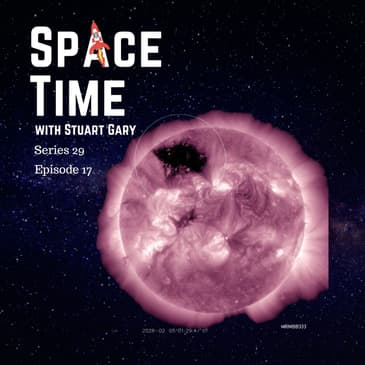
The sun has unleashed a barrage of solar eruptions, including 41 N-class flares and six X-class flares, with an X8.1 class flare setting a new record for 2026. This storm is described as the strongest radiation event in 20 years, with scientists noting its potential similarity to the historic 1859 Carrington event. The solar activity has disrupted radio communications and produced stunning auroras, while the sun continues its 11-year solar cycle.
Nasa's Artemis 2 Mission Delayed
NASA has postponed the launch of its Artemis 2 manned moon mission due to fuel leaks during a critical launch rehearsal. The mission aims to send a crew of four aboard an Orion spacecraft on a 10-day journey around the moon. The delays stem from issues with the SLS rocket's hydrogen tanks and other technical challenges, with new launch windows opening in March.
China's Orbital Space Carrier Plans
China has announced plans for a Star Wars-style orbital space carrier named Luanio, designed to deploy hypersonic missiles and unmanned stealth drones. This massive spacecraft would be part of an ambitious defense system, although the technology to build such a vehicle is still in the realm of science fiction. The announcement comes amid tensions between the U.S. and China regarding military advancements.
www.spacetimewithstuartgary.com
Become a supporter of this podcast: https://www.spreaker.com/podcast/spacetime-with-stuart-gary--2458531/support.
This is Spacetime Series twenty nine, Episode seventeen, broadcast on the ninth of February twenty twenty six. Coming up on Spacetime, Planet Earth hit by another massive solar storm erupting from the Sun, NASA forced to delay the launch of its Artemis to Man Moon mission until at least next month, and Beijing announces plans for a Star Wars style orbital space carrier. All that and more coming up on Spacetime. Welcome to Space Time with Stuart Gary. The Sun has just unleashed a powerful barrage of solar eruptions, included in the onslaught where some forty one M class solar flares at at least six even more powerful X class flares, one of which an X eight point one class flare, set a new record as the strongest solar flare so far this year. Scientists are describing this as the strongest radiation storm in twenty years, the third strongest geomagnetic storm in two decades, the third strongest solar flare of the current solar cycle, and one of the strongest solar wind magnetic fields ever measured. The incredibly violent storm, which lasted almost a week, was generated by a turbulent and fast growing sunspot region cataloged as AR one four three sixty six, which was at least ten times larger than the Earth. Some scientists speculated that this could end up being as powerful as the eighteen fifty nine Carrington event, regarded as the most powerful solar storm in modern history. Solar flares are classified on a logarithmic scale. There's a B and C, followed by M, and finally the most powerful being classified as X. Each of these classes represents a ten fought increase in energy and is followed by a number usually from one provide a more precise degree of strength. Although X class flares are open ended, the most powerful blast during the current storm, the spectacular X eight point one class event, was exceptionally rare and one of the strongest explosions seen during the current solar cycle. The Sun goes through an eleven year solar cycle, during which time solar activity gets more and more violent as the number of sun spots on the solar surface increases, eventually reaching climax known as solar maximum that was achieved last year. Sun spots are slightly cooler regions where the magnetic field lines break through the Sun's visible surface from deep below and extend out into space. As they do, they snap apart and then reconnect, triggering powerful blasts of energy known as solar flares. Now, if these blasts are erected towards the Earth, they can reach out planet in as little as eight point three minutes. Solar flares can sometimes drag clouds of material with them, known as chronal mass ejections or CMEs. CMEs are composed of ionized gas including protons, electrons, and atomic nuclei collectively know its plasma, as well as bits of magnetic field. If aimed at the Earth, they usually arrive several hours to a few days after the solar flare, triggering geomagnetic storms. After solo max, the Sun gradually starts to quieten down again until it reaches solar minimum, when there are often no visible sun spots on the solar surface. It's at this point that the Sun's magnetic poles flip polarity North becomes south and south becomes north, and then the next solar cycle begins as activity solewly starts to ramp up again. Our current solar cycle, number twenty five began back in November twenty nineteen, and it should end sometime around twenty thirty. Last week's X eight point one class event set a powerful surge of X rays and ultraviolet radiation, which rock the Earth's ion a sphere, the charge layer of the planet's upper atmosphere. It supports radio communications, and that resulted in strong THREEIS level radio blackouts. High frequency shortwave communications were disrupted, especially over eastern Australia and New Zealand, where signals temporarily dropped out. The solar flare was followed by a coronal mass ejection, with shockwaves seen traveling outwards from the site of the flare. However, this CME was fairly weak, with very little effect as that hit the Earth three days later. Preliminary models indicate that most of the ejected material missed the Earth, providing only a glancing impact at Merst. Still, the solar storm did produce some spectacular auroral activity the northern and southern lights the Aurora Borealis and Aurora australis. As sunspot AR one four three sixty six continued to rotate towards a more direct Earth facing position, it began to disperse, never reaching the powerful X forty level of the Carrenton event, which if it had would likely have disabled much of today satellites and technology. Instead, the intermediate part of the sun spot region underwent a significant decay, losing both magnetic and place city and penumberal area. Overall, the active region became more fragmented and less compact, but it's not over yet. At the time of recording, there has been evidence of some resurgence. Also, astronomers have noticed a massive new coronal hole beginning to breache the Sun's atmosphere. Now, these huge dark regions aren't cool spots. They're openings in the Sun's magnetic field, allowing high speed solar wind to escape directly into space. When one rotates Earth facing it can interact with our magnetosphere for days, affecting auroras, satellites, radio and navigation signals, and sometimes even how the atmosphere behaves. Professor Eva Cans from the University of Sydney says the past week's solar activity, though spectacular, isn't really all that unusual for this period in the Sun's solar cycle. Well, we've had a active sunsport region or active region moving onto the disc of the Sun facing US, and that region has been evolving as being becoming over time, and eventually, perhaps even now, it will start to decrease again, and the magnetic complexity of that region usually increases with time up for a while, and at various occasions when the magnetic field orientations are cracked, it appears as though we get large solar flares, and those solar flares can be in the X rays or the ultraviolet, and you also get significant radio bursts, microwave bursts, and also energetic particles produced. What causes a sunspot and solar flare. What causes the sunspot is that in a plasma or ionized gas, magnetic fields tend to be buoyant. So the different has a just a tube of magnetic force or a set of magnetic field lines running horizontal to the solar surface underneath. Maybe there's a little perturbation, one portion of that flat surface gets peaked up, and that portion tends to be buoyant, and when that region rises up, what was a only a nice horizontal tube now becomes a U shaped tube with the vertex of the U upwards, and that eventually moves up and reaches the photosphere, that's the visible surface of the sun, and you then see sunspots. Two sunspots to be precise, one on each end of that magnetic tube, that U shaped magnetic tube that goes down deeper into the Sun. And when you have more than one of those U shaped tubes, the magnetic field lines from those sunspots can be anti parallel as those sunspots move around, and when they become anti parallel and close by each other, the magnetic field lines can reconnect by a process we don't fully understand yet, and that basically converts some of the anti parallel magnetic field line energy into heated plasma and moving plasma. So you get jets of the plasma. Or ionized gas moving down towards the surface of the Sun and also outwards into the interplanetary medium. Both of those can affect us. The plasma moving downwards will often give us X rays and we see then X ray bursts which can ionize the upper atmosphere of the Earth for instance. Whereas the energetic particles can move out into the solar wind and move towards the Earth and impact our satellites. And for instance, if you have a big enough the number of those and they're energetic enough, that can charge out the satellite the wrong way and destroy its electronics for instance. So, yeah, these sunspots when they are the magnetic field lines, when they're anti parallel, as I mentioned, some of the plasma moves outwards and some of it moves inwards. And the plasma that moves outwards is usually in the form of a you might call it a magnetic bubble with magnetic field lines that close on themselves, and that is a bubble of plasma magnetic field that moves out into the corona and then the solar wind and that is a so called coronal acid ejection, and. Those can move fast. That can move up to I think the fastest ones that people have observed so far about three thousand kilometers a second, whereas the slower ones are just at the solar wind speed and so they're about three hundred four hundred kilometers a second. And that's where it gets really interesting. When these things reach the Earth. If they're pointing in that direction and they wind up hitting the planet, we get spectacular auroral activity, but also cause a lot of problems with technology. Yes, that's right, and that's due to multiple reasons. One of them is just the. Solar X rays an ultraviolet radiation can ionize the atmosphere, the upper atmosphere of Earth, and that ionization also has heating associated with. It, and it sort of puffs up the Earth's atmosphere. So the region of the atmosphere that's dense goes a little bit higher up, and that can then impact satellites that are moving through that region because they suddenly see a denser region and as the particles hit the spacecraft just slows them down a little bit. It slows the spacecraft down a little bit, and eventually and it changes the orbit. That's one form of there's one problem that we have for our technologies, but other ones are perhaps more direct. With the energetic particles, the electrons and photons, for instance, when they're above about a mega electron volt of energy, you can get these particles being ejected deep into the electronics of our spacecraft, and when that happens, you can get a dielectric breakdown. Basically lightning flashes inside the electronics that destroy the chips and the electronic components and render the satellite unable to function. Those are some of the effect, but one of. The other ones that I think you're really alluding to or being interested in is when we get magnetic reconnection at the front side of the Earth's magnetosphere. Again, when you've got magnetic fields that are anti parallel. In this case, it's the magnetic field of the Earth versus the magnetic field of the chronal mass ejection. And when that happens, you can get very large changes in the magnetic field and energetic plasma moving into Earth's magnetosphere and into the so called ring current or radiation belt. And when that happens, you get large numbers of particles bouncing back and forth between the Earth's poles, and they exist around and as they do so, they carry a current with them, and changes of that current gives rise to changes the magnetic field, which induces electric fields on things like telephone wires and gas line pipes and things like this, and those can give the induct and used electric fields on power cables, for instance, can destroy transformers and lead to major problems for the electricity grid of a country or a region near where these changing make field a reccurring. Now, everything you've described up until now is very much twentieth and twenty first century problems, but hasn't always been that way. For thousands of years we didn't have electricity, but then during the nineteenth century electricity started to become a thing. Telegraph wires were strung across the United States and Australia, and then all of a sudden, in eighteen fifty nine, there was an event, a solar storm from the sun called the Carrington event, and that was pretty famous. Very famous. Yes, And that's an example when we had these large electric fields that I was mentioning induced the long telegraph wires, and they were large enough apparently that you could have your telegraph turned off, so no power going to it, but you could still send messages back and forth across the Atlantic, for instance, due to in this case the power being provided by this space weather phenomenon this Carrington event, you also had little lightning flashes between the telegraph wires and the ground in many places, which led to forest fires and prairie fires. So it was a spectacular. Event, and it's actually predicted a number of people have predicted that if that event occurred during modern times, it would have in post about nineteen eighty it would have been large enough to take down the American East Coast power grid. Because there were relatively few of the large transformers being produced each year. The electricity might not have been Electricity. Supply might not have been renewed for approximately ten years, and you could imagine the consequences of that being catastrophic for the American economy, and for that matter, of the world economy. If one quarter of the United States was without power, the loss in economic activity would be huge, equivalent to a global recession. And the lives. Of people suddenly without their air. Conditioners or their heating systems summer or winter, respectively, would again be well, extremely difficult for most modern people to live to it with. And we got a bit of a hint of that in nineteen eighty nine when exactly what you described happened in Quebec, affecting much of the northeast of the United States and eastern Canada. Yes, that's right. My understanding is that we had a order a million Canadians without power for a number of days, and similar numbers of Americans, but for lesser times. It was March and so relatively cold in Quebec. Yes, that loss of power was difficult for people to live with, it was. Short term, and it didn't lead to major disruptions in people's lives, but the economic loss was still. On the order of one hundred million dollars. The accounton event would have been the equivalent of an X forty level solar flare. Yes, it was a very very large event, much bigger than any we've yet seen in or it's believed to have been much larger than whens we've seen in for. Instance, X rays, and also the. Speed of the coronal mass ejection and maybe the strength of the magnetic field in the coronal mass ejection. It's difficult to be precise though, of course, because we didn't have spacecraft at those times in eighteen fifty nine. And it turns out that, as I understand it, the solo flare was actually observed by Carrington, and it was one of the first solo flares actually observed in h alf in a certain emission line for hydrogen. So it was a very unique event. It was studied a lot, a reasonable amount at that time, but much more in the last thirty forty years. But yes, it's a very large event, believed to have been extremely large event, and almost I believe, larger than any we've seen since. That's Professor Eva Cans from the University of Sydney and this space time still to come. That's they're forced to delay the launch of its Itemis two man Moon mission at least until next month, and Beijing announces plans for a Star Wars style orbital space carrier. All that and more still to come on spacetime. NASA has been forced to delay the launch of its historic Artemis two man Moon mission until at leased next month following fuel leaks during a critical launch dress rehearsal. The leaks involving the hydrogen tanks aboard the massive ninety eight meter tall SLS space launch System rockets first stage, developed just hours into the fueling operations ahead of what should have been a wet launch dress rehearsal in advance of the flight, Itemis two will carry a crew of four aboard on Orion spacecraft on a ten day journey around the Moon and back from Space Launch Complex thirty nine B at the Kennedy Space Center at the Cape Canaveral Space for Space in Florida. And when it does happen, it'll be a long await at historic journey. You see Nasalas sent astronauts to the Moon during the Apollo program of the nineteen sixties and seventies, and the last humans to walk on the Moon were those of Apollo seventeen back in nineteen seventy two. The new Itemis program aims to set the stage for a permanent human presence on the lunar surface, including a new space station in Cislin or orbit. It'll provide a jumping off point for eventually sending humans on long emissions to Mars and beyond. Itemis two will test key systems aboard the IRT spacecraft, including its maneuverability, its docking capabilities, life support and radiation protection systems. A number of experiments, and the deployment of five satellites will also take place during the flight, which will travel more than six and a half thousand kilometers beyond the Moon in the process, making this journey the furthest humans have ever traveled from Earth. Splash down will be in the North Pacific off the California coast. Atomis two will be followed by the Artemis three mission That's the Big one, which will return humans to the lunar surface, landing near the Moon's south pole. The Atomis two wet dress rehearsal involved loading two point sixty five million liters of cryogenically cooled liquid hydrogen and liquid oxygen into the rocket, and then proceed with mimicking the final stages of an actual launch countdown, with automated systems taking control of all countdown operations, final checks of flight computers, engine bleed systems, operational and ground support equipment running as the rocket transitions to internal power, and the countdown proceeds towards a simulated engine start. However, excessive hydrogen quickly built up near the base of the launch vehicle that force mission manages to halk fueling at least twice as the launch team scrambled to try and dissolve the problem. Now, hydrogen is a highly efficient propellant for rockets, but its molecules are so tiny and light they can easily escape even the tightest of seals. Attempts to resolve the issue involved stopping the flow of liquid hydrogen into the core stage, allowing the interface to warm up for the seals to re seat, and adjusting the flow of the propellant. The same issue developed during the Space Launch System countdown for the unmanned Artemus one mission, which traveled around the Moon and back to Earth back in twenty twenty two bryogenic hydrogen and oxygen or also the fuels used on the Space Shuttle program, so finding a repeatable workaround must be possible. But the leaky hydrogen seals wasn't the only problem. Other issues encountered during this wet dress rehearsal included several radio communications dropouts, something that also happened in the weeks leading up to the exercise, and problems with the cameras aboard the spacecraft due to cold weather. And there was also a sticking valve on the Irion spacecraft crew module hats pressurization system which had to be replaced and then retrked. That resulted in the close out operations, which ensure Orion is secure and ready for crew ingress taking much longer than planned. The mission had already been delayed several days by freezing temperatures at the launch pad site, not to mention more than a dozen delays during the developmental phase of the program. Mission managers have now slated another launch attempt in March, with five launch windows available during the month on the sixth, seventh, eighth, ninth, and eleventh. Now, if the mission can't make any of those dates, another window opens on April the first, with alternatives between April the third and the sixth, and again on April thirtieth. This Space Time Still to come Beijing unvel's plans for a futuristic Star Wars style orbital space carrier capable of rating hypersonic missiles and unmanned stealth drones down on its enemies, and later in the science report, China announces the development of a new satellite killer energy weapon. All that and more still to come on Spacetime. This episode of space Time is brought to you by square Space. You're all in one website builder that makes it simple to create, share, and grow your presence online. Now, let's talk about one of our listeners, Emma. She's a science communicator who started hosting small science workshops at her local community hall. But when words started to spread, she knew she needed a professional online presence, and she needed it fast, and that's why she turned to Squarespace. Emma built her website in just one weekend. With Squarespace's easy tools, she listed her upcoming events and let people book tickets online. No awkward email chains, no manual payment schemes. The built in scheduling feature set out automatic confirmations, and she even knew square spaces email marketing to remind attendees about new events. Everything looked clean, on brand and totally professional. Emma started with blueprint A one. She then customized it using an award winning template, dragging and dropping content until it matched her vision for a modern, sleek science hub. And here's the kicker. People started finding her site straight away through Google. You see squarespaces seo tools. We're working quietly in the background. If you're ready to create your own story, go to square space dot com slash space time for a free trial, and when you're ready to launch, use the promo code space time to save ten percent of your first purchase of a website of domain that square space dot com. Slash space time with the code space time and you'll find the link in our show notes. You're listening to Space Time with Stuart Garry. Beijing is unvolid plans for a futuristic Star Wars style orbital space carrier. The giant space plane would be designed to rain hypersonic missiles and unmanned stealth drones down on its enemies. Called the Luanio after a mythical Chinese bird, The massive triangular spacecraft would be more than two hundred and forty two meters long, six hundred and eighty four meters wide, and way up to one hundred and twenty thousand tons. That's more than an aircraft carrier. China State broadcast as CCTV, which broke the story, says the spacecraft will carry eighty eight unmanned Wannu or Mysterious Woman fighter drones capable of operating in near Earth space or the upper atmosphere. The colossal flying aircraft carrier would be part of an ambitious air and space defense system called Nan Tianmen or Heavenly Gate. The plan remains purely science fiction for now, as no nation, including China, as the technology to build such a weapon, at least not yet, but it does provide an insight into Beijing's current thinking and long term plans. The story comes as the United States accuses China of conducting a secret underground nuclear test, claiming Beijing used advanced technology to try and conceal the explosion. US President Donald Trump says the clandestine test, which occurred in twenty twenty, was designed to help its close allies Iran and North Korea. This space time and time that to take a brief look at some of the other stories making us in science this week with a Science Report. China has announced the development of a new satellite killing energy weapon. Beijing says it's commenced production of a twenty giga white microwave weapon capable of firing sixty second bursts that can destroy satellites in loweth orbit, including Starlink's broadband Internet satellites. The key here is the new weapons be miniaturized down to just four meters long, weighing less than five tons. Now, that's just not small enough to be matter on a warship, aircraft, or even a hand to kill a spacecraft. It's small enough to be placed on the back of a truck. The Communist government says testing has confirmed at its new TPG one thousand C variant can fire several thousand pulses in a single sixty second burst, producing enough energy to destroy orbital spacecraft. The Doomsday clock has moved closer to midnight. The clock, developed by the Bulletin of the Atomic Scientists, provides a measure of how close civilization is through human annihilation. The latest adjustment eighty five seconds to midnight marks the third time in four years that scientists have been forced to tick the clock towards catastrophe, and it's the latest in more than a decade of steady advances in that fateful direction. The bulletin warns that since twenty twenty, humanity has moved closer to the precipice than at any time during the Cold War arms race. Threats of nuclear war by the Kremlin and tay Ran, as well as China's threat to invade Taiwan next year, are the primary concerns, compounded by the growing problem of climate change and the dangers posed by artificial intelligence and disinformation campaigns. The Bulletin of the Atomic Scientists, which was founded by nuclear scientists led by Albert Einstein and Robert Oppenheimer in nineteen forty seven, was initially set at seven minutes to midnight. A new study has shown that extreme hot and cold temperatures are sending thousands of Australian to hospital emergency departments every year. The findings, reported in the Australian New Zealand journal Public Health, shows that one in every fifteen emergency cases are now linked to extreme weather. The studies authors analyze the historical weather and hospital emergency department data for Canberra and say that nearly thirty six thousand visits between the year two thousand and twenty twenty one were linked to heat, representing one in forty or two point five percent of all hospital visits. They project that heat related visits in Canberra alone could increase to ninety thousand it's two point seven percent of all emergency department visits between twenty forty and twenty sixty one as the climate continues to warm. Interestingly, they also found more than fifty seven thousand, six hundred emergency department presentations in Canberra it's four percent over the two decades analyzed were linked to cold weather conditions. The authors say that while the share of cold related visits is expected to fall as winters warm, courd exposure is still projected to drive over eighty one thousand visits between twenty four twenty and twenty sixty one. For years now, conspiracy theorists have been warning society about secret government projects designed to spread chemicals into communities using high flying aircraft. The idea of ken trails probably originated with cloud seating experiments to encourage rain in drought affected areas, or maybe it was the use of agent orange to follians during the Vietnam War, or maybe even earlier to a time when crop dusting first began, whatever the original source. Chemtrol conspiracies are a real thing, and as the skeptics timmendum points out, it's not going away. That's despite a complete lack of any scientific proof. Kem trails are based on the idea of contrast. Contrails are the water vapor you find that behind a jet that's trapping through a certain atmosphere conduc certain speeds. Kem trails are suggesting that it's not water vapor of Xu's chemicals being put into the atmosphere for some nefarious purpose, and you start to wonder straight away what the purpose is. But before they look at purpose, they have to look at it isn't happening at all. So TV that's been around for a while and number of decades, probably since the mid nineties, that for some reason, these chem trusts are being put into the atmosphere, and it might be that in certain places there's a lot of aircraft, so there's a lot of contrails around in the sky, and they think, what are all those contrails doing well, because you've got a lot of planes, a lot of the contrasts laught for a while. They don't necessarily disappear sraight away. Some do, some don't. And the idea is that these things that do stay must be something in them to make them give them that longevity. It's totally unfounded. There's a lot of people giving cretins to that. The governments they have to get them. They hate government. What they are trying to do with is chem trails, but the government's nefarious activities is pretty unknown. I mean, it alsoes in's supposed to wipe out life. You sort of think, why I'm not going to do a government's a lot of good and other things that they will make people infertile. You think, why is the population control measure? Okay, surely you should be doing it in places with a bigger population growth than Western countries like the USA. And then it's just, yeah, it's brought about by people having just a fear of the unknown, the fear of ambiguity, and they need some sort of certainty. They see something in the sky, they see what they think as a chemtrail, chemicals being poured in there, and they have to find an explanation for it. They might think this is the explanation, but then you have to look at the reasoning and you think it's interesting because it looked at a long article. Recently they came out looking at kim trails and the belief in it. They never once actually say what's supposed to be happening to these things that it would be pretty important to think, well, what's the impact of this thing, Why are they doing it? They're just a conspiracy theory that the government's out to get us. The reason being put for it a pretty pretty shallow. There's also a lot of people involved in it who are now suddenly scientific experts who have no scientific background whatsoever. It's the famous guy who had claimed to have the contract of the big engineering company that he had electrical experience. He was actually a solar panel installer without any scientific qualifications at all, but that didn't matter. He suddenly becomes an expert. There's another guy who used to inspect septic tanks and he became an expert. So you know, people are claiming engineering backgrounds CIA associations that they don't have largely, so that's the initiators probably get more people now Obviously politicians and people in government are believing in chim trails, but a lot of people in the American government also believe in UFOs and stuff like that, and the evidence just ain't there. That's the skeptics timendum and this spaceed and that's the show for now. Spacetime is available every Monday, Wednesday and Friday through at bytes dot com, SoundCloud, YouTube, your favorite podcast download provider, and from space Time with Stuart Gary dot com. Space Time's also broadcast through the National Science Foundation, on Science Zone Radio and on both iHeartRadio and tune In Radio. And you can help to support our show by visiting the Spacetime Store for a range of promotional merchandising goodies, or by becoming a Spacetime Patron, which gives you access to triple episode commercial free versions of the show, as well as lots of bonnus audio content which doesn't go to wear, access to our exclusive Facebook group, and other rewards. Just go to space Time with Stuart Gary dot com for full details. You've been listening to space Time with Stuart Gary. This has been another quality podcast production from bytes dot com