



- 00:00:00 - This is spacetime series 27, episode 96, for broadcast on the 9 August 2024
- 00:00:44 - Five new studies provide fresh insights into the ways asteroids change over time
- 00:10:50 - Russia has unveiled the latest designs and timeline for its new space station
- 00:15:22 - Astronomers describe stars in terms of spectral types based on temperature and characteristics
- 00:19:58 - Messier four is one of 103 fuzzy objects discovered by Charles Messiere
- 00:22:16 - Sagittarius is known for its many nebula and clusters
- 00:23:23 - Ophiuchius contains several star clusters and other interesting features
- 00:27:02 - August is also the peak of the annual Perseids meteor shower
- 00:29:00 - The Milky Way is directly overhead in the southern hemisphere at this time of year
- 00:30:21 - The southern cross is visible in the evening sky during August
For more SpaceTime, visit our website at www.spacetimewithstuartgary.com
www.bitesz.com
Become a supporter of this podcast: https://www.spreaker.com/podcast/spacetime-with-stuart-gary--2458531/support
[00:00:00] This is SpaceTime Series 27 Episode 96 for broadcast on the 9th August 2024. Coming up on SpaceTime, fresh insights into the way Near-Earth Asteroids evolve over time, the ongoing mystery of the sun's super-headed corona, and the Kremlin unveils its new Russian orbital space station.
[00:00:21] All that and more coming up on SpaceTime. Welcome to SpaceTime with Stuart Gary. Five new studies have just been published, providing fresh insights into the ways that Near-Earth Asteroids threatening the Earth change over time.
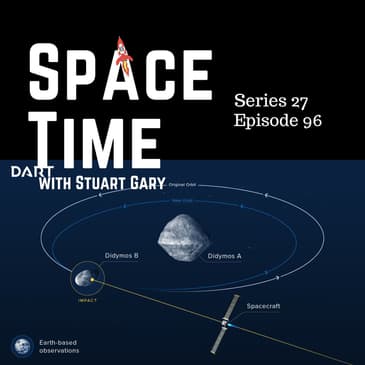
[00:00:53] Back in 2022, NASA's DART mission showed how a spacecraft impactor could be used to deflect an asteroid that was on a collision course with the Earth. The DART, or Double Asteroid Redirection Test, saw a probe crash into a small moon called Dimorphus which orbits around an asteroid called Didymos.
[00:01:12] The impact shortened Dimorphus' orbit around Didymos by around 32 minutes. It was an impressive feat, and scientists have since been pouring over all the data for additional information. World have now published all that information in five new studies in the journal Nature Communications.
[00:01:29] NASA's lead scientist for solar system small bodies, Thomas Statler, says the findings provide new insights into the way that asteroids can change over time. That's important not just for understanding the Near-Earth objects that are the focus of planetary defence,
[00:01:44] but also for scientists' ability to read the history of our solar system from these remnants of planetary formation. From the images captured by DART and its accompanying Lucia-Cube cubesat, the authors observed the small asteroid Dimorphus' topography which featured boulders of various sizes.
[00:02:00] In comparison, the larger asteroid Didymos was far smoother at lower elevations, though still rocky at higher elevations and with a lot more craters than Dimorphus. Now the authors think that Dimorphus likely spun off Didymos in a large mass shedding event.
[00:02:15] There are natural processes that can accelerate the spins of small asteroids and there's growing evidence that these processes may be responsible for reshaping these bodies or even forcing material to be spun off their surfaces. Analysis suggests that both Didymos and Dimorphus have very weak surface characteristics.
[00:02:35] That led the team to suggest that Didymos had a surface age 40 to 130 times older than Dimorphus, with a former estimated to be around 12 and a half million years old while the latter is probably less than 300,000 years old.
[00:02:48] The authors think the lower surface strength of Dimorphus likely contributed to DART's significant impact on its orbit. The images and data that DART collected at the Didymos system are providing a unique opportunity for up close geological observations of near-Earth asteroid binary systems.
[00:03:05] From these observations, scientists were able to infer a great deal about the geophysical properties of both Dimorphus and Didymos and expand their understanding on the formation of both asteroids. One of the papers compared the shapes and sizes of the various boulders
[00:03:19] and their distribution patterns across the two asteroids. It determined that the physical characteristics of Dimorphus indicate it was formed in stages, likely from material inherited from its Perron asteroid, Didymos. That conclusion reinforces a prevailing theory that some binary asteroid systems
[00:03:37] arise from shedding remnants of a larger primary asteroid accumulating into a new asteroid, Moonlet. Interestingly, before they settled on the name Dimorphus, the moon around Didymos was originally going to be called Didymoon. Which sort of reflects that way of thinking. The research team also found that thermal fatigue,
[00:03:56] that's the gradual weakening and cracking of material caused by heat, could rapidly break up boulders on the surface of Dimorphus, generating surface lines and altering the physical characteristics to this type of asteroid more quickly than previously thought. The authors were also able to determine that Didymos' bearing capacity,
[00:04:13] that is the surface's ability to support applied loads, was at least a thousand times lower than that of dry sand on Earth or even lunar regolith. Now all this is considered an important parameter for understanding and predicting the response of a surface,
[00:04:27] including for the purpose of displacing an asteroid. An analysis of surface boulders on Dimorphus, comparing them with those on other Rubberpal asteroids including Iterkawa, Ryugu and Benu, showed that the boulders all shared similar characteristics.
[00:04:41] And that suggests that all these types of asteroids formed and evolved in a similar fashion. The authors also noted that the elongated nature of the boulders around the dark impact site implied that they were likely formed through that impacting process. In other words, their ejector from the crash.
[00:04:59] These latest findings are forming a more robust overview of the origins of the Didymos system and they're adding to science's understanding of how such planetary bodies are formed. The European Space Agency's HERA mission is now preparing for its launch in October to the Dimorphus Didymos system.
[00:05:16] Once there in 2026, it'll further analyse the aftermath of the impact event. And so this research is providing a series of tests for what HERA will likely find and contribute to both current and future exploration missions or bolstering planetary defence capabilities. This is space-time.
[00:05:35] Still to come, there are more questions than answers as the ongoing mystery of the sun's superheated corona continues to baffle scientists. And the Kremlin unveils the final design for its new Russian orbital space station. All that and more still to come on space-time.
[00:06:07] The further one moves away from a heat source, the curler attempts to get. Yet for some mysterious reason, that's not true for our sun. Our local star is a core temperature of over 15 million degrees Celsius and a surface temperature of around 6000 degrees.
[00:06:24] However, the sun's outer atmosphere, the corona, has a temperature back into the millions of degrees. That's hundreds of times hotter than its surface, despite being much further away from the ultimate source of the heat, the sun's core.
[00:06:36] Now by diving into the sun's corona, NASA's Parker Solar Probe has ruled out what are called S-shaped bends in the sun's magnetic field as a potential cause for the corona's searing hot temperatures. How the corona's heat seemingly defies physics has been stumping scientists for decades.
[00:06:53] Yet it allows the sun's hot supercharged particles or plasma to move fast enough to escape the sun's gravitational pull and bathe our entire solar system as the solar wind. NASA's Parker Solar Probe was built to solve this mystery by diving into the corona to fight its heat source.
[00:07:11] The spacecraft is equipped with a set of instruments designed to directly measure the density, temperature and flow of the corona's plasma. And scientists thought they may have been on the right track because when it first approached the sun
[00:07:23] the probe detected hundreds of weird S-shaped bends in the sun's magnetic field. They were named switchbacks in reference to how they briefly reversed direction of the magnetic field along with thousands of shower bends.
[00:07:36] To some scientists, these switchbacks seemed like a promising source of heat to the corona and solar wind. Their severe S-shaped bends stored lots of magnetic energy, which likely released into the surrounding plasma as the switchbacks travelled through space and eventually straightened out.
[00:07:52] Scientists figured that all this energy had to go somewhere and so it could be contributing to the heating of the corona and the acceleration of the solar wind. The problem is to heat the corona, the switchbacks need to be moving through it.
[00:08:05] So learning where the switchbacks form was critical to understanding their influence on the corona's temperature. Now after pouring over all the data from the Parker Solar Probe's first 14 laps around the sun,
[00:08:17] scientists discovered that while the S-shaped bends are common in the solar wind near the sun, they're absent inside the corona. To make matters worse, scientists still can't agree on what's actually causing the switchbacks.
[00:08:29] Some think the magnetic field is being bent by turbulence in the solar wind beyond the corona. Others think the switchbacks are starting their journey at the solar surface. When churning magnetic field lines and loops explosively collide combining into bent shapes.
[00:08:42] But the state's new results, reported in the astrophysical journal letters, are ruling out the latter hypothesis. If switchbacks were being formed by colliding magnetic fields at the surface of the sun, they ought to be even more common inside the corona and that's just not the case.
[00:08:58] Other scientists are proposing that magnetic collisions could still be playing an indirect role in the origins of the switchbacks and therefore the heading of the corona. One idea suggests that while they must be formed outside the corona, there could be a trigger mechanism inside the corona
[00:09:13] that causes switchbacks to form in the solar wind. When the magnetic fields collide with the sun's surface, they vibrate like plucked guitar strings and send waves along the magnetic field lines into space.
[00:09:25] At the same time, the energy from these collisions creates fast streams of plasma in the solar wind. And it's this fast plasma which distorts the magnetic waves into switchbacks in the solar wind. And if some of these waves dissipate inside the solar atmosphere before becoming switchbacks,
[00:09:41] they could also be playing a part in hitting the corona. So the mechanisms which cause the formation of the switchbacks and the switchbacks themselves could heat both the corona and the solar wind. Trouble is there's currently not enough data to favour triggers in the sun's surface
[00:09:57] but there's no evidence of turbulence in the solar wind as the cause for the switchbacks. The Parker Solar Probe's next flyby into the sun will be on December 24th. There, it will pass even closer, collecting even more data which could further test various hypotheses.
[00:10:12] Needless to say, we'll keep you informed. This is space time. Still to come, the Kremlin unveils its latest design for a Russian orbital space station and the Red Supergiant Antares, the second nearest star system to the sun
[00:10:28] and the peak of the annual Perseids meteor shower are among the highlights of the August night skies on Skywatch. Russia has unveiled the latest designs and timeline for its new space station. Work on the core module, a research and power node, has been underway for several years now
[00:10:59] the Russian rocket company Energia but ongoing delays and cost overruns have repeatedly pushed the project back. Now, Moscow's insisting it's looking at a launch date in 2027. But of course that schedule doesn't just depend on Energia,
[00:11:15] it also depends on the success of Russia's next generation heavy lift rocket, the Angara A5. Surfer, the Angaras had three successful and one failed orbital test flight since 2014. But the leadership of Russia's Federal Space Agency Roscosmos are confident of smooth sailing ahead.
[00:11:33] They've now released details of the new orbital outpost known as the Russian Orbital Service Station or ROSS. By 2030, the Kremlin plans to abduct its four primary modules into a large X shape with an additional two special purpose modules scheduled for attachment by 2033.
[00:11:50] That'll actually give the ROSS a very similar design appearance to the old Mir space station. Roscosmos plans to have its first cosmonauts aboard the $7 million orbital outpost by 2028. But interestingly, unlike Mir and the International Space Station, it won't be permanently manned
[00:12:07] instead operating remotely from the ground for part of the time. Moscow says the ROSS would orbit at the same altitude as the International Space Station around 400 km above the Earth's surface. It'll be in a polar Sun synchronous orbit that will be especially useful
[00:12:22] for observing the entire surface of the planet and also providing a valuable view over the strategically important northern sea route. The Kremlin also wants ROSS to act as a command and control centre for a fleet of satellites using artificial intelligence and flying near the space station.
[00:12:39] These will spend part of their time docked to the space station and the rest flying independently. The Kremlin's also been looking at partnerships with other countries for its new space station. These include China, who have already agreed.
[00:12:52] They've also been holding talks with Brazil, India and South Africa in addition to other African nations. Russia has been a principal member of the International Space Station since the first modules were launched way back in November 1998.
[00:13:05] But it's always maintained a very separate feel for the so-called Russian segment of the orbiting outpost leaving the other partners, NASA, the European Space Agency, Jackson, the Canadian Space Agency to focus much of their work in the so-called American section.
[00:13:20] Back in 2021, as parts of the Russian section began experiencing reliability problems including air leaks into space, some of which still haven't been fixed but has cosmos signal its intention to build its own space lab calling it a successor to the mere space station.
[00:13:35] The Kremlin claims it wants to focus more on its own security and specific scientific projects which it believes have been handed by international agreements pertaining to operations on the ISS. Then in 2022 following the Russian invasion of Ukraine and heightened tensions between Russia and the West
[00:13:51] Roscosmos announced that it would leave the ISS program sometime after 2024. Now that date was chosen because it expected to have the first node of its new space station operational by then. With delays there, Russia was forced to change that date to sometime after 2028.
[00:14:09] Of course, the International Space Station itself is expected to undergo a plan to orbit in 2030 with SpaceX awarded the contract to carry out its descent and destruction. Although bits of the ISS could be carved off to provide operational nodes for other privately operated space stations.
[00:14:26] This is Space Time. And time that had turned our eyes to the skies and check out the Celestuous Fee for August on Skywatch. August is the eighth month of the year in the Julian-Ingagorian calendars.
[00:14:55] It was originally named Sextelis in Latin because it was the sixth month of the original 10 month Roman calendar under Romulus in 753 BCE when the year started in March. It only became the eighth month when January and February were added to the start of the year.
[00:15:11] In the year 8 BCE it was renamed in honour of the Roman statesman and military leader Augustus who had achieved several military victories including the conquest of Egypt during the month. Okay, turning to the heavens.
[00:15:24] And the constellation Scorpius the Scorpion is high overhead this time of year covering almost a third of the August night skies. At the heart of Scorpius located some 470 light years away is the red supergiant Antares. A light year is a distance of about 10 trillion kilometres.
[00:15:43] The distance a photon can travel in a year at 300,000 kilometres per second, the speed of light in a vacuum and the ultimate speed limit of the universe. Red supergiants have the largest diameters of any known star.
[00:15:56] They evolve out of main sequence stars with more than 8 times the mass of the Sun. A main sequence star is a star fusing hydrogen into helium in its core. When stars stop fusing hydrogen into helium in their core,
[00:16:10] the balancing act between gravity pushing a star's mass down towards the centre and energy from nuclear fusion in the core pushing outwards ceases and gravity wins, causing the star to begin to collapse inwards, crushing the stellar core until the increase in pressures and temperatures trigger helium fusion.
[00:16:27] At the same time a shell of hydrogen around the core begins to fuse causing the star's outer gaseous envelope to expand out into a bloated giant. And now being further away from the core the stellar surface starts to cool down becoming redder in colour.
[00:16:43] While sun-like stars will become red giants, those that are far bigger, 8 times or more the mass of the Sun, become red supergiants. Supergiants will fuse all their core helium into carbon and oxygen within just a few million years.
[00:16:57] They'll then begin fusing this core carbon and oxygen into progressively heavier and heavier elements until they eventually begin to produce iron in their core. Now no star, no matter how massive it is, is big enough to fuse iron into heavier elements.
[00:17:11] And so then the star will collapse catastrophically in what's known as a core collapse supernova an explosion bright enough to outshine an entire galaxy. The end result of this core collapse supernova will be the creation of either a neutron star
[00:17:26] or a black hole depending on the progenitor star's mass. The name Antares means rival of Mars and indeed when they're close together in the sky they do look very similar. Antares or Alpha Scorpius that's sometimes called has some 12.4 times the mass
[00:17:42] and an incredible 450 times the diameter of our Sun and is one of the largest known stars in the universe. Antares is so big that were it placed where the Sun is at the centre of our solar system
[00:17:54] it would engulf all the inner planets Mercury, Venus, Earth and Mars. It's outer surface would reach almost as far as the orbit of Jupiter. Antares is a binary system. There's a companion star orbiting with it called Antares B
[00:18:09] a massive spectrotype E blue-white star at least 7.2 times the mass and 5.2 times the radius of the Sun. It's located about 224 astronomical units beyond the primary star. An astronomical unit is the average distance between the Sun and the Earth about 150 million kilometres or 8.3 light minutes.
[00:18:31] Astronomers describe stars in terms of spectrotypes a classification system based on temperature and characteristics. The hottest, most massive and most luminous stars are known as spectrotype O blue stars. They're closely followed by spectrotype B blue-white stars then spectrotype A white stars, spectrotype F whiteish yellow stars
[00:18:53] spectrotype G yellow stars that's where our Sun fits in spectrotype K orange stars and the coolest and least massive of all stars are spectrotype M red stars commonly referred to as red dwarfs. Now each spectro classification is further subdivided using a numeric digit
[00:19:11] to represent temperature with zero being the hottest and nine the coolest and a Roman numeral to represent luminosity. Now put all that together and our Sun is a spectrotype G2V or G25 yellow dwarf star also included in the stellar classification system a spectrotype LT and Y
[00:19:31] which are assigned to failed stars known as brown dwarfs some of which were actually born as spectrotype M red dwarf stars but became brown dwarfs after losing some of their mass. Brown dwarfs fitted to a category between the largest planets which are about 13 times the mass of Jupiter
[00:19:48] and the smallest spectrotype M red dwarf stars which are about 75 to 80 times the mass of Jupiter or 0.08 solar masses. Located near Antares is the spectacular globular cluster Messier 4 or M4 for short named after the 18th century French astronomer and comet hunter Charles Messier
[00:20:09] it's one of a catalog of 103 fuzzy objects which weren't comets and so were of no interest to Messier and so he made a list of them so he didn't waste his time looking at them other astronomers have since added further celestial objects to the catalog
[00:20:23] bringing the total to around 110 located some 7,000 light years away Messier 4 can be seen through a pair of binoculars making it one of the closest globular clusters to Earth globular clusters are densely packed spheres containing thousands to millions
[00:20:38] of gravitationally bound stars which it's thought were either originally all born at the same time in the same stellar nursery or at the surviving cause of galaxies that have been cannibalized by larger galaxies they're almost always found orbiting the halo of galaxies
[00:20:55] the Milky Way has about 150 of them and they're all usually very ancient some dating back to around 12 billion years located just below the sting of Scorpius are two open star clusters M6 and M7 M7's the nearer of the two located about 800 light years away
[00:21:13] while M6 is a more distant 2000 light years open clusters are less densely packed than their globular cluster counterparts with the stars inside them less gravitationally bound and more prone to drifting away over time another open star cluster in Scorpius is NGC 6231
[00:21:31] located about 6,500 light years away just near the star Zeta Scorpii NGC 6231 is a bright open star cluster containing around 120 stars including a significant population of highly luminous supergiants numerous white-yellow stars and at least two Wolf-Rayet stars Wolf-Rayets are extremely luminous evolved stars reaching the ends of their lives
[00:21:56] having run out of hydrogen for core fusion they're no longer on the main sequence and are instead fusing progressively heavier and heavier elements in their cause this causes them to have surface temperatures of up to 200,000 degrees Celsius and such extreme temperatures generate powerful stellar winds
[00:22:15] just behind Scorpius is the constellation Sagittarius the half-man half-horse of Greek mythology and as we mentioned in last month's Skywatch the center of the Milky Way galaxy is found in Sagittarius roughly 27,000 light years away
[00:22:31] the name Sagittarius can be traced back beyond the Greeks to the ancient Mesopotamian archer god Nurgle Sagittarius is known for its many nebulae and clusters more than any other constellation one of the largest and brightest is the globular cluster M22
[00:22:46] big enough to be visible to the unaided eye located about 10,600 light years away near the galactic bulge M22 is more elliptical than most globular clusters it's located just south of the ecliptic the plane in the sky upon which all the planets orbit the sun
[00:23:03] and it contains over 70,000 stars covering an area of around 100 light years it also contains at least two black holes and is one of only a handful of globular clusters known to contain planetary nebulae the puffed off out-of-gasses envelopes of dead sun-like stars
[00:23:21] located in the sky next to Scorpius in the west and Sagittarius in the east is the constellation of Eustis the healer or serpent bearer the serpent's name is portrayed as a snake coiled around a man in Greek mythology Ophiuchus raises a rind from the dead
[00:23:37] after he was bitten by Scorpius Ophiuchus contains several star clusters and other interesting features including Barnard's Star Barnard's Star is the second nearest star system to the sun beaten only by the Alpha Centauri triple star system located some 5.9 light years away
[00:23:54] Barnard's Star is a spectral type M red dwarf and is 0.144 times the mass of the sun our sun is around 4.6 billion years old at between 7 and 12 billion years of age Barnard's Star is considerably older than the sun
[00:24:11] and may be among the oldest stars in the Milky Way Galaxy it's lost a great deal of rotational energy and its periodic slight changes in brightness indicate that it's rotating about once every 130 days by comparison our sun rotates roughly once every 29 days
[00:24:28] given its age Barnard's Star was long assumed to be quiescent in terms of stellar activity but in 1998 astronomers observed an intense stellar flare indicating that Barnard's Star is indeed a flare star flare stars are variable stars they can undergo unpredictable dramatic increases in brightness lasting a few minutes
[00:24:49] it's believed that the flares of flare stars are analogous to solar flares in the sun in that they're generated by stellar magnetic energy stored in the star's atmosphere lying just to the west of the scorpion is the constellation Libra the Scales
[00:25:05] in Greek mythology Libra represents the claws of Scorpius the Scorpion however the Romans considered Libra a distinct separate constellation from Scorpius and thought them to be the scales symbolizing the equinoxes the times of the year in March and September it gets equal lengths of day and night
[00:25:23] that's because 2000 years ago when all this was made up the sun moved into Libra at the time of the September equinox but due to procession as the Earth spin-axis wobbles in direction this point in time has now moved into the joining constellation of Virgo
[00:25:37] if you look to the south and the southern cross that's the constellation Centaurus another half man, half horse, mythical beast Centaurus was the teacher of many of the Greek gods and heroes he was placed among the stars in the heavens
[00:25:51] after accidentally being killed by a poisoned arrow fired by Hercules close to the point of star nearest the southern cross, Beta Centauri lies NGC 5139, Omega Centauri the largest and brightest globular cluster in the visible sky because of its brightness the ancient Greek mathematician and astronomer Claudius Ptolemy
[00:26:13] originally thought Omega Centauri was a star it has a diameter of more than 150 light years and contains an estimated 10 million stars giving it some 4 million times the mass of our sun located some 15,800 light years away Omega Centauri is another very ancient globular cluster around 12 billion years old
[00:26:35] and it contains many so-called population 2 stars these are the second generation of stars to have formed and were created directly out of the remains of the very first stars in the universe stars in the core of Omega Centauri are so crowded
[00:26:51] they're estimated to average on 0.1 light years away from each other and that compares to the nearest star to our sun, Proxima Centauri which is some 4.2 light years distant located close to Omega Centauri in the sky is the giant lenticular galaxy NGC 5128 Centaurus A
[00:27:11] which we see looking like it's split in half by a thick band of dust the galaxy was discovered in 1826 by astronomer James Dunlop from his home in what is now the Sydney suburb of Paramatta
[00:27:23] a time long before the bright lights of a modern city would make such a discovery impossible located some 13 million light years away Centauri is one of the strongest radius sources in the sky
[00:27:35] and is thought to be the result of a merger between an elliptical and a spiral galaxy it can be easily seen using a pair of binoculars but you'll need a telescope to make out its spectacular dust lanes
[00:27:47] August is also the time of the peak of the annual Perseus meteor shower the meteors are the debris trail ejected by the comet Swift-Tuttle as it travels along its 133 year orbit through the solar system as its name suggests the Perseus radiant that is the point in the sky
[00:28:05] from which the meteors appear to originate lies in the constellation of Perseus the Perseus is one of the oldest known meteor showers with early Chinese historical records of its activity going back almost 2,000 years they're active between July 17th and August 24th
[00:28:22] with a peak on August 12th with around 60 meteors an hour being visible the Perseus are very bright and fast moving meteors travelling at speeds of 59 km per second the best seen between midnight and just before dawn producing long bright trails and some fireballs
[00:28:40] most Perseus burn up in the atmosphere at altitudes of over 80 km their best seen from the northern hemisphere so for southern hemisphere sky watchers look to the north with a radiant below the northern horizon and now with our tour of the rest of the August night skies
[00:28:56] we're joined by Jonathan Nally from Sky and Telescope Magazine can I stir it well to go out in the evening at this time of the year you'll find a Milky Way which is our galaxy's infamy inside of course
[00:29:05] and it's stretching all the way across the sky from the northeast down to the south west that's sort of in mid-even 8 o'clock 9 o'clock that sort of time the centre of the Milky Way which is in the region of Sagittarius
[00:29:15] is directly overhead for those where I live at the latitude of Sydney in the southern hemisphere having the galactic centre because that fights an eye directly over here is one of the reasons why so many observatories have been set up in the southern hemisphere
[00:29:27] because this is where you get the best view of it and there's just so much to see towards the centre of the galaxy looking through that right into the sort of central part of the city if you like
[00:29:36] so there's lots of stuff there and star clusters and the Berlin, the Star Clouds and everything you want it's all in one spot like a supermarket of... I've never used that analogy before it's like a supermarket of space
[00:29:47] but anyway having the galactic centre up there is really good so this time of the year unfortunately of course for us in the southern hemisphere it's freezing cold in the middle of the winter
[00:29:54] but that's what you've got to put up with to get the best views of the southern sky our friends up in the northern half of the planet of course it's nice summer time up there so lovely viewing weather viewing conditions are nice
[00:30:04] but for most people in the northern hemisphere you can't really see the centre of the galaxy area too well because it's low down on the southern horizon and for a lot of people we have quite far north
[00:30:14] they can't see at all because it's below the horizon for them so they've got to come down here for a holiday and get some decent views of the southern sky and speaking of the southern sky down in the south
[00:30:23] because the southern cross is high in the southwestern part of the sky in the evening during August and it's lying on its right hand side it's shaped like a kite and it's lying on its right hand side
[00:30:32] and just above it is a pair of stars known as the two pointers they're quite bright these two stars if you go out at night and you look south these first two stars you see they're called the pointers because if you draw a line between them
[00:30:43] and you keep the line going you end up pretty close to the southern cross so a point towards the southern cross and both the cross and the pointers are located within the band of the Milky Way and stretching northwards along the line of the Milky Way
[00:30:56] heading along it we've got lots of other famous and interesting constellations you've got Centaurus which is brilliant if you get a chance to look even with Pervenokas Centaurus Scorpius Sagittarius the next one along is called Sputum which is a strange name that most people won't have heard before
[00:31:11] Sputum but it's right next to Sagittarius and it contains some really nice what astronomers call deep sky objects like Nebulium, class of the Tarkovs and things it's called Sputum because it's named after a scooter but not the kind you ride on it's F-C-U-T-A
[00:31:25] and it's from an ancient Roman word meaning shield so Sputum is the constellation of the shield now if you stay out skygazing for long enough as the night goes on and the earth is turning you'll notice that the band of the Milky Way
[00:31:37] which was sort of stretching across the sky has now shifted over to the north and west and it's getting lower and lower as the hours go past until it seems to disappear around about four o'clock in the morning but hasn't actually disappeared
[00:31:46] the entire Milky Way is sort of circling us in every direction north, south, east and west but flat along the horizon and if you then keep observing it all you if you're pulling it all night or if you get up early in the morning to have a look
[00:31:58] you'll find that the Milky Way then is coming up in the eastern part of the sky before dawn and this includes the marvellous constellation Orion the Hunter which is spoken about many many times in the program with its big bright stars right on Beetlejuice
[00:32:11] and it's easy to see a group of three stars in a row which forms the belt of the mythological Hunter Orion and to the northeast of Orion you've got a constellation called Taurus which everyone's heard of of course perhaps not everyone has seen in the sky
[00:32:24] it's really easy to spot because it's got a sort of triangular formation a very easy to see triangular formation of stars that it's made including a fairly bright reddish coloured star called Aldebaron and that brings us to the planet
[00:32:36] for this month because right at the beginning of August Mars is very close to that triangular stellar grouping in Taurus and that means we're going to have an excellent opportunity to compare the red planet with Aldebaron which is a red star
[00:32:50] and they're both almost exactly the same brightness only a couple of hundreds of what the astronomers call a magnitude difference that essentially the same brightness and they're the same colour and they're very close together in the sky at the start of August
[00:33:03] so for beginners the only way you're going to tell them apart is that from night to night Mars will be slowly moving away from Aldebaron and towards another much brighter what looks like a star in the sky but it's actually Jupiter
[00:33:14] but yeah if you go out one night and have a look if you spot Taurus and see these two red stars one of the planet will look like stars go out the next night you'll see one of them will have moved
[00:33:24] and the next night it will move a bit further and a bit further that's Mars so by the 15th if you're out there in the early morning hours before dawn you'll see Mars very close to Jupiter
[00:33:35] they're only going to be less than half a moon with the part it'll look really quite spectacular have a pair of binoculars get them onto this view because it'll look tremendous having these two planets I should say right next to each other
[00:33:47] and even a fairly small pair of binoculars you might be able to see one or two maybe three of Jupiter's moons they won't look like moons they just look like tiny pinprick stars just at the one side or the other side or both sides of Jupiter
[00:34:01] but to get all of that view in the one field of view would be really quite spectacular in the evening part of the sky we've got Saturn that's you can see that one above the eastern horizon in the mid-evening
[00:34:12] it looks like a fairly bright star in inverted commas but it's got a slightly yellowish tinge and of course it's a planet and around mid-August by the way about the middle of the month there's going to be four or five meteor showers
[00:34:23] going on and they're all in the same part of the sky as Saturn so if you go out and have a look and you've got some reasonably dark skies you should be able to see some meteor so you can pass to the planet too
[00:34:34] the other two planets visible this month are Mercury and Venus and both of them can be found low above the western horizon and after sunset so wait till the sun goes down when it's starting to get a little bit dark
[00:34:42] you should be able to see Mercury and Venus Venus is big and bright you won't miss it, you won't mistake it for anything else it's really big and bright whereas Mercury is more of a little tiny pinprick of light
[00:34:52] and if you want to see Mercury you have to be quick because even though you'll be able to see it at the start of the month low on the western horizon it's going to get lower and lower in the sky
[00:35:01] so by the end of the second week it will be gone it will be out of view lost in the glow of the sunshaft Venus low is going to be okay because it's going to be climbing higher and higher as each night passes during August
[00:35:13] so long as the weather is okay you've got a fairly clear horizon there are mountains or buildings in the way you should be able to see Venus all the way through August and that's Stuart is the Sky this month
[00:35:23] That's John of the Nelly from Sky and Telescope magazine and this is Space Time and that's the show for now Space Time is available every Monday, Wednesday and Friday through Apple Podcasts iTunes, Stitcher, Google Podcast Hockercasts, Spotify, A-Cast, Amazon Music, Bites.com
[00:35:59] SoundCloud, YouTube, your favorite podcast download provider and from SpaceTime with StuartGarry.com Space Time is also broadcast through the National Science Foundation on Science Zone Radio and on both iHeart Radio and TuneIn Radio and you can help to support our show by visiting the Space Time store
[00:36:18] for a range of promotional merchandising goodies or by becoming a Space Time patron which gives you access to triple episode commercial free versions of the show as well as lots of bonus audio content which doesn't go to air access to our exclusive Facebook group and other rewards
[00:36:35] just go to SpaceTime with StuartGarry.com for full details