

*Epoch of Reionization: New Insights from Webb
A groundbreaking study suggests the epoch of reionization, a pivotal era in the universe's early evolution, may have occurred 350 million years earlier than previously believed. Utilising data from the James Webb Space Telescope, astronomers have uncovered a greater abundance of extreme ultraviolet emitting galaxies, challenging established models. This revelation might imply that the cosmic microwave background radiation and the Lyman alpha forest should appear different, posing a conundrum for scientists and opening new avenues for understanding the universe's history.
*NASA's DaVinci Mission Prepares for Venus
NASA's upcoming DaVinci mission aims to explore Venus's enigmatic Alpha Regio, a mountainous region shrouded in mystery. The mission, set for the early 2030s, will delve into whether Venus once harboured oceans and continents, akin to Earth. By reanalysing old data and employing modern techniques, scientists have enhanced the resolution of Venus's topography, offering fresh insights into its geological features and potential volcanic activity. DaVinci's descent probe will capture unprecedented high-resolution images, potentially revealing new details about Venus's surface.
*China's First Reusable Satellite Test
China has successfully tested its first reusable satellite, the SHY119, launched aboard a Long March 2D rocket. Recovered after 13.5 days, the mission included various payloads, such as plant seeds and technology demonstration devices. This achievement marks a significant milestone in China's Space exploration efforts, showcasing advancements in reusable satellite technology.
The Science Robert
A study links hearing loss in older age to an increased risk of Parkinson's disease, with effective management through hearing aids potentially mitigating this risk. In the South Australian outback, palaeontologists have discovered one of Earth's earliest life forms, dating back 550 million years. Meanwhile, a new study warns that up to 33% of frog and toad habitats could become arid by the century's end due to climate change. Additionally, a Gallup poll reveals a significant drop in support for childhood vaccinations in the US, raising concerns about herd immunity.
www.spacetimewithstuartgary.com
www.bitesz.com
🌏 Get Our Exclusive NordVPN deal here ➼ www.bitesz.com/nordvpn. Enjoy incredible discounts and bonuses! Plus, it’s risk-free with Nord’s 30-day money-back guarantee! ✌
Check out our newest sponsor - Old Glory - Iconic Music and Sports Merch plus now with official NASA Merch!. Well worth a look....
Become a supporter of this Podcast and access commercial-free episodes plus bonuses: https://www.spreaker.com/podcast/spacetime-with-stuart-gary--2458531/support
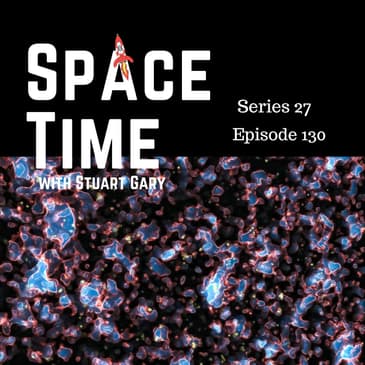
[00:00:00] This is SpaceTime Series 27 Episode 130, broadcast on the 28th of October 2024.
[00:00:06] Coming up on SpaceTime, has our understanding of the evolution of the universe been thrown into question?
[00:00:13] Old data yielding new secrets as work continues on preparing NASA's Da Vinci spacecraft for its mission to Venus.
[00:00:21] And China tests its first reusable satellite. All that and more coming up on SpaceTime.
[00:00:28] Welcome to SpaceTime with Stuart Gary.
[00:00:47] A new study has found that the epoch of re-ionization, a crucial period for the early evolution of the universe,
[00:00:54] may have occurred at least 350 million years earlier than previously thought.
[00:00:59] The new findings, reported in the Journal of the Monthly Notices of the Royal Astronomical Society Letters,
[00:01:04] are based on new observations using data from the Webb Space Telescope.
[00:01:09] Re-ionization was a crucial period in the history of the cosmos.
[00:01:13] It happened when the first stars and galaxies changed the physical structure of their surroundings,
[00:01:19] and eventually the entire universe.
[00:01:22] Established theories state that the epoch ended about a billion years after the Big Bang, 13.8 billion years ago.
[00:01:28] Throughout its history, the universe has undergone several major changes.
[00:01:33] For the first 380,000 years after the Big Bang, it was nothing more than a hot dense plasma of protons and electrons.
[00:01:40] Eventually, over time, things cooled enough for these protons and electrons to combine, forming the first neutral hydrogen atoms.
[00:01:48] Then, around 100 million years after the Big Bang, the first stars and galaxies began to form, ushering in the epoch of re-ionization.
[00:01:57] See, those first stars, these days we call them Population 3 stars, were huge and they were incredibly hot.
[00:02:04] Some estimates suggest they could have been between 30 and 300 times as massive as, say, our Sun.
[00:02:09] And they emitted a lot of energy in the form of extreme ultraviolet radiation.
[00:02:14] Now, this energy was so intense that as its photons struck near by hydrogen atoms,
[00:02:20] they were split into separate protons and electrons.
[00:02:23] And that's the process called ionization.
[00:02:25] After hundreds of millions of years, when almost all the hydrogen in the universe had become ionized,
[00:02:31] the epoch of re-ionization ended.
[00:02:33] Now, considering that roughly 75% of all matter is hydrogen,
[00:02:37] this represents an immense transformation.
[00:02:40] The study's lead author, Julian Munez, from the University of Texas at Austin,
[00:02:44] says this was the last major change to happen to the cosmos.
[00:02:48] The universe had literally gone from neutral and cold and boring to ionized and hot.
[00:02:54] And of course, it's important to remember, this isn't something that happened in just one or two galaxies.
[00:02:58] It happened across the entire universe.
[00:03:01] The process heated and ionized all the gas in the universe.
[00:03:04] And that regulated how fast galaxies grew and evolved.
[00:03:08] Because astronomers are unable to observe the ionization process directly,
[00:03:13] they need to use models to predict when it ended.
[00:03:16] These models are based on indirect evidence,
[00:03:18] including measurements of how much light has reached us from the afterglow of the Big Bang,
[00:03:22] known as the cosmic microwave background radiation.
[00:03:26] Other evidence is an early abundance of a wavelength associated with energy changes in hydrogen,
[00:03:31] known as the Lyman-Alpha forest.
[00:03:33] Both of these help astronomers calculate how much hydrogen was transformed during reionization,
[00:03:39] and by extension, how much energy was needed to do that.
[00:03:43] Munez says astronomers know that all the hydrogen was neutral before reionization.
[00:03:47] And from there, you need enough extreme ultraviolet radiation to split each atom.
[00:03:53] So at the end of the day, you can do the math and figure out when reionization ended.
[00:03:58] But now, the James Webb Space Telescope is challenging this established model.
[00:04:03] With Webb, astronomers compare further back into the cosmos than ever before,
[00:04:08] and therefore deeper into this critical epoch.
[00:04:11] And this is leading to many unexpected observations in the early universe,
[00:04:15] one of which is an apparently greater abundance of extreme ultraviolet emitting galaxies
[00:04:20] than what was expected.
[00:04:22] Webb has revealed that these bright galaxies were enough to ionize the universe all by themselves,
[00:04:27] and this counters what was anticipated.
[00:04:30] And so with these new observations, all the accounting is off.
[00:04:34] Munez says if you were to trust the Webb results blindly,
[00:04:37] it tells you that reionization ended 550 million to 650 million years after the Big Bang,
[00:04:43] instead of the current estimates of a billion years.
[00:04:45] Now, if that's true, the cosmic microwave background radiation should look very different,
[00:04:50] and the Lyman-Alpha-Forus would also be different.
[00:04:53] So, there's the problem.
[00:04:55] It's unlikely that reionization happened hundreds of million years earlier than predicted.
[00:05:00] That means something else is going on, something we don't understand.
[00:05:03] It means that the established models are missing a key piece of crucial information.
[00:05:08] For example, sometimes ionized photons and electrons could come back together,
[00:05:13] reforming neutral hydrogen atoms.
[00:05:15] That's a process called recombination.
[00:05:17] Now, if that happened more often than current models assume,
[00:05:20] that could increase how much ultraviolet light was needed to ionize the entire universe.
[00:05:26] Munez says more detailed and deeper observations of galaxies are needed
[00:05:29] in order to gain a better understanding of the recombination process.
[00:05:33] He says resolving this tension on reionization will be a key step
[00:05:38] to finally understanding this pivotal period of the universe's evolution.
[00:05:43] This is space-time.
[00:05:45] Still to come, old data yielding new secrets as NASA's Da Vinci spacecraft
[00:05:50] is prepared for its mission to Venus.
[00:05:52] And China has successfully tested its first reusable satellite.
[00:05:57] All that and more still to come on space-time.
[00:06:15] Due to launch in the early 2030s, NASA's Da Vinci mission will investigate
[00:06:20] whether the planet Venus, a sweltering world wrapped in an atmosphere of noxious gases,
[00:06:25] once had oceans and continents like the Earth.
[00:06:28] Consisting of a flyby spacecraft and a descent probe,
[00:06:31] Da Vinci will focus on a mountainous ridge called Alpha Reggio,
[00:06:35] a possible ancient continent.
[00:06:36] Alpha Reggio is one of the most mysterious places on Venus.
[00:06:40] Its terrain, known as Tessera, is similar in appearance to rugged Earth mountains,
[00:06:45] but much more irregular and disorderly.
[00:06:47] So called because they resemble a geometric parquet floor pattern,
[00:06:51] Tessera have been found only on Venus.
[00:06:53] And Da Vinci will be the first mission to explore this terrain in detail
[00:06:57] and map its topography.
[00:06:58] Da Vinci's probe will begin photographing Alpha Reggio,
[00:07:02] collecting the highest resolution images yet,
[00:07:04] once it descends below the planet's clouds,
[00:07:06] starting at about 40 kilometres in altitude.
[00:07:08] So far, only a handful of mostly Soviet spacecraft have plunged through Venus's atmosphere.
[00:07:14] And most of those didn't survive for very long once they reached the ground,
[00:07:18] thanks to the planet's extreme surface temperatures of 162 degrees Celsius
[00:07:21] and its crushing atmospheric pressure,
[00:07:24] which is some 92 times greater than average sea level surface pressure on Earth.
[00:07:29] Venus is shrouded in thick opaque clouds,
[00:07:32] producing corrosive droplets of metal-eating sulphuric acid.
[00:07:35] Scientists have seen what look like snow caps on some of Venus's taller mountain ranges.
[00:07:39] But that snow isn't frozen water, it's actually metallic.
[00:07:43] In fact, the clouds are so heavy,
[00:07:45] they quite literally crush Venus's rich carbon dioxide-based atmosphere,
[00:07:49] acting like the lid of a pressure cooker and giving the planet its high surface pressure.
[00:07:53] The surface of Venus is dominated by more than 1600 volcanic structures.
[00:07:58] That's more than any other planet in the solar system.
[00:08:01] So, there's a lot to study, and scientists developing the new Da Vinci spacecraft
[00:08:05] are preparing for the mission by looking over all data we have from previous flights.
[00:08:10] And by using modern data analysis techniques to pour over decades-old observations,
[00:08:15] they've made some interesting new discoveries.
[00:08:18] Between 1990 and 1994, NASA's Magellan spacecraft used radar imaging and altimetry
[00:08:24] to map the topography of the Alpha Regia region from Venus orbit.
[00:08:28] Now, Da Vinci's team wanted more data,
[00:08:30] so they supplemented this information with radar images taken on three occasions
[00:08:34] from the former Arecibo Observatory in Puerto Rico.
[00:08:38] And they then used machine vision computer modelling to scrutinise the data
[00:08:41] and fill in gaps in the information.
[00:08:44] And this has provided amazing new tenfold higher-resolution images of Alpha Regia,
[00:08:49] including new geologic features which are raising fresh questions
[00:08:53] about how these patterns could have been formed.
[00:08:55] The same sort of evidence has already allowed scientists to find new evidence
[00:08:59] for modern-day volcanic activity on Venus.
[00:09:02] With three forthcoming missions to Venus,
[00:09:05] NASA's Da Vinci and Veritas,
[00:09:07] plus the European Space Agency's Envision mission,
[00:09:09] more and more archival space data is being used to help scientists prepare for their missions.
[00:09:14] One of the other problems facing Da Vinci scientists
[00:09:17] are the atmospheric gases which will scatter light in ways that make the images appear blurred.
[00:09:22] So Da Vinci scientists are working on a solution.
[00:09:25] Recently, scientists reanalyzed old Venus data imaging
[00:09:28] using a new artificial intelligence technique
[00:09:30] that can sharpen the images and use them to compute three-dimensional topographic maps.
[00:09:35] And this technique will ultimately help the team optimise Da Vinci's images and maps
[00:09:39] of the Alpha Regio mountains.
[00:09:41] The upgraded images will give scientists the most detailed view ever,
[00:09:45] right down to resolutions of a metre per pixel,
[00:09:48] possibly allowing them to detect small features such as rocks, rivers and gullies for the first time.
[00:09:53] By analyzing the surface texture and rock types at Alpha Regio,
[00:09:57] scientists hope to determine if Venci and Tesserae formed through the same processes
[00:10:01] that created mountains and some of the volcanoes here on Earth.
[00:10:05] This report from NASA TV.
[00:10:07] The surface of Venus is completely inhospitable for life.
[00:10:12] Barren, dry, crushed under an atmosphere about 90 times the pressure of Earth's,
[00:10:17] and roasted by temperatures two times hotter than an oven.
[00:10:21] But was it always that way?
[00:10:22] Could Venus once have been a twin of Earth?
[00:10:25] A habitable world with liquid water oceans?
[00:10:28] Here are 10 mysteries of Venus that NASA scientists are still grappling with.
[00:10:37] Did Venus ever host life?
[00:10:39] To answer this question, we first need to understand the past environment on Venus.
[00:10:44] This involves studying the atmosphere, geology and history of the planet,
[00:10:48] something NASA's Da Vinci mission plans on exploring in great detail.
[00:10:53] Why did Venus evolve so differently than Earth?
[00:10:55] Venus and Earth are similar in size and density, and yet they are strikingly different.
[00:11:00] Air pressure at the surface of Venus is 90 times that of Earth.
[00:11:04] Venus rotates on its axis backwards compared to the other planets in the solar system,
[00:11:09] and the surface of Venus is over 900 degrees Fahrenheit,
[00:11:12] making it the hottest planet in our solar system, hot enough to melt lead.
[00:11:17] Venus's evolution through time may help us understand how habitability evolves over time,
[00:11:23] and where we might find habitable planets beyond our solar system.
[00:11:27] How did Venus form?
[00:11:29] It is still not known if Venus was bombarded by comets and asteroids rich in water the way Earth was.
[00:11:36] Understanding the delivery of water to Venus is important for evaluating its potential to host oceans in the past.
[00:11:44] What is the atmosphere composition at Venus?
[00:11:47] One of the biggest mysteries of Venus's atmosphere lies in the lowermost or deep atmosphere,
[00:11:52] where carbon dioxide is heated and pressurized to the point where it acts more like a hot liquid than a gas.
[00:11:59] The da Vinci probe will measure chemistry, pressure, temperature and dynamics at least every 200 meters,
[00:12:06] as it descends through Venus's atmosphere to the surface.
[00:12:08] How are the rocks of Venus formed?
[00:12:13] Da Vinci's high-resolution imaging beneath the clouds will test ideas about the role of water in forming what may be ancient continental crust on Venus at human scales.
[00:12:24] Da Vinci will study one of these tesserae, Alpha Regio, to better understand its composition.
[00:12:29] How much water did Venus have?
[00:12:32] Liquid water is essential for life.
[00:12:34] We cannot assess Venus's past habitability without knowing how much water Venus may have had.
[00:12:40] And when and how it lost that water.
[00:12:42] Scientists will use measurements of the atmosphere from the da Vinci probe to explore clues of the story of past water on our sister planet.
[00:12:51] What is the nature of surface activity at Venus?
[00:12:54] Earth's crust hosts a network of relatively thin plates jostling around on the planet's surface in constant horizontal motion.
[00:13:02] If similar plate tectonics exist on Venus, the planet's crust must experience continental drift, like Earth.
[00:13:08] Another key mystery about the surface of Venus is volcanism.
[00:13:11] The two upcoming missions to Venus, da Vinci and Veritas, aim to understand the current volcanic activity at Venus.
[00:13:19] What do the mountains look like on Venus?
[00:13:22] Previous Venus landers, Venera and Vega, have taken photographs of the Venusian planes from the surface.
[00:13:28] But da Vinci's cameras will snap the first ever high-resolution aerial photos of a mountainous tesserae surface as the probe descends over the rugged Alpha Regio Highlands region.
[00:13:38] Are there Venus-like planets beyond our solar system?
[00:13:41] We will be able to relate what we discover at Venus to Venus-like exoplanets observed by the James Webb Space Telescope.
[00:13:49] If Venus shows signs of previous habitability, that could mean these exoplanets might be habitable as well.
[00:13:55] New mysteries we haven't thought of yet.
[00:13:57] There are many new mysteries we can't even imagine right now.
[00:14:00] With NASA's newest missions to our sister planet, there are plenty of new discoveries to be made.
[00:14:05] Venus, here we come.
[00:14:11] This is Space Time.
[00:14:13] Still to come, China tests its first reusable satellite.
[00:14:16] And later in the science report, paleontologists discover one of Earth's earliest life forms in the South Australian outback.
[00:14:23] All that and more still to come on Space Time.
[00:14:42] China has successfully tested its first reusable satellite.
[00:14:45] The Shaiwan-19 was launched from the Zhukhan Satellite Launch Center aboard a Long March 2D rocket.
[00:14:51] The US Space Force tracked the mission, claiming the satellite was placed into a 322 by 339 km high orbit, inclined at 41.6 degrees.
[00:15:02] The China National Space Administration says the satellite was recovered at the Dongfang landing site in Inner Mongolia 13 and a half days later.
[00:15:10] Beijing claims the mission carried a number of payloads, including plant seeds, microorganism samples, technology demonstration devices, space experimental instruments and cultural items.
[00:15:22] This is Space Time.
[00:15:24] And time now to take a brief look at some of the other stories making news in science this week with a science report.
[00:15:45] A new study has shown that people who sustain hearing loss in older age are more likely to go on to develop Parkinson's disease.
[00:15:52] The findings, reported in the Journal of the American Medical Association, suggest that this risk can be mitigated by tracking the hearing loss itself.
[00:16:00] The authors used data from an American veteran health study to compare hearing loss measured by audiograms with later diagnosis of Parkinson's disease.
[00:16:10] They found that the more severe hearing loss was in a person, the more likely they were to go on to develop Parkinson's.
[00:16:16] However, they say that if a person with hearing loss received a hearing aid within two years of their audiogram, the risk was reduced, suggesting effective management of hearing loss could mitigate Parkinson's risk.
[00:16:30] Paleontologists have discovered one of Earth's earliest life forms in the South Australian outback.
[00:16:35] The ancient fossil Quas de Zosimsonorium, which dates back some 550 million years, was found at the famous Ediacra National Park Reserve in the northern Flinders Ranges.
[00:16:46] This region has become famous for its early marine animal fossils, which represent some of the planet's first complex animal life, known as the Ediacran,
[00:16:55] a pivotal moment in the history of evolution during which single-celled organisms began to evolve into more complex life forms.
[00:17:02] The new findings reported in the journal Evolution and Development show this animal, which is a little smaller than the size of your palm,
[00:17:09] has a question mark shape in the middle of its body, which distinguishes between the left and the right.
[00:17:15] There are no other fossils from this time period which have shown this type of organisation.
[00:17:20] Now this is especially interesting, as it's also one of the first animals that was capable of moving on its own.
[00:17:26] The study's authors described the creature as behaving sort of like a small marine version of a Roomba vacuum cleaner,
[00:17:33] consuming nutrients from microscopic algae, bacteria and other organisms as it moved along the sea floor.
[00:17:39] The collection of microbes formed an organic mat, like a layer of slime filled with nutrients.
[00:17:45] This formed a specific texture preserved in the rock slabs which make up the park's fossil beds.
[00:17:51] Scientists discovered Quaze Teo impressions, along with evidence of its trails, known as trace fossils, in this fossilised matte texture.
[00:17:59] A new study warns that by the end of the century, up to 33% of frog and toad habitats could become arid,
[00:18:06] putting further pressure on an already threatened class of animals.
[00:18:09] The findings reported in the journal Nature Climate Change suggest that if global temperatures rise by 2 degrees,
[00:18:15] then around 6.6% of frog and toad habitats will become arid-like.
[00:18:20] But if temperatures rise by 4 degrees, the arid conditions will impact around 33.6% of the areas they live in.
[00:18:27] The authors also found an increase in the habitats exposed to worsening drought, especially Australia.
[00:18:32] They say the findings highlight the combined threats of warming and environmental drying, which frogs and toads are already facing.
[00:18:41] A new Gallup poll shows that support for childhood vaccinations has dropped considerably since 2019.
[00:18:48] The data shows that the percentage of Americans who say vaccinating their children is essential
[00:18:53] has dropped from 58% in 2019 down to just 40% now.
[00:18:58] The survey also suggests that only 51% believe the government should require children to be vaccinated.
[00:19:05] That's down from 62% in 2019.
[00:19:08] Meanwhile, a Centers for Disease Control report has found that vaccination rates have dropped from 95%
[00:19:13] amongst kindergarten kids during the 2019-2020 school year to 93% two years later.
[00:19:20] Tim Mendham from Australian Skeptic says,
[00:19:22] While 2% may not seem like much for diseases like measles, herd immunity becomes threatened when vaccination rates fall below 95%.
[00:19:31] Can you believe it that we almost wiped out measles?
[00:19:32] A number of years ago, the actual cases of measles were dropping dramatically.
[00:19:36] I think about eight years ago, it fell under 100,000 cases worldwide for the first time.
[00:19:41] And it was going down and down and down.
[00:19:42] And then suddenly the anti-vaccination movement got on top of it.
[00:19:46] See its famous anti-vaxxers who are putting forward supposed theories about the MMR vaccine,
[00:19:51] the measles, mump, rubella vaccine, etc.
[00:19:52] And that scared a lot of people.
[00:19:54] And as soon as it scares people, they stopped vaccinating their kids.
[00:19:57] And the cases of measles increased dramatically.
[00:19:59] I think a case in Oregon in the US, it's actually in the last year has increased 300% or close to it.
[00:20:06] So yeah, triple the number of measles cases.
[00:20:08] Now the numbers are not huge.
[00:20:09] A lot of people don't report them, although they should.
[00:20:11] The doctors should.
[00:20:11] It's a dangerous disease.
[00:20:13] It's not just a simple thing of sort of getting a few spots and that sort of stuff.
[00:20:16] It can kill, especially for kids.
[00:20:17] So we regard that as pretty serious.
[00:20:19] And it was very encouraging to see the number of cases dropping.
[00:20:22] And then suddenly anti-vaxxers come on the scene.
[00:20:24] They're sort of better at using the media than they used to be.
[00:20:27] And COVID scared a lot of people.
[00:20:28] So the rates of measles has jumped up again, especially in the US, but across the world.
[00:20:32] And it's not just measles.
[00:20:33] Polio rates are going up again, which is unheard of.
[00:20:36] That's right.
[00:20:36] Polio was almost entirely wiped.
[00:20:38] It was only in two countries, I think, at one stage fairly recently.
[00:20:41] Now it's coming back up again for much the same reason.
[00:20:44] So people don't like getting a polio vaccine.
[00:20:46] The issue is most people alive today have never seen a case of polio.
[00:20:49] They've never seen someone in a lying lung machine or walking around with calipers.
[00:20:53] Most of them have never seen a case of measles.
[00:20:55] But they're there and they're endemic.
[00:20:56] The moment you take a foot off the brake, they'll leap back up again.
[00:20:59] And that's what's happening.
[00:21:00] And of course, the ideal figure for vaccination, especially amongst kids, is about 95%.
[00:21:04] That's when you reach the stage of herd immunity, where the measles have fewer candidates to actually attack
[00:21:09] and therefore have less spreading capacity.
[00:21:11] But in some cases, the vaccination rate of adults and things is down below 50%.
[00:21:16] And that is ripe for these diseases to attack the population.
[00:21:20] And once they start, they grow and they grow and they grow and they start killing people.
[00:21:24] Well, you mentioned Oregon earlier.
[00:21:25] Yeah.
[00:21:25] That's a bit of a hippie zone.
[00:21:26] Of course, we have our own version of Oregon here in Australia, the Northern Rivers of New South Wales.
[00:21:31] That's right.
[00:21:32] The north coast of New South Wales is a strong area for alternative lifestyle people.
[00:21:36] And a lot of alternative lifestyle people think vaccines are, one, unnecessary, two, dangerous,
[00:21:42] three, a government conspiracy to try and take over your minds or whatever,
[00:21:46] to inject mind-altering silicon chips into your bloodstream.
[00:21:49] And all sorts of theories like that.
[00:21:51] And therefore, the vaccination rate's there rather than 90-odd percent.
[00:21:54] Amongst kids are down to 60%.
[00:21:55] And there are cases of whooping cough where the vaccine is not as effective as a lot of the other ones are,
[00:22:01] but it's still effective.
[00:22:02] And whooping cough is definitely not good for little kids, babies especially, who can't be vaccinated.
[00:22:07] They're too young.
[00:22:08] But because the adults are not vaccinated, the mothers are vaccinated before giving birth.
[00:22:12] That kills kids.
[00:22:13] That's Tim Mindum from Australian Skeptics.
[00:22:31] And that's the show for now.
[00:22:32] Spacetime is available every Monday, Wednesday, and Friday through Apple Podcasts, iTunes, Stitcher, Google Podcasts, Pocket Casts, Spotify, Acast, Amazon Music, Bytes.com, SoundCloud, YouTube, your favorite podcast download provider, and from SpacetimeWithStewartGary.com.
[00:22:52] Spacetime's also broadcast through the National Science Foundation on Science Zone Radio and on both iHeartRadio and TuneIn Radio.
[00:23:00] And you can help to support our show by visiting the Spacetime store for a range of promotional merchandising goodies.
[00:23:06] Or by becoming a Spacetime patron, which gives you access to triple episode commercial free versions of the show, as well as lots of bonus audio content which doesn't go to air, access to our exclusive Facebook group, and other rewards.
[00:23:20] Just go to SpacetimeWithStewartGary.com for full details.
[00:23:24] And if you want more Spacetime, please check out our blog, where you'll find all the stuff we couldn't fit in the show, as well as heaps of images, news stories, loads of videos, and things on the web I find interesting or amusing.
[00:23:36] Just go to SpacetimeWithStewartGary.tumblr.com.
[00:23:40] That's all one word, and that's Tumblr without the E.
[00:23:43] You can also follow us through at StuartGary on Twitter, at SpacetimeWithStewartGary on Instagram, through our Spacetime YouTube channel, and on Facebook.
[00:23:53] Just go to Facebook.com forward slash SpacetimeWithStewartGary.
[00:23:58] You've been listening to SpacetimeWithStewartGary.
[00:24:01] This has been another quality podcast production from Bytes.com.