



AI Transcript
[0:01] This is Space Time Series 26 Episode 1, full broadcast on the 2nd of January 2023. Coming up on Space Time, how spiral galaxies lose their arms, the asteroid Raegu sheds
new light on the solar system's history, and solar orbiters solves one of the Sun's great magnetic mysteries.
All that and more coming up on Space Time. Welcome to Space Time with Stuart Gary.
[0:30] Music.
[0:47] A new study suggests that spiral galaxies, like our Milky Way galaxy for example, to lose their spiral arms when they lose the molecular gas needed for star formation.
The findings, reported in the Monthly Notices of the Royal Astronomical Society, are based on new computer simulation tools using artificial intelligence to accelerate their learning.
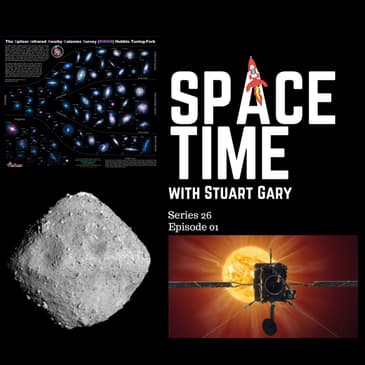
Ever since the Hubble Tuning Fork, sometimes referred to as the Hubble Sequence, which classifies galaxy morphologies was invented back in 1926, astronomers have been refining understanding of galaxy evolution and morphology as technology advances.
For example, by the 1970s, scientists had confirmed that lone galaxies tend to be spiral-shaped.
However, those found in galaxy clusters were more likely to either be spherical and featureless, what we refer to as elliptical galaxies, or flat, lens-shaped lenticular galaxies.
And the new AI computer simulations may finally have vented the decades-long debate about exactly how spiral galaxies evolve to become either ellipticals or lenticulars.
The simulations are showing there's a whole bunch of different things going on when lots the galaxies get packed together.
[2:02] It seems the spiral arms in galaxies are really fragile, and as you get higher densities in galaxy clusters, spiral galaxies start to lose their gas.
And this loss of gas causes them to drop their spiral arms, transforming them into lenticular galaxies.
On the other hand, when two similar mass galaxies merge, as the Milky Way and M31 Andromeda will do in around 4 billion years time, they'll coalesce to form a single large elliptical galaxy.
To reach these findings, the study utilized the powerful Eagle simulations to analyze a group of galaxies in detail, using AI algorithms to classify galaxies by their shape.
[2:43] The neural network-based algorithm can classify about 20,000 galaxies per minute, compressing what typically would have taken weeks into just an hour.
And the results of those simulations closely match what's actually been observed in the real universe, giving researchers the confidence to use the simulation results to interpret observations of galaxy clusters.
But the studies also identified several inticular galaxies outside of the high density regions where they're expected to be found.
And here the modeling suggests that they were also created by the merging of two separate galaxies.
One of the study's authors, Kenji Beke, from the University of Western Australia node of the International Centre for Radio Astronomy Research, says there's been lots of suggestions over time, but this is the first work to put all the pieces of the puzzle together in a single package.
So in this work we try to identify galaxies in the supercomputer simulation.
[3:41] So in this simulation we produce many southern galaxies and then try to classify galaxies into elliptical galaxies and spiral galaxies and then ticular galaxies.
So range-guided galaxies are very interesting objects because they don't have any spiral arms.
[3:57] And this galaxy can be found in cluster environment or group environment. And on the other hand, spiral galaxy can be found mostly in the field environment where the density of galaxy is very, very low.
[4:11] For a key question of the Hubble sequence is why the H-Pillar galaxy can be found mostly in the group or cluster environment.
And this paper discuss this origin. And what conclusions did the simulations show? So simulations show for the very first time that lenticular galaxies can be formed through gas stripping or galaxy merging in a group and cluster environment.
So you've got these spiral galaxies. The spirals are very delicate, aren't they? And lots of gas there.
That's when new stars are being formed. These galaxies, for some reason, are losing their spiral arms and becoming lenticular? So spiral arms can keep their spiral arms due to star formation within the gut.
[4:58] So spiral arms are composed mostly of young stars. If the spiral actually loses their gut, they can no longer form stars, so spiral arms gradually disappear.
[5:11] So spiral galaxy can be transformed into lenticular galaxy without any spiral arm. So gas is very important for the maintenance of spiral arm in galaxy.
So this is a kind of a basic physics.
So in a cluster environment, spiral galaxy can lose their gas by stripping, what we call ram pressure stripping.
So, land pressure slipping is caused by interaction between cold gas within the disk and hot gas in the cluster.
[5:44] So, when the gas galaxy can lose gas, they can also lose their power. So, there's got to be a galaxy cluster nearby and that's drawing the cold gas from within the galaxy itself. Yes, yes, yes.
So, the key physical process is the slipping of cold gas. cold gas can form stars so if the star formation cannot continue, spiral galaxy can lose their.
[6:11] Spiral arm. I guess the other side of the Hubble fork in this case would be elliptical galaxies and I take it that's pretty well understood now it's merging of spiral galaxies that causes them to convert into elliptical galaxies what we're going to become in five billion years from now. Yeah so,
So okay, the galaxy matter can create a different type of galaxy.
If the mass ratio of two galaxies is larger than 0.3, the two spiral galaxies can be transformed into the elliptical galaxies.
[6:42] But the mass ratio of the two galaxies is very small, like 0.1. These two galaxies can become the S-galaxies.
[6:49] So the first one is major mergers. Second one is minor mergers.
So major measure can create elliptical reaction, but minor measure can create ester reaction.
And this minor measure can happen in a field or a small group of reaction.
[7:09] So that's a transformation process from spiral into S0 in a small group or a field environment.
So there are two physical mechanism of ester formation. One is gas lifting in a cluster.
The other is minor matter in a field of small groups.
[7:27] So there are two ways of losing the fire arm. One is just slipping, the other is minor merger. And there is a very important distinction between minor and major mergers in galaxy transformers.
So when we see things like the Sagittarius dwarf galaxy being slowly stripped into the Milky Way, is that considered a minor merger? It's a minima. That's the mass ratio of the Sagittarius dwarf,
to the middle way is too small, less than 0.1. So it's such matter cannot damage the,
Galactic disk.
Okay. So yeah, it's too small. Yeah. It's like mini matter. When you put this artificial intelligence program together, were you looking at a particular epoch of the universe? I mean, today or 10 billion years ago?
We can apply this AI to any red ship.
[8:23] So for this paper, we use AI to classify a galaxy for the red ship zero, the present reverse.
This is one of the innovations of this paper because our AI can classify a galaxy, one thousand galaxies within one second.
That's a huge innovation. So so far, Astronomers have to spend one minute or two minutes per galaxy to classify a galaxy, But for this AI, it takes only one second for one thousand years.
This is the most innovative part of this paper. That's astronomer Kenji Becky from the University of Western Australia node of the International Centre for Radio Astronomy Research.
And this is space time.
Still to come, the asteroid Ryugu sheds new light on the solar system's history and Solar Orbiter solves one of the sun's great magnetic mysteries.
All that and more still to come on Space Time.
[9:16] Music.
[9:31] Scientists studying samples returned to Earth from the asteroid Ryugu have found that it's composed of some of the first solid material in our solar system.
The material is known as Ivernotype carbonaceous chondrites, and it's named after the Iverna meteorite which landed near Iverna in Tanzania back on December 16, 1938.
Iverna is one of only nine known meteorites classified as Ci1 carbonaceous chondrites.
And these all have compositions very similar to that of the Sun, meaning they're essentially unaltered since they were formed about the same time as the solar system itself, some 4.6 billion years ago.
[10:13] Put simply, that means they're some of the most chemically primitive meteorites known. The designation Ci1 means that Iwuna underwent a high degree of chemical change due to the presence of water.
This alteration took place in the parent body of the meteorite at low temperatures, probably around 20 to 50 degrees Celsius in a water-rich environment.
By contrast, chondrites experience thermal metamorphism under dry conditions, usually at temperatures between 600 and 900 degrees Celsius.
The findings reported in the journal Nature Astronomy show that nearly two years after Japan's Hayabusa-2 mission returned samples of the asteroid Ryugu to Earth,
scientists are continuing to reveal valuable new information about the early history of the Solar System.
In this particular study, scientists were looking at the isotopic composition of zinc and copper within Ryugu.
It was these isotopic signatures that showed that Ryugu's composition was close to Iverna-like carbonaceous chondrites.
[11:16] By the way, Ryugu-like material from the outer Solar System accounts for about 5 to 6 percent of the Earth's mass.
So we're finding out not just about the Solar System itself, but also about our own planet.
Meteorites found on Earth give scientists access to samples representing the first moments of the solar system.
However, the return to Earth in December 2020 of the Japanese space agency's Ibusatou mission provided much more than that.
It gave scientists five grams of pristine Ryugu fragments, pieces of another world which have been completely unaltered since their arrival and stay on Earth.
[11:55] The first analysis showed that some isotopic signatures, including titanium and chromium, overlap with other groups of carbonaceous chondrites.
So the details of the link between Ryugu and Avuna-like carbonaceous chondrites wasn't fully understood.
Zinc and copper are two moderately volatile elements, and they're key to studying the process of a creation of volatiles during the formation of terrestrial planets.
[12:20] The different groups of carbonaceous chondrites showed distinct copper and zinc isotopic compositions, with iverna-like carbonaceous chondrites being more enriched in volatile elements.
So by carrying out the additional analysis of the copper and zinc isotopic compositions of Ryugu, scientists wound up with access to a crucial tool for studying the origin of the asteroid.
They found that the isotopic ratios of copper and zinc in the samples of Ryugu were identical to carbonaceous chondrites, but different from all other types of meteorites.
By finally confirming the similarity between Ryugu and carbonaceous chondrites, the study establishes that these primitive samples of this asteroid represent the best estimate for the solar composition to date for copper and zinc.
The 900-metre-wide asteroid Ryugu is classified both as a near or near-Earth object and as the potentially hazardous asteroid of the Apollo group of asteroids whose orbit takes them inside Earth's orbit around the Sun for at least part of their journey.
And that makes them pieces of space rock worth studying. This is space time.
Still to come, Solar Orbiter solves one of the Sun's great mysteries and later in the science report, researchers use artificial human embryos to study how the human spine is created.
All that and more still to come on Space Time.
[13:42] Music.
[13:57] New data obtained by the European Space Agency's Solar Orbiter spacecraft has found compelling new clues about the origins of one of the Sun's great magnetic mysteries known as magnetic
switchbacks and how their formation accelerates the solar wind, the stream of charged particles flowing out from the Sun which encompass and bathe the Earth.
Solar switchbacks are weird.
They're a sudden and large deflection of the solar wind's magnetic field.
Observations by Solar Orbiter provide scientists with a first full view of the structure, confirming the hypothesis that it has an S-shaped character.
[14:35] But it doesn't stop there, the findings also showed that these rapidly changing magnetic fields have their origins near the Sun's surface.
While a number of spacecraft have flown through these puzzling regions before, in situ data has only previously ever been measured at a single point in time.
Consequently, the structure and shape of the switchbacks had to be inferred from plasma and magnetic field measurements taken at just one point.
When the German and American Helios 1 and 2 spacecraft flew close to the Sun back in the mid-1970s, Earth probes recorded sudden reversals of the Sun's magnetic field.
These mysterious reversals were always abrupt and always temporary, lasting from just a few seconds to a number of hours before the magnetic field switched back to its original direction.
[15:21] These magnetic structures were also probed at much larger distances from the Sun by NASA's Ulysses spacecraft in the late 1990s.
But instead of a third of Earth's orbital radius from the Sun, where the Helios missions made their closest pass, Ulysses operated mostly beyond Earth's orbit.
[15:38] The amount of data available, however, has risen dramatically with the arrival of NASA's Parker Solar Probe in 2018. Parker showed that sudden magnetic field reversals were far more numerous close to the Sun,
and that led to suggestions that they were being caused by S-shaped kinks in the magnetic field itself.
And it was this puzzling, the still hypothetical behavior, which earned the phenomenon the name switchbacks. A number of ideas were then proposed to try and explain how they formed.
Early last year, Solar Orbiter was just a day away from its close pass of the Sun, well within the orbit of the planet Mercury, and it was imaging the Sun's outer atmosphere known as the corona.
The particles in the corona are electrically charged, and they follow the Sun's magnetic field lines out into space.
As Solar Orbiter was imaging the corona, it recorded a distorted S-shaped link in the coronal plasma, looking suspiciously like a possible solar switchback.
[16:35] Later comparisons of visible light and extreme ultraviolet images of the event confirm this hypothesis. Usually active regions are associated with sunspots and magnetic activity.
And further analysis showed the speed of the plasma above this region was actually very slow, as would be expected from an active region that's yet to release stored energy.
The observations of the plasma resembled a generating mechanism for the switchbacks, an idea first proposed by Gary Zank from the University of Alabama in Huntsville.
The hypothesis was looking at the way different magnetic regions near the Sun's surface interact with each other. Close to the Sun, especially above active regions, there are closed and open magnetic field lines.
[17:19] The closed lines are loops of magnetism which arch up into the solar atmosphere before curving around and disappearing back deep into the Sun.
Now very little plasma can escape into space above these field lines, so the speed of the solar wind around this area tends to be really slow.
But open field lines are the reverse, emanating from the Sun and ultimately connecting with the interplanetary magnetic field lines of the solar system.
Figure them as magnetic highways, along which plasma can flow freely and give rise to very fast solar wind.
The switchbacks seem to occur where there's an interaction between the region of open field lines and a region of closed lines.
It seems as the field lines crowd together, they tend to reconnect into more stable configurations. Magnetic reconnection is a bit like cracking a whip as it releases lots of energy at the,
same time setting up an S-shaped disturbance traveling off into space.
And it's this S-shaped disturbance passing the spacecraft, which is then recorded as a switchback.
The key observation here was that the switchbacks could be seen emanating from above an active solar region.
[18:28] Late last year, Solar Orbiter made a gravity-assist flyby of Venus in order to adjust its orbit around the Sun.
And subsequent Venus flybys will now start raising the inclination of the spacecraft's orbit, allowing it to access higher latitudes of the Sun, heading more towards the Sun's little understood polar regions, where more mysteries are waiting to be solved.
[18:50] This report from ACTV. Solar Orbiter will help answer fundamental questions about the Sun's activity.
After some 20 years of development, six years of construction and more than a year of testing, engineers have had the challenging task of designing a mission to make detailed observations,
of the Sun, capture the closest ever pictures of our nearest star and the first images of,
the poles.
The spacecraft has a number of key new technologies that have been developed just for the purpose of flying close to the sun.
[19:22] We have a specific heat shield designed just for solar orbiter that will reach temperatures of over 500 degrees centigrade on the front side and will keep things as cool as just about 50 degrees centigrade on the back side to protect the sensitive electronics.
[19:36] The sun generates a bubble of plasma enveloping the entire solar system. as the heliosphere, anything within it, including Earth, is subject to a stream of charged particles called the solar wind.
[19:50] Violent space weather from flares and coronal mass ejections has the potential to damage satellites, disrupt communications and knock out power grids on the ground.
One of the key questions the scientists have is how the heliosphere is actually generated and how it's accelerated, so what is really driving the solar winds.
And the second key question of the mission is understanding what makes the sun change or vary over this 11-year cycle that we all know. So understanding the magnetic properties of the Sun and how this changes over this 11-year cycle is one of the key scientific,
objectives of Solar Orbiter.
To measure the magnetic environment around the Sun, Solar Orbiter is fitted with a suite of 10 extremely sensitive instruments. And so it can take pictures, the heat shield has peep holes through it, covered by protective doors.
[20:44] We are going to places where no other solar telescopes have been before. We are going to be very close to the Sun to take very high resolution images of the Sun, unprecedented spatial resolution.
And we are also going to fly over the poles of the Sun, regions that are very much unknown because we don't see them very well from Earth, but they are the source of the fast solar wind and therefore are very important.
Solar Orbiter will take several years, using the gravity of Venus and Earth to reach its operational orbit.
But once in position, the spacecraft will take measurements that complement NASA's Parker Solar Probe, which launched in 2018.
We will not get as close to the sun, but we will have vastly bigger payload complements, so more instruments with more cameras looking at the sun.
So we will do science that is complementary to solar probe and the two will really have a great deal of synergy.
[21:36] This is Space Time. And time now to take a brief look at some of the other stories making news in Science.
[21:37] Music.
[21:57] This week with a science report.
Have used artificial human embryos to study how a lump of tissue will elongate and form segments creating a spine.
A report in the journal Nature claims scientists created the embryo surrogates from pluripotent stem cells.
These differentiated artificial human embryos when exposed to specific chemical signals. The authors are using these artificial human embryos to model human congenital spine diseases such as scoliosis by disrupting the organism's artificial spines development.
[22:34] The British medical journal has been slammed by scientists and medical practitioners around the world after publishing a meta-analysis study which wrongly claimed that acupuncture helped relieve lower back and pelvic pain often experienced during pregnancy.
[22:49] Dr Steve Novella from Science Based Medicine criticized the analysis, saying the study clearly showed that acupuncture didn't work other than as a placebo.
He says the authors of the study still tried to spin it the other way. He questioned how the authors could have reached their conclusions based on the scientific data they published.
Novella says the meta-analysis was based on just 10 studies. Most of those studies weren't blind, which would have disqualified them immediately.
And none of the studies were double-blinded, which is the accepted standard for scientific research.
The British Medical Journal's analysis also glossed over studies with unfavorable results. Two of the studies it did include had a greater than 20% dropout rate.
The people dropped out because the acupuncture wasn't working, meaning those left were skewing the results.
Neville says the studies were showing publication bias, with the scientifically stronger more rigorous studies which showed less support for acupuncture given less attention, while,
the scientifically weaker, less rigorous studies which were more supportive of acupuncture given far greater prominence.
Importantly, the meta-analysis also failed to show which acupuncture points were being used.
[24:04] That's important because different acupuncture practitioners use different locations on the body because there's no agreement between practitioners about where the acupuncture points are actually meant to be, or for that matter what each point does.
None of the studies shown in the meta-analysis use the same acupuncture points. Avila says that's because they don't really work so it doesn't matter.
It's worth pointing out that the organisations behind these studies in the meta-analysis were the Ku Ming Municipal Hospital of Traditional Chinese Medicine and the third affiliated hospital of the Yunnan University of Chinese Medicine.
And the entire study was funded by the Traditional Chinese Medicine Bureau of Guidan Province.
[24:47] A new study has found that Australian baby boomers, those born in the 1950s and 60s, are still the most likely to use cannabis were it legal.
The findings reported in the Journal of Drug and Alcohol Review looked at the cannabis use of some 160,000 Australians aged between 18 and 79.
The authors found favourable attitudes towards cannabis use have increased over time, moreso in children of the 1950s and 60s than among older or younger generations.
However, the study also found that children of the 90s are beginning to catch up when it comes to their willingness to try cannabis were illegal.
[25:26] Ouija boards have been with us for over a hundred years now, becoming especially popular for teenagers in movie scripts everywhere.
And of course they also make an appearance in real life, especially around Halloween.
While most see it as harmless fun, just to pile a game a while away the hours, others swear by the board's ability to communicate with those who have passed across to the other side.
But Tim Mendham from Australian Skeptics says what the true believers are really seeing is something called the idiomotor effect.
In your youth when you do a séance as you do with your mates, you darken the room, you stick a few candles around. I've been there, done that, yeah. Yeah, you often set up a homemade Ouija board, right?
Well, you write the letters on a bit of paper and you put those around the table, really yes, no.
So it doesn't have to be the upmarket, expensive wooden Ouija boards. They were actually made, a lot of them, by Hasbro, which makes a lot of board games,
by the way, and with a little plonchette thing, a little wooden thing that you did with wheels that you put your fingers on and then moves around.
So, you know, we're just supposed to be channeling spirits who then can read out particular suggestions by going through a letter and spelling out a word or going to yes or no or goodbye actually, if here's one of the options as well.
So you've got a yes and no and then lots of letters around and that's the way you spell out a message.
[26:41] And lo and behold, someone's discovered that people might be manipulating this. Oh no!
I'm the one who usually did that. Yes, didn't we all? And you think, and then you get the argument, no, I didn't push it.
Did you push it? No, I didn't push it. What they're suggesting is not even consciously pushing, it might be unconsciously pushing.
And this is the suggestion that it's something called the idiomotor effect, which is brain over physics, if you like.
Your brain subconsciously wants something to happen, so it manipulates what you do. It's often used as an explanation for how divining rods, dousing rods,
the little sort of bent stick or the bent bit of wire or something, bit of wire or something, why they move and why they cross over etc. But if you look at people who are using those things, their hands tend to move a little bit, only a tiny bit,
because these things are way off center of balance, so a tiny movement subconsciously,
can move dividing rods and the same thing can apply to moving this little planche around.
That's not accounting for the fact that some people are pushing it on purpose like you and me. Yeah, unconsciously people who are sincere might be moving down to a particular result, but probably you get a lot of people who are sincere all doing the same thing at the same time.
They're probably going to get a very sort of a weird result spelling out words that don't exist. They're moving all over the place. Of course, they often move quickly and you don't have to push very hard on these things, these things to move. And so practical joke, idiom motor effect,
not necessarily spirits is basically what this article is saying and I would agree with that.
That's Tumendam from Australian Skeptics.
[28:05] Music.
[28:20] And that's the show for now. Spacetime is available every Monday, Wednesday and Friday through Apple Podcasts iTunes,
Stitcher, Google Podcasts, Pocket Casts, Spotify, Acast, Amazon Music, Bytes.com, SoundCloud,
YouTube, your favorite podcast download provider and from spacetimewithstuartgarry.com.
[28:42] Spacetime's also broadcast through the National Science Foundation on ScienceZone Radio and and on both iHeartRadio and TuneIn Radio.
And you can help to support our show by visiting the Spacetime store for a range of promotional merchandising goodies.
Or by becoming a Spacetime patron, which gives you access to triple episode commercial free versions of the show, as well as lots of bonus audio content which doesn't go to air, access to our exclusive Facebook group and other rewards.
Just go to spacetimewithstewardgarry.com for full details. And if you want more space time please check out our blog where you'll find all the stuff we couldn't fit in the show, as well as heaps of images, news stories, loads of videos and,
things on the web I find interesting or amusing.
Just go to spacetimewithstuartgarry.tumblr.com. That's all one word and that's Tumblr without the E.
You can also follow us through at Stuart Gary on Twitter, at Space Time with Stuart Gary on Instagram, through our Space Time YouTube channel and on Facebook just go to Facebook,
and space time is brought to you in collaboration with Australian Sky and Telescope magazine, window in the universe.
You've been listening to Space Time with Stuart Gary. This has been another quality podcast production from Bitesz.com.