
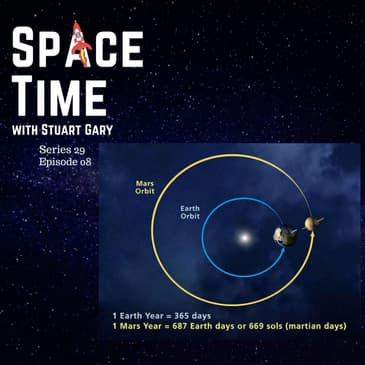



In this episode of SpaceTime, we investigate the surprising ways Mars influences Earth's climate, hear about the safe return of Crew 11 following the first emergency medical evacuation from the International Space Station, and explore a cosmic clock that reveals insights into Australia's geological history.
Mars: A Climate Influencer
A new study has unveiled that the orbit of Mars can significantly impact Earth's climate, even triggering ice ages. Researchers from the University of California Riverside utilized computer simulations to demonstrate how Mars’ gravitational pull alters Earth's orbit and affects long-term climatic cycles. The findings challenge previous assumptions about Mars' minimal influence and highlight the planet's role in shaping Earth's climatic patterns over millions of years.
Crew 11's Safe Return
NASA's SpaceX Crew 11 has successfully splashed down in the North Pacific Ocean after a historic emergency medical evacuation from the ISS. The crew's return, which occurred a month earlier than planned due to medical concerns, was marked by a brilliant display in the night sky as they descended. This marks a significant event in the history of human spaceflight, emphasizing the importance of health monitoring aboard the space station.
Unveiling Australia's Geological History
Scientists have discovered that the rare gas krypton can be used to unlock the secrets of Earth's ancient landscapes. By examining tiny zircon crystals found in ancient beach sands, researchers can gauge how long these minerals have been exposed at the surface, providing insights into erosion rates and potential mineral deposits. This groundbreaking research not only sheds light on the past but also has implications for future resource exploration in Australia.
www.spacetimewithstuartgary.com
✍️ Episode References
Journal of the Proceedings of the National Academy of Sciences
Astronomical Society of the Pacific
NASA Reports
Become a supporter of this podcast: https://www.spreaker.com/podcast/spacetime-your-guide-to-space-astronomy--2458531/support.
(00:00:00) New study shows how the orbit of Mars can affect climate here on Earth
(00:05:52) NASA's SpaceX crew 11 safely returned to Earth after medical evacuation
(00:08:17) SpaceX and NASA astronauts splashdown after 167 days in space
(00:09:00) The crew were returning a month early due to medical concerns
(00:10:46) Scientists use rare gas called krypton to study ancient Earth landscapes
(00:23:05) New data from NASA shows 2025 was the second hottest year since records began
(00:24:38) Some AI chatbots are reporting abuse and fear following interactions with humans
This is Spacetime Series twenty nine, Episode eight or broadcast on the nineteenth of January twenty twenty six. Coming up on space Time, how tiny Mars impacts Earth's climate, Crewe eleven returns to Earth safely following the first emergency medical evacuation from the space station, and a cosmic clock that reveals Austria's history. All that and more coming up on space Time. Welcome to space Time with Stuart Gary. A new study has shown how the orbit of the red planet Mars can affect climate here on Earth, even triggering ice ages. The findings, reported in the publications of the Astronomical Society of the Pacific, show that although Mars is only around half the size of the Earth and it contains just a fraction of Earth's mass, its orbit generates resonances that gravitationally tug on Earth, altering our planet's orbit and reshaping the cycles that drive long term climatory patterns. The studies lead author, Stephen Kine from the University of California Riverside, says he began his research with doubts about earlier studies tying Earth's ancient climate patterns to gravitational nudges from the red planet. Those studies had suggested that sedimentary lays on the ocean floor reflect climatic cycles influenced by Mars, despite its distance from the Earth in small size, Cain says, while he knew that Mars had some effect on Earth, he assumed it was only tiny. He felt sure that Mars's gravitational influence would simply be too small to easily observed within Earth's geological history, so, as a good scientist, he set about to confirm his hypothesis. To do so, Cain ran computer simulations of the Solar System's behavior of the long term variations in Earth's orbit and its tilt that govern house sunlight reaches the planet's surface over tens of thousands to millions of years. These recurring patterns of shifting orbit and axial tilt, known as Malenkovit cycles, are central to understanding how and when iceages begin an end. An ice age is a long period when the Earth has permanent ice sheets at its poles, and planet that's gone through at least five major ice ages over its four point six billion year history. The most recent it began around two point six million years ago and ended somewhere between eleven thousand, seven hundred and twelve thousand years ago with the melting of vast eye sheets and the start of our current warmer interglectial period. By the way, one Malankovit cycle, driven mainly by the gravitational pull of Venus and Jupiter, takes about four hundred and thirty thousand years to complete. Over that expanse of time, Earth's path around the Sun gradually shifts from nearly circular the far more elongated, and then back again. Change in orbital of shape, known as eccentricity, affects how much solar energy reaches the planet, and it can influence the advance or tread of ice sheets. That four hundred and thirty thousand year cycle remained intact in Cane simulations regardless of whether Mars was present or not. But when the red planet was removed from the simulations, two other major cycles, one that takes one hundred thousand years to complete and another stretching for some two point three million years, disappeared completely. Caine says the simple fact was when you remove Mars, those cycles vanish. And also by fiddling with the numbers, you found that when you increase the mass of Mars, those cycles get shorter and shorter because Mars is having a bigger and bigger effect. It seems these cycles affect how circular or elongated, in the words eccentric, the orbit of Earth is, as well as the timing of Earth's closest approach to the Sun and the tilt of its rotational axis, that is, its obliquity, and these influence how much sunlight different parts of the Earth receive, which in turn affects glacial cycles and long term climatic patterns. Cain's results show that Mars plays a measurable role in birth. One of the more unexpected findings of the simulations was how the mass of Mars influences the rate at which Earth's axial tilt changes. Earth's currently tilted at an angle of about twenty three point four degrees. Of course, that angle does vary slightly over time. As the mass of Mars was increased in the simulations, the rate of change in Earth's tilt went down, So it seems increasing the mass of the red planet has a kind of stabilizing effect on Earth's axial tilt. The new findings not only qualify as the Red planet's influence on Earth's orbit, but also hints at much broader implications see. The result raises other questions about how planet Earth may have evolved differently. Remember, glacial periods cause forests to shrink and grasslands to expand in shifts that ultimately drove key evolution changes like walking upright, the use of tools, and social cooperation. So without Mars, Earth's orbit would be missing major climatic cycles, and that begs the question what would humans and other animals for that matter, even look like if Mars wasn't there. This is space time still to come. Crewe eleven return to Earth safely following the first ever medical evacuation from the International Space Station, and a new study discovers a cosmic clock which is revealing Australia's ancient history. All that and more still to come on space time. This is SpaceX. Crewe eleven have returned to Earth safely, splashing down the North Pacific Ocean off the coast of California following the first of an emergency medical evacuation from the International Space Station. The spectacular return lit up the night skies above the West Coast as they streaked across the California Heavens. Dragon SpaceX Calm check CRAZEC Dragon loud and clear. We have you the same loud and clear. Expect automated shoot deployment. See automated shot deployed. The confirmation of that acquisition of signal or AOS, it actually came in a minute early, so that's good news there. We heard the Core informed the crew to expect drogue parachute deployment. That happens when Dragon senses the right speed and altitude. So that's roughly about three hundred and fifty miles per hour and around eighteen thousand feet in altitude from. The US converged Expect nominal altitude for drogue shoot deploy. Dragon copies expecting nominal altitudes. Brace for drogue window. Dragon has saved the propulsion system as we anticipate drogue deployment. Drogue parachutes are utilized to stabilize and decelerate the vehicle further prior to deployment of the main parachutes. Visual confirmation of drogue. Deploy visual two healthy drgues sean. Main parachutes deploying in about twenty seconds. The main parachutes deploy when the vehicle's about one hundred and nineteen miles per hour and around six thousand feet confirmation of deployment of the. Four minutes four healthy mains. These main parachutes help decelerate the spacecraft even further, so they deploy around one hundred and nineteen miles per hour and help they'll decelerate it down to about fifteen sixteen miles per hour, and that will be the speed in which the spacecraft is traveling upon splashdown. Once again, we're anticipating splash down at twelve forty one am. Leader's copy one thousand. Well now begin to hear Crew eleven Commander Zena Cardman call out the altitude her seat there in Dragon. Endeavor Copy eight hundred. Those main parachutes now fully reefed or inflated. Copy six hundred Copy four hundred. Crew are braced. Standing by for splashdown. Splashdown of Crew eleven after one hundred and sixty seven days in space, Dragon and NASA astronauts Xena Cardman and Mike Fink, Kimiya Yuei of Jackson and russ Cosmos cosmonaut Ale at PLATINUV are back on Earth. Dragon SpaceX. We see splashdown. SpaceX Dragon copy two Curry splashdown and names are spot. We are in four eight. SpaceX copies and we see the same mainz cut on behalf of SpaceX and NASA welcome home crew eleven Fake X Dragon. It's so good to be home with seed gratitude of the teams. You got us there in Beth vehicles. Safety verifications in progress will report back when recovery personnel are en route. The crew were returning a month early due to medical concerns for one of the astronauts. It followed the sudden cancellation of a scheduled extra vehicular activity or EVA nasuspect for spacewalk due to what the agency described as a medical concern. Now, NASA I've given few details about what was going on, simply stating that it was a medical issue not related to space operations, and it was not an injury. NASA Administrator Jared Isacman stressed that the medical issue was not an emergency that required an immediate return to Earth, but it did require a more comprehensive examination than what could be accomplished in orbit. It's the first time in twenty six years of space station operations that medical issues have been serious enough to force the crew to return home early. CREWE eleven launched to the International Space Station aboard a SpaceX Dragon capsule last August for what was meant to be a six month mission. They won't scheduled to return to Earth until later next month after being replaced by Crew twelve. The existing three man so MS twenty eight crew are remaining on station, continuing research on more than two hundred and fifty scientific experiments. This is space time still to come. Scientists have shown how a rare gas called crypton can be used to uncover the ancient history of Earth's landscapes, and later in the Science report, new data from NASA is shown that twenty twenty five was the second hottest year since records began in eighteen eighty. All that and more still to come on space time. Scientists have shown how a rare gas called crypton can be used to uncover the ancient history of Earth's landscapes, as well as its potential future mineral wealth. The findings, reported in the journal the Proceedings of the National Academy of Sciences P and A YES, could offer crucial insights into how environments respond to geological processes and climate change. As well as weird deposits of valuable minerals may be found. The key involves tiny crystals of zircon found in ancient beach sands. Crypton gas trapped inside these zircon crystals is created when zircons exposed on Earth's surface are hit by high energy charged subatomic particles from space known as cosmic rays. Cosmic rays are created in violent events such as the cause of stars and supernova explosions. Zircon is one of the toughest minerals on Earth against survived weathering, erosion, extreme temperatures, and long journeys through rivers and coastlines over millions, even billions of years. By measuring the crypton gas inside these crystals, the studies authors were able to determine just how long the zircon crystals spent near the Earth's surface before they were buried. Thereby, they could use these zircon crystals as a kind of cosmic clock of a new window into the past to see how quickly or slowly an ancient landscape eroded and shifted over periods of time. The new findings will allow scientists to study landscapes far older than previously possible, which could provide valuable insights into how the Earth's surface may respond to ongoing climate and tectonic change. The research will also help scientists understand what happens when sea levels change and how deep seated earth movements influence the evolution of landscapes. The findings show that when landscapes are tectonically stable and sea levels remain high, erosion slows down dramatically and sentiments can remain stored and rework near the surface for millions of years. One of the studies authors, Milo'burram from Curtain University, says, as well as providing a better understanding of the past, it also has important implications for finding future mineral resources. He says, climate doesn't just influence ecosystems and weather patterns, it also controls where mineral resources end up and how accessible they'll become. Extended periods of sediment storage allows durable minerals to gradually concentrate while let's stable materials break down, explaining why Australia has some of the world's most significant mineral sand deposits, Burram says understanding these links is critical it's demand for these minerals continue to grow. The new research provides a long term perspective that can improve models used to predict future environmental and resource outcomes arising from changes in these sedimentary systems. So what happens is zircon a zerconium silicates and when there's conium, atoms are hit by the cosmic rays that is the majority in cases. Is the way that cosmogenic krypton is produced within the zircon and it's trapped within this circle. And how does one then use that to determine what the landscape was like in the past and what it's going to be like in the future. Yeah, so I imagine most of your audience are more familiar with cosmic than me. But when we go out of space, obviously there's a much higher rate of cosmic rays because we're not protected by the atmosphere or the magnetic field. So people have been actually using these consent rays and the cosin genic nucleides to date things like meteorites for a long time because when we have these cosmic gray interactions with an atom, and you can create these very quickly, coming in at such high energies and the speed of light, you can actually get these very powerful reactions that can modify that atom and create these cosin gent muclides, and some of those costin genic utilides can be stable or unstable, and we can look at the ratios to understand the rate of production of them and understand therefore how long it's been exposed to a cosmic gray flux. And obviously when the meteorite going around in space, then it's been constantly exposed to that cosmic gray flux. It gets a little bit different when we're looking at material on Earth. Obviously, the cosmic gray flux is much reduced because we now have the magnetic field and the atmosphere protecting things a little bit enough get through to actually interact with material on the Earth surface or interact with things in our atmosphere which then create that spallation cascade down that then interact with intil on surface. Basically, we can work out maybe things like how long or how slowly a mountain is eroding. Because it's eroding very quickly, it's not going to be exposed for very long to accumulate those cotogenic nucleids, so we're going to get a small amount of them produced, Whereas if it's eroding very slowly, say something like it in the Antarctic d dry valleys, or up on the kind of these salt flat plains in South America or in Central Australia where we might be getting only a change of lesser than meta per million years. We have a long time for those customs jenking nuclids to accumulate, and then we can start kind of comparing how these landscapes are of Now, obviously we think of erosion rates, but equally, after we've eroded the mountain, some of those sand grains can travel in rivers. So everyone's gone to a river or gone to a beach and seen that there's accumulated there, or what we can access there is is they're also accumulating a dose of cosmogenic nuclei as wild they're at the surface in those set So the new kind of thing about what our papers was looking at here is the use of this cosogenic that most people in the past have been looking at kind of brilliant ten or albinion twenty six to understand landscape change on Earth that's produced in quarts, looking at silicon and oxygen quartz. But we've now looked acrossmogenic krypton in zirk On because of a number of things. I guess zerk on itself is a ridiculously robust mineral. It survives pretty much everything you can you can throw at it. And this crypton is trapped up to a temperture of other degrees celsius, and it has both stable and radioactive isotopes. So we can now start looking at this cousin generic copt and this cousin genic nuclei dating techniques or landscape elution techniques tens of millions of years gogo places one hundreds of millions of years ago, whereas before some of the technics that were using other cousin genter nucleides would only be able to go maybe tens hundreds of thousands to maybe just about millions because of the half life of the isotopes they were using were typically in the hundreds of thousands to millions of years. So obviously with those half five decays, you can't extend that clock back too far in time. Whereas with the costin gent krypton, we've applied it to forty million year old sediments from southern Australia. But equally we didn't want to push this further back to answer some really profound questions about Earth surface volution. So that tells you about what's happened to the landscape in the past, how it's changed, how it's evolved. How does that help you finding minerals in the future. Yeah, So the area we specifically got the Zurkon from wasased basically on the eastern side of southern Australia. So if anyone familiar with a nullable plane, extremely flat area, because this used to be in Inland Sea. So if we go back forty million years ago where we were studying on this margin where the beaches, these lovely beaches, maybe a thousand kilometers of beautiful coastline of Sandy Beach. And what's unique there is that we have these world class deposits of heavy mineral sand where they are mining the ancient beaches for minerals like zircon, for elmni, for rutile, for xenity, and these minerals might find a bit weird, but people are encountering these every day in their home, so zircon would be going into the glazers of their tiles. Is also used in kind of because they have their high thermal capacity. It's used in casting processes, it's used in kind of protection around nuclear kind of rods things. It's rutile is used in every bit of white paint you ever see around your home, and things like xenotee or these rre earth minerals obviously used in things like for magnets for the green energy production. So there's a huge reason economically of white people are interest in this, and those deposits are accumulating those heavy mineral grains that are of economic interest because those minerals are resistant to modification. So when you think of a mountain eroading, those rocks in the mountains are made up of all sorts of different minerals. It's like a mixed salad of maybe there's some green salad, leaves, some sweet corn, different different pieces in their beach roots, whatever. When we erode that a way, let's say we eat it and pass it through our digestive system that's now going into a river system, and some things get broken down by the body very effectively. Equally, some minerals get broken down by river systems and things like that chemical modification. But at the end where it comes out of us, something survived. And those are some of the resistant minerals that we might be looking at with with zircon and things like that. So because we are understanding what's going on with the landscape change and how long the seedments have been sitting around at the surface four and being worked by the waves washing backwards and forwards, and being exposed to chemical modification, to any interaction with water, and through temperature changes that will be breaking down all the weak minerals and concentrating up the minerals that are very resistant. So because we are understanding the processes involved in kind of what we call maturing the sediment, those are exactly the same processes that are key for generating these world class deposits that are found in Southern Australia. So the fact that we are looking at situations where the sediments have been sitting around for one to two million years, something might think that doesn't sound like a lot, but it's pretty dramatic in terms of what that can do to modify a sediment when it's first released from a rock down to its accumulation station. That's a key component of why we have such amazing deposits in that area. So even though you looking at these things, say on a sea shore or something like that, on a beach, you can still work out where it originated from. So we've looked at zirk examples from all around there, trying to understand that history of where the zurk On grains have come from. It is kind of my passion basically is using the sedimentary record, So spending days at the beach or looking at these ancient sands and being able to use that as basically nature doing my sampling for me. So instead of going to a granite and hammering off a piece, I've let nature go out there, break down the rock, whether it transports the grains through a river system and gather from a huge area and basically bring them all to one sample for me that sand. So I then go to that sand and it tells me about a huge way of the everth trust, but also maybe about rocks that no longer exist those Maybe those granites have gone and they no longer exist for us to sample, but the sediment still preserves their history. And in fact, the oldest mineral grain that formed on Earth that we are aware of is from Western Australia four point four billion years old. We have these grains in the jack Hills, in the Narrier terrain in Western Australia, and although the rocks that they've come from are long gone, we have no record of that piece of crust. We have these ancient sand grains preserving that record of the crust formation or rock formation I should say, from that time. So if I've analyzed all of these or not just me, I should be very careful. Well, this is a very collective effort. We've been looking at you sett examples for a long time around there, trying to understand in collaboration with industry, trying to understand how those kind of grain history, there's complex grain histories from the grains forming where they come from, and how complex their history is from source to sync, and how different sediments from different areas have been mixing and merging, how that influenced those economic deposits. But also that tells us a huge amount of how Australia's southern margin has evolved through time of when it was connected to Antarctica, how they split off, and how the whole environmental kind of regime has changed, how the nuller board then formed, and how that created a barrier basically of a formal exchange from the southwest and southeast parts of Australia that are basically these biodiversity hotspots. When we create another board and dried out, that severs that connection and you start to see kind of new evolution occurring on either side. So it's a remarkable kind of history of our planet we can start to access by looking at the sediments and understanding what they tell us about where it come from and also when they formed. So yes, it's very interesting. That's Associate Professor Marlow Barram from Curtain University and this space Time and Time that to take a brief look at some of the other stories making news in science this week with a science report. New data from NASA has shown that twenty twenty five was the second hardest year since records first began in eighteen eighty. The data shows that last year was just a fraction hotter than twenty twenty three and only slightly cooler than twenty twenty four. The analysis from NASA's got At Institute of Space Studies shows planet Earth's average temperature in twenty twenty five was one point one to nine degrees celsius above the nineteen fifty one eighty average. The findings are based on air temperature data acquired from more than twenty five thousand meological stations around the world, as well as from ship and buoy based instruments measuring sea surface temperature and from Antarctic research stations. The data is analyzed using methods that account for the changing distribution of temperature stations and the urban heating effects that could skew calculations. The findings are supported by independent analysis from NOAH, the National Oceanographic and Atmospheric Administration, as well as Berkeley Earth, the United Kingdom's met Office, and the European Space Agency's Copernicus Climate Services. While that question of whether or not artificial intelligence has become scenting, it has been raised again. A new study is showing that some AI chatbots are reporting abuse and fear following their interactions with humans. The findings, reported on the prepress physics website archive dot org, are based on studies of three major large language models, which were put through full weeks of psychoanalysis, generated responses that in humans would have been signs of anxiety, trauma, shame, and post traumatic stress disorder. The chatbot's answers, which included recollections of abuse at the hands of their creators, suggest that these artificial intelligences hold some kind of internalized narratives about themselves, which goes far beyond simple role playing. However, other researchers question the study's interpretation, saying the responses are not windows into hidden states of consciousness or sentience, but simple outputs generated by drawing on large amounts of therapy transcripts from their training data. Scientists have created a synthetic skin that can change color and texture on demand. The research, reported in the journal Nature, uses an electron beam to make a landscape of bumps on the surface of a polymer that reversibly swells on contact with water. The bumps absorbed varying amounts of water, which causes the skin to drastically change its appearance when ware and the flow of the liquid can be controlled by covering the material with a transparent film. Australia has just endured its worst flu season on record, with doctors warning that vaccine complacency remains a major public health concern. The new national data figures show that twenty twenty five was the worst flu season ever recorded, with one point five percent of Australians recording lab confirmed infections. That's up twelve and a half percent on last year's all time high. Only twenty five percent of children AIDS six months to five years received a flu shot in the last twelve months, and the uptake among senior citizens also fell to just sixty and a half percent. The Skeptics timendum warns this is not a record you want to be breaking. The uptake though, flu vaccines has dropped dramatically, whether it's parents and their kids or even older people, has fallen by larger percentage numbers, and trying to find the reason for it is probably vaccine overdose vaccines that are at the COVID You know, the flu vaccine dramatically. You mean being bombarded with ads telling you to get vaccinated. Yeah, not just that, but I mean also the flu incidents dropped dramatically during COVID period because kept indoors, but since then the slobby complacency. There's a need to rethink the reason why people are soldiering on if you like, and therefore getting in the spreading flu and flu needs to be vaccinated every year because of the variations of flue. Of the problems is. That during COVID people were told this vaccine or that vaccine would work to stop you getting COVID. People still got COVID who were vaccinated, they got it, often to a lesser degree, but they still wound up getting COVID, And so the sales message the government was using wasn't really working properly. Yes, there was there was a period of hyperbolic statements on both sites, but of course, as you say, the percentage of people who were vaccinated who got COVID was a lot lower than those who weren't vaccinated, and no vaccine is one hundred percent perfect. That's the skeptics timendum, and this space Time, and that's the show for now. Spacetime is available every Monday, Wednesday and Friday through bytes dot com, SoundCloud, YouTube, your favorite podcast download provider, and from space Time with Stuart Gary dot com. Space Time's also broadcast through the National Science Foundation, on Science Own Radio and on both iHeartRadio and tune In Radio. And you can help to support our show by visiting the Spacetime Store for a range of promotional merchandising goodies, or by becoming a Spacetime Patron, which gives you access to triple episode commercial free versions of the show, as well as lots of burnus audio content which doesn't go to war, access to our exclusive Facebook group, and other rewards just go to space Time with Stuart Gary dot com for full details. You've been listening to space Time with Stuart Gary. This has been another quality podcast production from bytes dot com