



This episode of Spacetime is brought to you with the support of Squarespace...when it's time to get online, it's time to visit Squarespace. Free trial. To find out more visit squarespace.com/spacetime
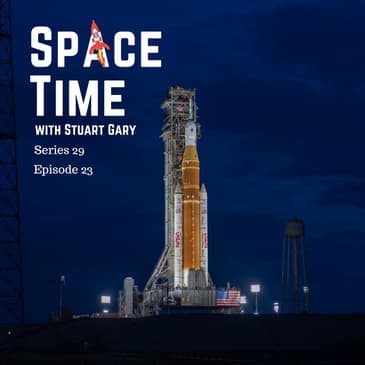
SpaceTime with Stuart Gary Gary - Series 29 Episode 23
In this episode of SpaceTime, we investigate the discovery of a nearly invisible galaxy dominated by dark matter, the latest delays in the Artemis 2 mission to the Moon, and the anticipated launch of Australia's new hypersonic scramjet.
A Dark Matter Galaxy Unveiled
Astronomers have identified an almost invisible galaxy, catalogued as CDG2, located in the Perseus galaxy cluster approximately 300 million light years away. This galaxy is believed to be composed of about 99% dark matter, making it one of the most dark matter-dominated galaxies ever detected. The findings, published in Astrophysical Research Letters, reveal that dark matter constitutes roughly 80% of the universe's total matter, and CDG2's faint presence was confirmed through observations of its globular clusters using NASA's Hubble Space Telescope and the European Space Agency's Euclid Space Observatory.
Artemis 2 Mission Delayed Again
NASA has announced another delay for the Artemis 2 mission, which aims to return humans to lunar orbit for the first time in over 50 years. A helium leak discovered in the Space Launch System (SLS) rocket's upper stage has prompted the agency to roll back the launch vehicle to the vehicle assembly building for repairs. This setback eliminates the potential for a March launch, with the next available windows opening in early April. The Artemis 2 mission will carry a crew of four on a 10-day journey to the Moon, including critical system tests and satellite deployments.
Australia's Hypersonic Scramjet Launch Imminent
An Australian company is set to test its new hypersonic scramjet-powered aircraft, the Dart AE, before the end of the month. This innovative vehicle will utilize a 3D printed Spartan Scramjet engine, designed to operate at speeds exceeding Mach 5 with liquid hydrogen fuel. The mission, codenamed Cassowary Vex, will launch aboard a Rocket Lab electron rocket and aims to validate the scramjet propulsion system under real hypersonic flight conditions while producing zero carbon emissions.
www.spacetimewithstuartgary.com
✍️ Episode References
Astrophysical Research Letters
Become a supporter of this podcast: https://www.spreaker.com/podcast/spacetime-with-stuart-gary--2458531/support.
Versus Spacetime Series twenty nine, episode twenty three, well broadcast on the twenty third of February twenty twenty six. Coming up on Spacetime, have astronomers discovered a dark matter galaxy, another launch delay for the Artemis to a mission to the Moon, and Australia's new hypersonic scramjet expected to launch this month. All that and more coming up on Spacetime. Welcome to space Time with Stewart Gary. Astronomers have discovered an almost invisible galaxy that may be composed of some ninety nine percent dark matter. The galaxy catalog as CDG two was detected in the Percius galaxy cluster some three hundred million light years way. The findings, reported in the journal Astrophysical Research Letters, suggest it's one of the most heavily dark matter dominated galaxies ever detected. No one knows exactly what dark matter is. It doesn't reflect, emit, or absorb light, but scientists know it exists because they can see its gravitational influence on normal matter, preventing galaxies from flinging a part as they revolve and magnifying distant objects through gravitational lensing. Observations suggest it makes up at least eighty percent of all the matter in the universe, meaning everything we see from stars, planets, and comets through the trees, cars, houses, and people make up less than twenty percent of the universe. Our leading candidates for dark matter are things called weakly interactive massive particles or whimps, which are unidentified elementary subatomic particles. The problem is we've not yet found anything that comes even close to matching the description of the substance. In the vast tapestry of the universe. Most galaxies shine bright across cosmic time and space, Yet there's a rare class of galaxies that remain nearly invisible, low surface brightness galaxies dominated by dark matter and containing only a sparse. Scattering of faint stars. The studies authors believe that CDG two may be one such elusive object. Detecting such faint galaxies is incredibly difficult. Astronomers were able to identify ten previously confirmed low surface brightness galaxies and to additional dark matter galaxy candidates by searching for tight groupings of globular clusters compact spherical star groups typically found orbiting normal galaxies. These clusters can signal the presence of faint hidden stellar populations. To confirm one of the dark matter candidates, astronomers employed a tray of observatories nassas, Hubble Space Telescope, the European Space Agency's EUCLID space observatory, and the ground based Subaru telescope in Hawaii. Hubble's high resolution imaging revealed a close collection of four globular clusters in the Perseus galaxy cluster. Follow Up studies using Hubble, Euclid and Subaru then revealed a faint, diffuse glose surrounding these star clusters, strong evidence of an underlying galaxy. The steadiesly authored David Lae from the University of Toronto, says this is the first galaxy detected solely through its globular cluster population. He says the underlying conservative assumption is that these four clusters represent the entire globular cluster population of CDG two. Preliminary analysis suggests that CDG two has a luminosity of roughly six million sun like stars, with the globular clusters accounting for about sixteen percent of the visible content. Remarkably, ninety nine percent of the galaxy's mass, which includes both visible matter and dark matter appeace to be dark matter. Much of its normal mass to enable staff formation, primarily hydrogen gas, was likely stripped away through gravitational interactions with out the galaxies inside the Perseus cluster. Globular clusters possess immense still a density and a gravitationally tightly bound together, and that makes globular costs more resistant to gravitational tidal disruptions and therefore reliable traces of such ghostly galaxies. This report on CDG two from MESSTV. Across the universe, galaxies shine like scattered jewels, vast collections of stars lighting the darkness. But hiding among this brilliance are ghosts galaxies so faint they nearly vanish into the void. These are low surface brightness galaxies, collections of dim stars dominated almost entirely by dark matter. Dark matter is a mysterious invisible substance that makes up the bulk of our universe. Astronomers study being the Perseus galaxy cluster found one of the darkest yet, a faint smudge known as CDG two. Detecting it was like spotting a black cat in a coal bin. Scientists uncovered CDG two not by its light, but by its companions ancient globular clusters. These densely packed spherical star groupings typically orbit larger galaxies. Researchers found a small increase in the density of these clusters, suggesting the existence of an underlying faint galaxy pulling them together. Using NASA's Hubble Space Telescope, ysa's Euclid Observatory, and the Subaru telescope in Hawaii, astronomers confirm CDG two's faint halo of diffuse lights surrounding four of these compact globular clusters. Preliminary analysis suggest CDG two as the luminosity of roughly six million sunlike stars, with the clusters comprising about sixteen percent of its visible matter. The galaxy's total mass, including both visible and dark matter, is overwhelmingly dominated by dark matter, which is ninety nine percent of the total. Much of CDG two's normal matter, primarily hydrogen gas, was likely stripped away by gravitational interactions within the perseus cluster. Globular clusters are more resistant to such disruption because they are so densely packed together and gravitationally balanced. With the ongoing efforts of Hubble and companion observatories such as WEB and the upcoming Roman Space Telescope, Astronomers will continue uncovering these hidden realms, galaxies made not of what we can see, but of what holds the universe together. This is space time still to come. Another launch delay for the atomis to emission to the moon, the first solar eclipse for twenty twenty six, and Australia's hyposonic Scramjet expected to launch this month. All that and more still to come on space time. This podcast is brought to you by squarespace. If you want to look polished online without any headaches, square space is the only one website platform that helps you claim your domain, build a beautiful site, showcase what you do, and get paid all from the one place. I guess you can think of square space sort of like a tidy roommate for your business. It handles all the scheduling crumbs, the unpaid invoices under the couch, and actually answers the door when customers knock. If you offer services, consulting, classes, events, whatever you call your expertise, square space makes booking and getting paid straightforward. Built in appointment scheduling, professional invoices, and secure online payments means you can spend less time juggling spreadsheets and more time doing what you love. And now for the showstopper design square Space's blueprint A one will sketch a fully customized site for you based on a few simple questions, industry personality goals, and then hand you a polished copy in the layout to tweak. But if you preferred DYI, well, you can choose an award winning template drag and drop and watch your brand grow from works in progress to stop the scrolls in just minutes, no coding tantrums required, So why not try it for free at square space dot com slash space time and when you're ready to launch, use the offer code space time to save ten percent of your first purchase of a website or domain that square space dot com slash space time and the promo code space time and remember you'll find the links in our show notes. NASA is expected to scrub the targeted March six launch date with the ITEMIS two mission, which will return humans to lunar orbit for the first time in over half a century. The agency's preparing to roll back the items to launch vehicle to the vehicle assembly building following the discovery of a helium leak in the SPA base launch system SOLS rocket upper stage heliums and inert gas used to maintain pressure in the liquid hydrogen and liquid oxygen propulsion tanks as fuel is used up now. The helium system worked normally during both wet dress rehearsals, but during a routine vehicle pressurization operation, mission managers suddenly discovered they couldn't get healing to flow through the vehicle. The same issue developed during the countdown for the unmanned Artemus I mission, which flew around the Moon and back to Earth in November twenty twenty two. The wet dress rehearsal involved loading two point sixty five million liters of cryogenically cooled liquid hydrogen and liquid oxygen into the rocket, and then proceed with mimicking the final stages of an actual launch countdown, with automated systems taking control of countdown operations, vinyl checks of flight computers, engine bleed systems becoming operational, and all ground support equipment running as the rocket transitions to internal power and the countdown proceeds towards a simulated engine start. Right now the rocket is safe, engineers have switched to a ground based PERG system instead of the on board helium supply while they investigate. Now there are several possible causes which are being examined. One is a filter in the ground to vehicle umbilical, another is the quick disconnect interface between ground and the vehicle, and a third is an internal check valve on the upper stage of the rocket. That's what happened with artemis Ian. The problem is all these components are inaccessible on the launch pad, meaning repairs can only be done inside the vehicle assembly building. So NASA is now preparing to roll back the rocket, and officials have confirmed such a move will remove any March launch window from consideration. Now. If a March launch is scrubbed, the next window opens on April the first, with alternatives between April the third and the sixth, and again on April the thirtieth. The announcement follows the completion of a successful wet launch dress rehearsal last week at the Kennedy Space Center in Florida. It comes in the wake of an earlier dress rehearsal in January, which was plagued by hydrogen leaks on the interface between the massive ninety eight meter tall SLS Space launch System Moon Rocket and the launch pad infrastructure. Excessive hydrogen quickly built out near the base of the launch vehicle during the previous dress rehearsal in January, forcing mission managers to twice halt fuelly try and resolve the issue. The problem is, while hydrogen is an efficient propellant for rockets, its molecules are so small and light they can easily escape even the tighter seals. A similar issue developed during the Atoms one mission. Hydrogen was also the key propellant used during the Space Shuttle program, and engineers were able to resolve those problems back then. Attempts to resolve the issue during January's wet launch dress rehearsal involved stopping the flow of liquid hydrogen to the core stage, allowing the interface to warm up for the silts to receipt, and then adjusting the flow of the propellants. However, replacing the components for this latest stress rehearsal appears to finally resolve the issue. Shoes encartered during the January wet dress rehearsal included several radio communications dropouts and problems with the cameras due to cold weather. There was also a sticking valve on the Orion spacecraft crew module hatch pressurization system, which had to be replaced and then retalked. That'll be more important than ever for Artemis two because, unlike the Artemis one test flight back in twenty twenty two, Artemis two will carry a crew of four people. After launch, they'll spend a day in Earth orbit testing systems aboard the Orion spacecraft, including live support, avionics, maneuverability, and docking ability, as well as crew radiation protection. Then, if all goes well, they'll ignite Orion's main engine undertaking a trans lunar injection burn, which will send them on a four day journey to the Moon. A number of experiments in the deployment of five satellites will also take place during the flight. Orian will travel around the Moon, swinging out to between six and a half and nine and a half thousand kilometers beyond the lunar farcide, and that will make it the furthest Um have ever traveled from the Earth. They'll have several hours to study an image lunar farcide for undertaking another man engine burn to bring them back home. Overall, The mission will last ten days, with splashdown in the North Pacific Ocean off the California coast. The Artemis program is setting the stage for man's return to the lunar surface on the Artemis Iree mission in twenty twenty eight. There'll also be a new space station called Lunar Gateway in Sis lunar orbit, acting as a sort of jumping off point for regular missions down to the lunar surface, and together Artemis and Lunar Gateway will provide the foundations for both a permanent human presence on the Moon and eventually man missions to Mars and beyond. This is space time still to come, the first solar eclipse for twenty twenty six and Australia's hypersonic scramjet expected to launch this month. All that and more still to come on space time. Parts of Antarctica have played host to a spectacular annular solar eclipse. Annular eclipses occur when the Moon passes between the Earth and the Sun, but it happens at a time when the Moon is near apergen its orbit, meaning it's a bit further away from the Earth than average. Therefore, it appears to be slightly smaller than average, and that means it can't cover the entire face of the Sun a scene from Earth. The result is a blazing annulus called a ring of fire, visible around the Moon. For those watching, it looks like a mesmerizing, glowing halo, a ring suspended in the blackened sky as daylight transforms into an aerie twilight. The annularity for this month's eclipse lasted some two minutes and twenty seconds. Outside the path of annularity, a partial solar eclipse was visible across the west of Antarctica, as well as part of Southern Africa, Chile, and Argentina in South America, and wide areas of the Great Southern, South Pacific, Southern Atlantic, and Indian Oceans. Solar eclipses are always procedure or followed by a lunar eclipse, when two weeks earlier or later, the Earth blocks out the sunlight reaching the full Moon, resulting in the lunar eclipse. Now this will happen on the second and third of March, when a total lunar eclipse should turn the face of the Moon red. The skysia will be visible from Australia, the Americas, Far Eastern Europe, and Asia, both the Antarctic Antarctic and across the Pacific, Atlantic and Indian oceans. The reddish colour is caused by a light from the Sun passing through its atmosphere and being stretched into longer, reder wavelengths. The exact shade can vary from a pale pink through to a deep blood red, depending on the amount of dust and pollution in the air that the Sun's light has to travel through in order to reach the lunar surface. It's often poetically described as seeing all of Earth's sunsets and sunrises at once, which in fact is a very accurate description. Solar eclipses happen a few times each year and are usually only visible from a location or a path near the moon shadow. On the other hand, because the Earth's shadow is covering so much of the Moon, lunar eclipses are visible over. Far broader areas. Last year, the Earth experienced two partial solar eclipses, and the last total solar eclipse swept across North America in twenty twenty four. Astronomers have described this ltticed event as the start of a golden age of solar eclipses over the next few years, with three annular and three total solar eclipses between twenty twenty six and twenty twenty eight. The next, on August the twelfth, will be a total solar eclipse visible across the Arctic, Eastern Greenland, Iceland and northern Spain. Then on February the sixth next year, another annual eclipse will take place, this one sweeping over southern South America, the South Atlantic and parts of Africa. On August the second next year, a total solar eclipse lasting a spectacular six minutes and twenty three seconds of totality will travel across the Mediterranean, Egypt, Saudi Arabia and into the Indian Ocean. Then on January the twenty sixth, twenty twenty eight, another annular eclipse will cross parts of South America and the Atlantic, and finally for US in Australia, the big one. On July the twenty second, twenty twenty eight, Australia will be in the bark seat for a total solar eclipse of the Sun with up to five minutes and ten seconds of totality. The show will kick off over the Western Australian Kimberley region at eleven am local time, before crossing into the Northern Territory and passing just south of TenneT Creek shortly after midday. It then proceeds into southwestern Queensland before finally entering New South Wales, passing directly over the towns of Burke and Dubbo before reaching Sydney around two o'clock in the afternoon. Australian Eastern Standard Time then pass over the South Pacific before crossing the southern part of the New Zealand South Island. The last such cadence of solar eclipses was between twenty eight and twenty ten, and it won't happen again until twenty forty four. This space time still to come. An Australian company says it could fly its new hypersonic scramjet powered aircraft as soon as this month and later in the Science Report. It sounds like something out of a horror movie, but scientists have now discovered a bacteria which has been buried in an ice cape for five thousand years, which appears to be resistant to many modern antibiotics. All that and more still to come on space time. Australian company Hypersonics says it could flights new hypersonic scram jet powered aircraft before the. End of the month. The Australian developed dot AE vehicle will be powered by the company's reusable three D printed Spartan scramjet engine. The engine has no moving parts and is designed to operate at speeds in excess of MAC five, using a liquid hydrogen fuel rather than conventional kerosine based propellants. The long term aim of scramjet technology is to develop a single stage to orbit capability. Ultra long range, high altitude hypersonic travel is a more immediate goal now. Existing scramjet designs only begin operating once the vehicle has already reached supersonic speeds, and so are more conventional power plants needed to accelerate the vehicle and the scramjet to sufficiently high speeds for ignition to begin. And in true ANZAC tradition, the three and a half met along Australian dot AE test aircraft will be launched aboard a New Zealand Rocket Lab Electron rocket. The flight will lift off from Rocket Labs Launch Complex two Wallaps Island spaceport on the Virginian mid Atlantic Coast. Hypersonics have codenamed their mission Cassoery vex, although Rocket Lab are calling the electron launch. That's not a knife. During the test flight hypersonics start, aaircraft will attempt to validate not only its advanced scramjet propulsion system, but also its ability to function under extreme temperatures, the operations of its onboard sensors, and the performance of its avionics, including its guidance and control systems under real hypersonic flight conditions. And unlike other jet engines, including scramjets fueled by kerosene, the hydrogen powered Spartan engine produces no carbon dioxide emissions, just pure water vapor. The underlying scramjet technology for the test was developed by a team of scientists and engineers at the University of Queensland and was initially tested using sounding rockets at the Womera Rocket Range in. Outback South Australia. This is Space Time. And time that to take a brief look at some of the other stories making news in science this week on the Science Report, Scientists have discovered a new species of Spinosaurus dinosaur in the Central Sahara Desert of Niger. Famed paleontologist Paul Serena from the University of Chicago led the team which uncovered the spectacular new fossil, which they've named Spinosaurus mirabellus, meaning astonishing spinosaurus or spine lizard. The discovery, reported in the. Journal Science, describes a ninety five million year old theropod with a unique hornlight crest on its head. Previously, spinasaurid bones and teeth had only been found in kersal deposits not far from the shoreline, leading some scientists to hypothesize that these fish eating carnivores may have been aquatic pursuing prey underwater. However, the new fossil area in Niger documents animals that were living well inland up to one thousand killer murters from the nearest marine shoreline. Their proximity to intact partial skeletons of long neck cerropod dinosaurs or buried in river sediments suggest that they lived in a forested inland habitat dissected by rivers. Generally speaking, spinosaurids are thought to have reached links of up to fourteen meters and weights of more than eight tons, making them very similar in size to Tyrannosaurus rex, but with a more crocodilian like skull. Well, it sounds like a plot from a sci fi horror movie, but scientists have uncovered a strain of bacteria buried for over five thousand years which is resistant to at least ten modern antibiotics. A report in the journal Frontiers in Microbiology says researchers discovered the psychobacter sc sixty five, a three bacterial strain, in an ice cave in Romania. The bacterium has over one hundred genes known to be resistant. Related psychobacter is already known to infect animals, including humans, though rarely as the species prefers court environments. A new study warns that CIS coverage on the Antarctic Peninsula cood for by as much as twenty percent under high carbon emission scenarios. The findings, reported in the journal Frontiers and Environmental Science, show a scenario that could devastate krill species, with flow on effects affecting wells and penguins. Authors modeled what could happen to the Antarctic Peninsula under the best and worst case scenarios, with either limit warming to one point eight degrees celsius or allowing it to rise up to four point four degree celsius. They found that a lower emission scenario, went to c ice would only be slightly smaller than today, and sea level contributions from the peninsula would be limited to just a few millimeters. But under a high emission scenario, authors worry about the permanent changes that could happen. They say these changes would be irreversible on human timescales, as it will be very hard to regrow glaciers and bring back the wildlife that makes Antarctica so special. A new study is warning of the likelihood of kidney cell damage caused by high exposure to microplastics. The findings, reported in the journal's Cell Biology in Toxicology by scientists at Flinders University, follows growing concerns about the effects that tiny, microscopically sized plastic particles are having on human health. Researchers examine the effects of the accumulation of nanoplastics on human kidneys, the body's major blood filtering system. The study caused for more investigations into the long term risks, warning that high nanoplastic particle burden could seriously compromise kidney cell health and function. To quote the immortal doctor Sheldon Cooper from Big Bang Theory, there is absolutely no scientific evidence to support clear voyants of any kind, which means that fortune tellings are fraud. The profession is a swindle, and its livelihood is dependent on the gullibility of stupid people, which brings us to Kim Kardashia. It's cracky that her family psychic wrongly assured her that she'd pass a bar exam. The reality star and a sparring lawyer has expressed frustration towards the psychics that she and her family have relied on for many years, calling them pathological liars for predicting that she would succeed. The skeptic's ten. Mendum says, what's the world coming to if you can't rely on your family psychic. Yeah, she didn't actually blame for psychic all these comments for her. She says, they're full of waste material. Becertually described the words to that effect. She was going for a law exam. She's been studying since twenty nineteen, and she previously passed what's called the baby bar exam on her fourth attempt in twenty one's. As she's trying to get to be a full blown lawyer, she went to the test that she didn't pass. Now, some psychics had told her her family psychic as a describeder, that's are worry had told her that she will pass and she'll become a lawyer, and she didn't pass, so naturally her reaction is not that opsite, stuffed up, I need to study more, but that her psychics are full of waste material and that they're to blame, you know, so you should take some credit for her failure. I think when you think about it, lawyers are just people who aren't bright enough to go to med school or undertake a doctorate in physics. They get more money. That's the skeptics timendum and this space Time, and that's the show for now. Space Time is available every Monday, Wednesday and Friday through at bytes dot com, SoundCloud, YouTube, your favorite podcast download provider, and from space Time with Stuart Gary dot com. Space Time's also broadcast through the National Science Foundation, on Science Own Radio and on both iHeartRadio and tune in Radio. And you can help to support our show by visiting the space Time Store for a range of promotional merchandising goodies, or by becoming a Spacetime Patron, which gives you as to triple episode commercial free versions of the show as well as lots of burnus audio content which doesn't go to weir, access to our exclusive Facebook group, and other rewards. Just go to space Time with Stewart Gary dot com for full details. You've been listening to space Time with Stuart Gary. This has been another quality podcast production from bytes dot com