
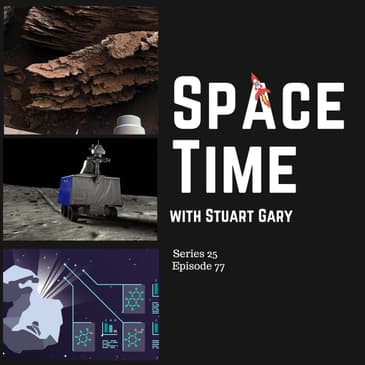



*Curiosity finds organic material on Mars comparable with some parts of Earth
Scientists measuring the total organic carbon - a key component in the molecules of life - in Martian rocks for the first time have found levels comparable with some location on Earth.
*All systems go for NASA’s Viper lunar rover mission
NASA are planning to land a lunar rover on the Moon’s south pole next year to search for water ice in the permanently dark shadows lurking at the bottom of craters that never seen the Sun.
*The unexpected chemical complexity Comet 67P Churyumov Gerasimenko
Scientists have discovered a whole series of complex organic molecules in the Comet 67P Churyumov Gerasimenko.
*The Science Report
480 million year old spore-like microfossils found in Australia.
How to talk when loved ones are sleeping.
The Dingo has a unique genome distinct from domestic dogs.
Alex on Tech: The iPhone turns 15 – do you feel old yet?
Listen to SpaceTime on your favorite podcast app with our universal listen link: https://spacetimewithstuartgary.com/listen
For more SpaceTime and show links: https://linktr.ee/biteszHQ
If you love this podcast, please get someone else to listen to. Thank you…
To become a SpaceTime supporter and unlock commercial free editions of the show, gain early access and bonus content, please visit https://bitesz.supercast.com/ . Premium version now available via Spotify and Apple Podcasts.
For more podcasts visit our HQ at https://bitesz.com
Your support is needed...
SpaceTime is an independently produced podcast (we are not funded by any government grants, big organisations or companies), and we’re working towards becoming a completely listener supported show...meaning we can do away with the commercials and sponsors. We figure the time can be much better spent on researching and producing stories for you, rather than having to chase sponsors to help us pay the bills.
That's where you come in....help us reach our first 1,000 subscribers...at that level the show becomes financially viable and bills can be paid without us breaking into a sweat every month. Every little bit helps...even if you could contribute just $1 per month. It all adds up.
By signing up and becoming a supporter at the $5 or more level, you get immediate access to over 240 commercial-free, double, and triple episode editions of SpaceTime plus extended interview bonus content. You also receive all new episodes on a Monday rather than having to wait the week out. Subscribe via Patreon or Supercast (you get a month’s free trial with Supercast to see if it’s really for you or not)....and share in the rewards. Details at Patreon www.patreon.com/spacetimewithstuartgary or Supercast - https://bitesznetwork.supercast.tech/
Details at https://spacetimewithstuartgary.com or www.bitesz.com
#podcast #spacetime #space #science #astronomy #news
SpaceTime S25E77 AI Transcript
Stuart: This is Spacetime series 25, episode 77, full broadcast on the 30th July, 2022. Coming up on space time, NASA's Curiosity Mars rover finds organic material on the red planet. It comparable with that found on some parts of Earth. It's all systems go for NASA's viper lunar rover mission and the unexpected chemical complexity of comet 67 p sherimoshire Cemenko. All that and more coming up. Um, on Spacetime.
VO Announcer: Welcome to spacetime with Stewart gary.
Stuart: Scientists measuring turtle organic carbon in Martian rocks for the first time have found levels comparable with some locations on Earth. Uh, turtle organic carbon is a key component in the molecules of life. The new findings, reported in the journal the Proceedings of the National Academy of Sciences shows there's at least 200 to 273 parts per million of organic carbon in these red planet rocks. And that's comparable to or even more than the amount found in rocks in some places on Earth, such as the Atacama Desert in South America. The data was gathered by NASA's Mars Curiosity rover, which has been exploring the red PlanetScale crater. Curiosity is advancing the field of astrobiology by investigating Mars habitability and studying its climate geology. The Carsigh six wheel robotic laboratory landed on Mars almost a decade ago in August 2012, on what was meant to be a twoyear primary mission to determine if the red planet could ever have supported life. It quickly resolved that question with a very firm yes. The new studies lead author Jennifer Stern from NASA's Goddard Space Flight Center in Greenville, Maryland, says total organic carbon is one of several measurements that help scientists understand how much material is available as feedstock for preparctic, chemistry, and potentially, biology. Put simply, organic carbon is carbon bound to a hydrogen atom. It's the basis for organic molecules which are created and used by all forms of life. However, organic carbon on Mars doesn't prove the existence of life there, because it can also come from nonliving sources such as meteorites and volcanoes, and it can be formed in situ by surface reactions. Organic carbon has been found on Mars before, but prior measurements only produced information on particular compounds or represented measurements capturing just a portion of the carbon in the rocks. The new measurements are giving the total amount of organic carbon in these rocks. Although the surface of Mars is inhospitable for life today, the Curiosity rover has confirmed that billions of years ago, mars was a warm, wet world with a thicker Earthlike atmosphere and liquid water flowing in rivers, um, and streams. There was even a vast ocean covering much of the planet's northern hemisphere. Since liquid water is necessary for life as we know it, scientists think Martian life, if it ever evolved there, could have been sustained by key ingredients, such as organic carbon if it was present in sufficient amounts. The rovers drawed samples from three and a half billion year old mudstone rocks in the Yellow Knife Bay formation area of gal Crater, the site of an ancient Martian lake. The mud stone in Gal Crater was formed as very fine sediments from the weathering of volcanic rocks in water, which then settled at the bottom of the lake and was buried. Organic carbon was part of this material and became incorporated into the mudstone. Besides liquid water and organic carbon, gal Crater hosted lots of other conditions conducive to life, such as chemical energy sources, low acidity and other elements essential for biology, such as oxygen, nitrogen and sulfur. Uh, Stern says that basically this location would have offered a habitable environment for life had it ever existed on Mars. To make these measurements, Curiosity first drilled a sample of the Martian rock, then supplied this to its sample Analysis at Mars instrument, which is basically an oven which heated the powdered rock to progressively higher and higher temperatures. This experiment used oxygen and heat to convert the organic carbon to carbon dioxide, with the amount then measured to get the amount of organic carbon in the rocks. This experiment was actually performed back in 2014, but it required years of analysis to understand the data and put the results in context of the missions of the discoveries at Gal Crater. The resource intensive experiment was performed only once during Curiosity's ten years on Mars. The process also allowed Curiosity to measure the carbonisotope ratios which help scientists understand the source of the carbon. Isotopes are versions of elements which have slightly different masses due to the presence of one or more extra neutrons in the nucleus of their atoms. Um, for example, carbon twelve has six neutrons, while the heavier carbon 13 is seven. Since heavier isotopes tend to react a bit more slowly than lighter isotopes, the carbon of life is richer in carbon twelve. Stern says in this case, the isotopic composition can really any tell them what portion of total carbon is organic carbon and what portion is mineral carbon. While biology can't be completely ruled out, isotopes can't really be used to support a biological origin for this carbon either. That's because the range overlaps with igneous or volcanic carbon and meteoric or organic material which are the most likely sources for this organic carbon anyway. This is spacetime still to come, as all systems go for NASA's viper lunar rover mission and the unexpected chemical complexity of comet 67 P sherimarger cimenko. All that and more still to come up, uh, space time. NASA is planning to land a lunar rover in the Moon south pole next year. The mission will search for water ice in the permanently dark shadows, looking at the bottom of craters that have never seen the sunlight. The water found by the Viper uh, mission could ultimately be used to help sustain humans exploring the Moon and could even be converted into rocket fuel. Most of the Moon is completely dry without water. That's because of the way it was formed four, 5 billion years ago through a giant impact between the early proto Earth and a Mars sized planet, probably a Trojan called thea. The impact caused both bodies to melt, forming a magma ocean which eventually solidified into the Earth. However, some molten impact ejector from the collision was sent into orbit around the nascent world, which eventually coalesced to form the Moon. Of course, those temperatures were so high, any water that was present would have evaporated and degassed into space. But over the following four and a half billion years, meteors and comets containing water ice bombarded the Moon, releasing water ice molecules across the lunar surface. Now, a lot of this water ice would simply have melted and sublimated back into space. But because the Sun's angle of the lunar poles is steep, creating long shadows, the floors of some deep craters would never receive any direct sunlight, and so they'd be in permanent darkness, and that would result in some of the coldest temperatures in the solar system just a few degrees above absolute zero. So, uh, any water ice deposited in these craters would have remained there, frozen. In time. To find this valuable resource, uh, NASA developed the volatiles investigating Polar Explorer Rover, or Viper. It's a golf cart sized robotic laboratory designed for the extremes and unknowns of the Moon south pole. The rover, which will travel, uh, over several kilometers over several lunar days that's about 100 Earth days assess things like what form the water is in, how much water is there, whether it's likely to be frost on the surface or ice at depth, and whether there's more of it in some areas than others. Currently being assembled at NASA's Johnson Space Center in Houston, Texas, vipers being customized to meet the specific conditions it'll encounter at the Moon south pole. There's the crated soil with various levels of compaction, requiring four independently controlled wheels that can handle slopes up to 30 degrees. Then there's the Moon's drastic temperature swings, which range from 107 degrees Celsius in the sun during the day down to -240 degrees in those permanently shadowed areas viper is designed to handle those immense temperature swings. And it's designed to handle the darkness of those long, lumina nights as well, being equipped with the first headlights ever used on a rover in order to, uh, illuminate places on the Moon that have never seen sunlight. Of course, as with any space mission, there are the conflicting needs of science and logistics the science caused for Viper to spend its time in the shadows. But the rover will also need to periodically climb out of the craters in order to recharge its batteries in the sunlight. Most rovers solar arrays are located on their roofs, but the angle of the polar sunlight requires Vipers arrays to be mounted on its sides instead. To track its position and orientation, viper is equipped with accelerometers, devices that are typically used to determine changes in position and rover tilt. Accelerometers are extremely sensitive and can detect even minuscule changes in gravity such as that experience as you roll over an all body of different density to its surroundings. Known as gravimetry, it's already being used for mining prospecting on Earth and by rovers on Mars. Viper is part of NASA's Artemis program, a multiphase project to return humans to the lunar surface, this time to stay. Artemis One is slated to launch in a few weeks time carrying an unmanned Orion uh, capsule beyond the moon and back to Earth on a four week test run. If all goes well, it will be followed by Atomos Two, which will carry humans on a trip around the moon and back to Earth in 2024. And if that goes well, the Artemis Three mission will return people to the lunar surface sometime around 2025. And Viper will help prepare, uh, the Way launching next year to help explore the terrain in advance. This report from NASA TV.
Guest: We know from decades of study that the moon has, uh, water, but where and how much? In 2023, a robotic rover will explore the moon's surface in search of water ice. NASA's Viper moon rover will perform the first resource mapping mission on another world using advanced instruments and tools to determine the location and concentration of water on the moon.
Guest: To send Viper to the moon, we're leveraging industry as part of our commercial Lunar Payload Services program, a program designed to send science instruments and technology payloads to the surface of the moon. Michael represents a very different development paradigm. We are developing each instrument for launch on eclipse ahead of wiper, totally flipping on its head how we normally do this. This is truly creative. An industry partner will launch Viper to the moon south pole. This is a place where no human or rover has ever been before.
Guest: The rover's survey will provide scientists with the most detailed view of the moon's water to date and point to spots where water could be harvested by future astronauts.
Guest: Viper will be the first resource mapping mission on the surface of another celestial body. It represents a new kind of mission for NASA in which the objectives of advancing science and human exploration are closer than ever. The measurements that Viper's instruments will make can help us understand the source and distribution of the water and other volatiles on the moon, giving us insight into the evolution of the moon and the Earth moon system. The moon's water is also a precious resource that could be extracted to support human exploration of the moon and beyond. What we learn from Viper will bring us a step closer to developing a sustainable, long term human presence on the moon.
Stuart: And in that report from NASA TV, we heard from associate Administrator of NASA Science Mission Director At Thomas Sabotage and NASA Planetary Science Division Director Laurie Glaze. This is space time. Still to come, the unexpected chemical complexity of comet 67 P sheer mobile cimenco. And later in, uh, the science Report, scientists discover 480,000,000 year old sporelike micro fossils in ancient Australian rock. All that and more still to come on Spacetime. Scientists have discovered a whole series of complex organic molecules in Comet 67 P shearermaf Sheriff Cimenko comets are ancient fossils from the depths of the early solar system, relics from the formation of the sun, planets and moons. Back in the mid 1980s, a number of spacecraft, including the European Space Agency Jacob mission, studied Comet P One Haley during its 1986 close encounter with the Earth. On board with several spectrometers, these measured the chemical composition of both the comet's coma that is, its thin atmosphere due to sublimation of cometry ice as close to the sun and also that of impacting dust particles. However, the data collected by these instruments back then didn't have the resolution needed to allow for unambiguous interpretation. But fast forward 30 years and the high resolution mass spectrometer aboard the European Space Agency's Rosetta spacecraft is a generation more advanced. It was used to undertake a detailed spectra of the comet 67 P sherimarzero cimenco between 2014 and 2016. And these observations, reported in the journal Nature Communications, have now for the first time allowed scientists to shed light on the complex organic composition of this comet. When Comet 67 P reached perihelion, its closest orbital position to the sun, it became very active and supplementing cometry ices created an outflow which dragged along dust particles. The expelled particles were then heated up by the solar radiation the temperatures beyond those typically experienced on the comet surface. This allowed larger and heavier molecules to dabsorb, making them available to the highresolution mass spectrometer aboard Rosetta. Now, due, uh, to the extremely dusty conditions, the Rosetta spacecraft had to retreat to a safe distance, a bit more than 200 km above the cometary surface, in order for the instruments to be able to operate safely under steady conditions. Still, it was possible to detect species composed of more than a handful of atoms which had previously remained hidden in the cometry dust. The study's lead author, Norahini from the University uh of Burn, says her team successfully identified a number of complex molecules which had never been found in the comet before. These included, uh, naphthalene, which is responsible for the characteristic smell of mothballs benzoic acid, a natural component of incense and benzaldehyde, which is often used as an artificial almond flavor for foods. Haney says these heavy organics would make Comet 67 P scent even more complex, but also more appealing. As well as these fragrant molecules, other prebiotic molecules are also identified in the spectra, including formaldehyde, an important intermediate and synthesis of biomolecules, such as sugars and amino acids, which are the building blocks of life. Any speculates that it therefore seems likely that these impacting comets as essential supplies of organic material also contributed to the emergence of carbon based life on Earth. In addition, uh, to the identification of individual molecules, the authors also carried out a detailed characterization of the full ensemble of complex organic molecules in the comet, placing it in the larger solar system context. It turns out that on average, Comet 67 P's complex organic budget is identical to some soluble parts of meteoric organic matter. And apart from the relative, uh, amount of hydrogen atoms, the molecular budget of Comet 67 P also strongly resembles the organic material raining down on Saturn from its innermost ring, as detected by NASA's Cassini spacecraft. Henry and colleagues not only found similarities with other organic reservoirs in the solar system, but many have. Comet 67 P's organic molecules are also present in molecular gas and dust clouds, which are the birthplaces of new stars. And, uh, he says the findings are consistent with and support the scenario of a shared presolar origin of the different reservoirs of solar system organics, confirming that comets indeed carry material from the times long before our solar system emerged. This is space time and time now to take another brief look at some of the other stories making news in Science this week with a science report. Paleontologists have discovered 480,000,000 year old sporelike microfossils in Australia. Until now, the first fossil evidence of land plants was from the Devonian period some 420,000,000 years ago. The discovery, reported in the journal Science, fills a gap of approximately 25 million years in the fossil spore record, linking well accepted younger land plant spores to older, earlier forms of uncertain relationship. The fossil spores were extracted from a rock sample drilled in northern Western Australia. You have to say the finding suggests scientists may need to rethink how they view the origin of terrestrial plants, moving life from water to land, and undertake a serious reinterpretation of problematic fossils that had previously been interpreted as being fungi rather than plants. A new study suggests that if you're trying to talk around a sleeping loved one, you might be better off just using your regular voice. A reporter the journal J Nervik found sleeping people's brains tend to respond more to unfamiliar voices than familiar ones. Researchers exposed sleeping adults to unfamiliar voices, finding that participants showed higher levels of brainwave activity linked to being perturbed during sleep compared to the sound of familiar voices. This may well have been a self defense arousal mechanism in times past. A new study of the Australian dingo suggests that while they may look like domestic dogs, their genome is structurally very distinct, uh, from dogs like the boxer, German shepherd, Great Dane or Labrador retriever. However, the findings reported in the journal Science Advances shows they still share more similarities to domestic dogs than with species like the Greenland wolf. It's believed that the lean, tang colored canines first arrived in Australia between 5008 and a half thousand years ago. Though not normally aggressive, they're not especially interested in humans and have developed a bad reputation for killing livestock such as sheep. The study set out to test the differences in how dingos metabolize nutrients compared to domestic breeds. By running a controlled diet study on a number of dingoes and German shepherds, they found that like wolves, dingos have only one copy of the gene that creates a pancreatic protein that helps dogs live on starchy food diets, which humans thrive on. German shepherds have eight copies of this gene. The study suggests that dingoes evolve to prey on small marsupials, and so can't easily digest high fat foods. Therefore, lambs are more likely to be hunted by feral dogs or hybrids. Okay, time to make you feel really old. Did you know it's been 15 years now since the introduction of the iPhone? And if that doesn't scrap your barnacles, it's now been 50 years, half a century, since we first started playing pong on our TV screens. With the details, we're joined by technology editor Alexey V. Royce from ity.com.
VO Announcer: Well, on June 27, 1972, Atari was born. Now, that's the company that started off with the game called pong, which is the table tennis and tennis sort of game. Yes. And now there were computer games before then on some of the mainframes. This was one of the first arcade games. In fact, when they put it into one of those places, like pinball machines, the company that owned that rainbow next day, oh, your machine is broken. They came in. The thing was packed with quarters, was so popular that it spawned a thousand clones, and of course, it eventually spawned the Atari VCs, the first video game console machine.
Stuart: You plug it into your tele.
VO Announcer: That's right. Now, the problem with the Atari VCs, they did start off very strong with asteroids, space invaders, pacman, a whole bunch of different games. That's right. But there was, um, no quality control. There was no Nintendo feel of quality back then, and there was a whole stack of shovelware that went onto the platform, including the failure of the game Et. Which was programmed in six weeks. And it was a bit of a disaster. And in fact, they ended up burying most of those hundreds of thousands of cartridges they created, which didn't sell. And in fact, a few years ago, they dug them up from the landfill that they were in. It was a documentary about it on YouTube. But there was a big video game console crash, 1983, partly because the market was flooded with crappy games that devalue the whole space. Now, we did see the Nintendo console come back in the mid eighty s, and restart reboot the video console revolution. And we have the CV Genesis master system, and we had TurboGrafx and Atari, but with other consoles that came back. But Nolan bush, now when he first started atari 72, had Steve Jobs working for him, and I think Steve wozniak as well. Now, both Steve obviously, went up to form Apple, but that was the real boom of the 70s, video game era, and they had to make games that you could figure out in an incident. Today's games, you have these cutscenes that go for it, and you have to spend an hour in sort of exposition to learn all this stuff before we can start playing the game. But back then, you just have to start the game and go. So 50 years for Atari. Bled Runner did have the Atari logo up in big lights, but it probably should have been Apple because they're the $3 trillion company today. Today, Atari still makes games consoles, but they are repackaged PCs with an AMD Ryzen chip. They're good at what they do, but they're obviously not top of the line in terms of how they compete with Sony PlayStation and Xbox. And Atari is also launching the 50th anniversary games pack with 90 games from across the Atari consoles, including Pong and some of the original games through to the Atari links, which was the competitor to the Game Boy, which the links was color. And also the Atari Jaguar, billed as the world's 1st 64 bit system, although it had 232 bit chips inside, and it was only part of its graphics with 64 bit. Didn't quite succeed. But for us, $40, you can buy the 50th game anniversary edition very soon from all your local stores. It'd probably be closer to $100 in Australia. But, yeah, Tyree 50 years old.
Stuart: That's not, uh, the only thing that's going to make us feel old. 2022 also marks the year that George Jetson is meant to have been born.
VO Announcer: And of course, we all remember Rosie, the robots flying cars, which we don't quite yet have today in 2022.
Stuart: Exactly.
VO Announcer: Well, it's more of a flying drone. Most of the flying cars, they are more like planes than actual cars.
Stuart: Soil and greens this year as well, isn't it? Soil and green was set this year.
VO Announcer: Sorry for the spoiler of the people, but it has been several decades. But soil and greens is people.
Guest: You got to tell them.
Stuart: Soil and breed is people. This year also marks the 15th year of a device that, well, it's just woven itself into our life.
VO Announcer: You're talking about the iPhone now. I remember we were speaking about this when you're doing Star stuff. Yeah, that's right. Now, this was first announced in January, but it was on June 29, 2007, that the iPhone first went on sale. It was revolutionary at the time, even though we had large screen devices. The Motorola A 1000, the Palm Pilot. Even the Apple meeting before it. This was a device with a full color 3.5 inch screen at a time when most of the nonsense had one and two inch screens. It didn't have a camera, didn't have copy and paste, didn't even have third party apps. Although there were sort of Applets that you could run in the browser, but it had multitouch where you could pinch and zoom. And the whole thing was a touch experience. And it was capacitive touch where you can use your finger, whereas most of the previous touch devices were resisted. You needed your fingernail or a stylist, and it was revolutionary. And within a year, Google had copied it. That launched with HTC Dream, also known in the US as the T mobile g one. I still have the original iPhone, and I still have the T mobile G one or the equivalent thereof. And the T mobile G one was everything the iPhone wasn't. It had a slide up a screen which showed a keyboard and had a little pearl style trackpad, but it didn't have the multi touch, which made the iPhone famous. I had an iPhone, the original one. By the end of July, I was showing everybody the multi touch. I even showed one of the apple pie people from today and he said, alex, do you remember you were the one who showed me this multi touch. That was before they were at Apple.
Stuart: Well, you go back even further that you're the one who told us on Star stuff about this idea called convergence, where all these different features will be put on the one device. I'm sitting there looking at my 64 gig ipod, and you're telling me that my phone and my camera will all be included in this one little device.
VO Announcer: And look at the time. Nokia did actually have that. They promoted themselves in a pre iPhone world as the seller of the most cameras in the world, the most MP3 players, you could even argue the most calculators, the most phones, but they weren't in the easy to use finger touch style that was the iPhone. The Nokia devices rely on a lot of buttons. They didn't have touch screens. Some of them did have touch screens. I didn't launch communicator, but it wasn't a phone, it was just an internet communications browsing device and could so easily have owned this place, but they just didn't think far enough. And by the time they came up with their own versions thereof, it was just a power limitation of what the iPhone launched 15 years later. The iPhone is your everything device. It can give you a window into all the security cameras in your home. It can be running any program you can think of. It can be transcribing your voice perfectly, both with keeping the recording through the audit program and giving you incredibly accurate transcription and handwrite on iPads, which the capability isn't quite there yet for the iPhone in terms of having the stylish capability from Apple's own native pen. But I remember having a keyboard that you could use your finger or one of those bubble stylists, uh, to write text on an iPhone. I mean, that keyboard still exists and it converts it into text. So, yeah, the iPhone has become the essential device that can pretty much do everything. With Google Translator Apple Translate. You can speak in other languages like the Star Trek Universal Translator or the Babel fish from Chose Garden Galaxy.
Speaker UNK: Promise?
VO Announcer: And the next 15 years is going to see the iPhone morph into the augmented reality and extended reality glasses, where you'll have the iPhone and the glasses to begin with, but eventually all that smart will just go into the glasses itself and your eyes will directly see both. Either a virtual reality world where the rest of the world is cut out, or you'll see elements of augmented reality overlaid on the real world. So you'll see directions on the floor, arrows as you're walking around, which you can already see on your phone. But imagine you go to a party. You'll meet the people that you met before. And in your field of vision will pop up their names. The names of their partners. The names of their kids. The last time you saw them. And the information will either be read to you into your ear through the phone deductions so nobody else can hear it. And it will be visually in your field of view. So we really are getting to a world where you will need technology to interact in the world. Otherwise you may as well join the game or some of those tribes in the Amazon which have no technology at all because. Uh. Without the technology. It will be a bit like having to check into places or show you a vaccine passport and having a flip phone or not having any phone at all. It's quite difficult for people over the past couple of years you didn't have that. And it will be equally as difficult over the next few years not to have the glasses that shows you the digital world overlaid on the real world. You will be forced to become a digital nation. Otherwise it will be very difficult life. So well, the iPhone is going to continue to morph and the convergence this time of humans and technology will jump to an even greater level. And the only level beyond that is when we actually start implanting chips into ourselves. Hopefully, I hope that it becomes wireless. We don't actually have to have things implanted, but ultimately that will happen too. It's happening already with cochlear implants and all the rest, and it's just going to get more sophisticated and all of our Sci-Fi dreams, nightmares are liable to come true.
Stuart: That's Alex harefroyd from itycom. And that's the show for now. Spacetime is available every Monday, Wednesday and Friday through Apple Podcasts, itunes, Stitcher, Google Podcast, Pocket Casts, Spotify, uh, Acast, Amazon Music Bytescom, SoundCloud, YouTube, your favorite Podcast download provider and From Spacetime with Stuart Garycom. Spacetime is also broadcast through the National Science Foundation on science known radio and on both iHeartRadio and tune in radio. And you can help to support our show by visiting the Spacetime Store for a range of promotional merchandising goodies. Or by becoming a Spacetime patron, which gives you access to triple episode, commercial free versions of the. Show, as well as lots of bonus audio content which doesn't go to air access to our exclusive Facebook group and other rewards. Just go to spacetimewithstewardgarry.com for full details. And if you want more space time, please check out our blog, where you'll find all the stuff we couldn't fit in the show, as well as heaps of images, news stories, loads of videos and things on the web I find interesting or amusing. Just go to spacetime with Stuartgarry Tumblrcom. That's all one word and that's Tumblr without the e. You can also follow us through at Stuart Gary on Twitter, at Spacetime with Stuartgarry, on Instagram, through our Spacetime YouTube channel and on Facebook. Just go to facebook.com spacetime with Stewart Gary and Spacetime is brought to you in collaboration with Australian Sky and Telescope magazine, Your Window on the Universe.
Guest: You've been listening to SpaceTime with Stuart Gary. This has been another quality podcast production from Bitesz.com.