


Earliest Supernova Ever Detected
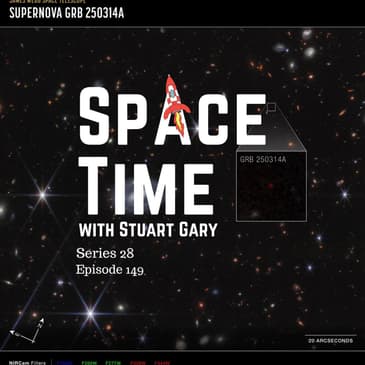
Astronomers have achieved a remarkable milestone by detecting the earliest supernova ever observed, dating back to a mere 730 million years after the Big Bang. Using the powerful Webb Space Telescope, this supernova, cataloged as GRB250314A, emitted a gamma ray burst that has shattered previous distance records. Lead author Andrew Levin shares insights into how this discovery provides a glimpse into the universe when it was only 5% of its current age, revealing surprising similarities with modern supernovae despite the vast differences in their epochs.
Liquid Water on Mars: New Evidence
New seismic data from NASA's Mars InSight lander suggests that liquid water could still exist beneath the Martian surface, potentially providing a habitat for microbial life. The analysis of marsquakes has revealed boundaries in the Martian crust that indicate the presence of water-filled cracks, offering compelling evidence that life may persist on the Red Planet. We discuss the implications of these findings and the methodologies used to analyze the Martian subsurface.
The Great Geminids Meteor Shower of 2025
The annual Geminid meteor shower is reaching its peak, presenting stargazers with the chance to witness up to 100 meteors per hour under optimal conditions. Unlike many meteor showers that originate from comets, the Geminids are unique as they come from the asteroid 3200 Phaethon. Dr. Robert Massey provides tips on how to best observe this spectacular celestial event, emphasizing the importance of dark skies and the naked eye for optimal viewing.
www.spacetimewithstuartgary.com
✍️ Episode References
Astronomy and Astrophysics
British Medical Journal
Nature Communications
Become a supporter of this podcast: https://www.spreaker.com/podcast/spacetime-your-guide-to-space-astronomy--2458531/support.
(00:00:00) New clues suggest that liquid water could still exist on Mars today
(00:00:48) Astronomers have detected the earliest supernova ever seen using the Webb Space Telescope
(00:05:10) New study based on seismic data suggests liquid water may still exist on Mars
(00:09:12) The Geminids are visible between now and December 20th
(00:13:10) New study finds coffee may slow down biological aging of people with mental illnesses
This is Spacetime Series twenty eight, episode one hundred and forty nine, for broadcast on the nineteenth of December twenty twenty five. Coming up on Space Time, the earliest super and over ever seen. New clues suggest that liquid water and consequently the potential for life could still exist on the red planet Mars today and the Great Geminid's meteor shower of twenty twenty five. All that and more coming up on space Time. Welcome to space Time with Stuart Gary. Astronomers have detected the earliest supernova ever seen, dating back to a time when the universe was just seven hundred and thirty million years old. The observations, reported in the journal Astronomy in Astrophysics, were made using the web Space Telescope. The exploding star, catalogged as GiB twenty five zero three fourteen A, emitted a super bright flash of light known as a gamma ray burst. The detection broke the previous super and ova distance record, an event dating back some twelve billion years. The studies lead author, Andrew Levin from Redbound University in the Netherlands, says this new detection shows that astronomers using web can find individual stars when the universe was just five percent of its current age. While a gamma ray burst typically lasts for just seconds or minutes, a supernerva rapidly brightens over several weeks before it slowly begins to dim. In contrast, this supernova brightened over months. Since it exploded so early in the history of the universe, its light was stretched as the cosmos expanded over billions of years. As light is stretched, so is the time it takes for events to unfold. Web's observations were intentionally taken three and a half months after the gamma ray burst ended, since the underlying supernova was expected to be brightest at that time. Gamma ray bursts are incredibly rare. Short period gamma ray bursts can last for just a few seconds and are thought to be caused by the merger of two neutron stars creating a black hole, or alternatively, by the merger of a neutron star into a black hole. On the other hand, long period gamma ray bursts can last around ten seconds and are thought to be caused through the explosive supernova deaths of massive stars resulting in the formation of a black hole. As for this event, the first alert was sent out back on March the fourteenth, news of a gamma ray burst from a very distant source came from so FOAM, the space based Multiband Astronomical Variable Object's Monitor mission, which is designed to detect brief transient events like gamma ray bursts. Within ninety minutes, NASA Swift Space Telescope pin pointed the X ray source's location in the sky, and that enabled subsequent observations to pin down the distance for where ZEB. Eleven hours later, the Nordic Optical Telescope on the Canary Islands was skewed up and revealed an infrared light gamma ray burst afterglow, an indication that gamma rays might be associated with a very distant object. Four hours later, the European Southern observatori's Very Large Telescope, the VLT in Chile estimated the object existed just seven hundred and thirty million years after the Big Bang. Eleven points out there have only been a handful of gamma ray bursts in the last fifty years that have been detected during the first billion years of the universe's existence, and he says that makes this event both very rare and very exciting. Since this is the earliest and most distant superinova ever seen. Astronomers compared it to modern day, more nearby supernovae. Amazingly, the two turned out to be very similar. That's surprise scientists because very little is known about the first billion years of the universe's existence. It's thought that early stars likely contained far fewer heavy elements, they were more mad, and they led far shorter lives. They also existed during the epoch of realization, that's when the gases between galaxies was largely opaque. The high energy light but WEB showed that this supernova looked exactly like modern supernovae. Before researchers can determine why such an early supernova is so similar to nearby events, more data will need to be gathered in order to pinpoint tiny differences. The web observations also indicate that the distant galaxy from which the supernova originated was also similar to other galaxies that existed around that same time. Since the galaxy's lights blended into a few pixels, making the galaxy look like a red and sponge, astronomers are still limited and exactly what they can learn about it. Still seeing it at all is a major breakthrough this is space time still to come. New clues suggest that liquid water and consequently the potential for life could still exist on the red planet Mars today, and how to observe the Great Geminids Metea or Shower of twenty twenty five. All that and more still to come on space time. A new study based on seismic data suggests that liquid water and the potential for life could still exist beneath the surface of the red planet Mars today. The findings are based on a new evaluation of mass quakes recorded by NASA's Mars Inside lander, which touched down on the red planet in twenty eighteen. This lander used its robotic arm to place a seismometer on the Martian surface, designed to measure seismic waves generated by meteor impacts or Martian geologic activity, and thereby providing a picture of the planet's interior. One of the studies authors, Ikukatama from Hiroshima University, says the new interpretation of this seismic data does suggest the presence of liquid water below the surface, and if liquid water does exist on Mars, that would present a habitable location for microbial activity. That is, if life does exist on the red planet. When a Mars quake, if that matter, a meteorite impact occurs, Insight was able to read that energy emitted as pea waves, S waves, and surface waves, allowing it to create an image of the planet's interior. Scientists can use the pea waves and S waves to determine a lot about the rocks that make up Mars, including the density of the material or potential compositional changes within rocks. For example, S waves can't travel through water, and they move at a much slower speed than pea waves. Therefore, the presence, absence and arrival time of S waves can determine what the subsurface looks like. Pea waves travel faster through high density material and slower through less dense stuff, so their velocity can help determine the density of the material they're traveling through, as well as if there are any changes in the density along the way. Searsmic data collected by Insight shows boundaries at a depth of round ten kilometers and at twenty kilometers based on discrepancies in the searsmic velocity. Now, these boundaries had previously been interpreted as sharp transitions in the porosity of rocks or the chemical composition of the Mustian interior. However, Caddiamor and colleagues have interpreted these cracks as potential evidence of water within the Russian subsurface. They say the searsmic data indicates a boundary between dry cracks and water filled cracks in the Russian subsurface. In order to test the hypothesis, the authors measure the searsmic velocity passing through rocks with the same structures and composition of typical Marshan crustal rock under wet, dry, and pros and conditions. Typical Martian rocks are similar to the diabase rocks found in Sweden due to their evenly sized plagia eclays and orthopyroxine grains. In the lab, Catiamor and colleagues measured P wave and S wave velocities using a piezoelectric transducer, which uses electrical energy as a wave source that monitors seized mcwave energy on dry, wet and frozen diabet samples. Their work showed that the searsmic velocities of the dry, wet and frozen samples were significantly different. That supports the idea that the boundary at ten kilometers and twenty kilometers could be caused by a change from a dry rock to a wet rock. These laboratory experiments back up the hypothesis that the boundary measured by seismic data indicates a transition from dry to wet rocks rather than a change in porosity or chemical composition. Katiyama says the findings therefore provide compelling evidence for the existence of liquid water beneath the Martian surface this space time still to come the Great Geminid Shower of twenty twenty five, and later in the Science report, a new study shows that the family housecat will mew more frequently for male caregivers and female ones, and the studies authors think they know why. All that and more still to come on space time, one of the most spectacular meteor showers of the year is now at its peak, giving sky watch is a chance to see up to one hundred meteors an hour under perfect conditions. The Geminids are visible between now and December the twentieth. They're considered to be one of the best and most reliable annual meteor shower events. They were first observed in eighteen sixty two and are thought to be intensifying every year. Most meteor showers are caused by comets, but the Geminids are unusual because they originate from a debris trail left by an object known as thirty two hundred feeton, which is more likely an asteroid. Rather than being white like other meteors, the geminids have a distinct greenish hue when they burn up in its atmosphere. That's because their chemical composition oxygen, magnesium, and nickel usually produce a green color. Meteors are small pieces of interplanetary debris which spurn up in its atmosphere after coming in at high speeds, typically around one hundred and thirty thousand kilometers an hour. In the case of the geminids, friction in the upper atmosphere quickly heats up the incoming debris. The air around them glows brightly, and the particles are rapidly destroyed. The resulting streak of light is what we see on the ground as a meteor, often incorrectly referred to as a shooting star. Robert Messi from the Royal Astronomical Society says the best way to see the geminids is in dark skies, well away from any light source. He says you can expect to see perhaps one hundred meteors an hour, and that means around one or two every minute. The Geminids are in meteor shower, and in this particular case, they all appear if you trace the meteors palms backwards to originate from a point in the sky in the constellation of Geminy near the bright Star Castle. And like other meteor showers, they're connected with a particular celestial object. Now, most meteor showers we connect to commets. In this particular case, they appear to originate from the asteroid thirty two hundred feeth On, which could be a weird example of something called a rock comet, which is putting debris into the Solar System, and once a year the Earth runs into that debris. It burns up in the Earth's atmosphere, and that's when we see a meteor shower with meteors. What you're going to expect to see is something that you might regard as a shooting star, in other words, a short streak of light that generally lasts maybe half a second or so, usually so quick it's impossible to point out someone you're with, so you need to keep your eyes up the advice on looking for them is to get yourself something comfortable to actually lie down on or sit down on, So take out a sun lounger and then simply look up at the sky. Now, the best view is if you're away from sources of light pollution, so try and get away from at least direct lights in towns and cities, ideally out in the countryside. Obviously you also need a clear sky if it's cloud and you're not going to see anything, and then really you're looking up at the sky and you expect to see perhaps if we're lucky, up to one hundred meteors an hour, so that might be one or two a minute, which would be a brilliant view. It is one of the strongest showers of the year. The great thing about a meteor shower, including the geminids, is that actually the naked eye is the best way to see them. If you get a telescope or a pair of bronocutas, you're automatically restricting your view of the sky. And with a meteor shower, what you want is the widest possible view. You want to be lying down looking up at the broad panoply of stars. I can use that expression and watching for meteors. That by far the best way to do that is with the naked eye. Now, some people are really really good at taking pictures of these things too, either with all sky cameras or or they get lucky they've got camera set up on tribuds and they snap them over a period of time. If you do manage to get some photos, please share them. That's doctor Robert Massey, Deputy Executive Director of the Royal Astronomic or Society, and this space time and time out take another brief look at some of the other stories making us in science this week with a science report. A new study has shown that drinking three to four cups of coffee a day might slow down the biological aging of people with severe mental illnesses. The findings, reported in the British Medical Journal, show that coffee can produce an additional five extra biological years by lengthening telomerase, a compound structure at the end of chromosomes which acts as an indicator of cellular aging. While tilomere shortening is a natural part of the aging process, seems to be accelerated in those with major psychiatric disorders like psychosis, schizophrenia, and bipolar disorder. A recently excavated site in POMPEII may have solved one of the great mysteries of Roman cement. The site appears to have been under active construction when it was suddenly a badge and in the year seventy nine due to volcanic activity. Now archaeologists say the rare find of construction tools and raw materials at the site has allowed them to better investigate how the Romans were making cement at the time. They found materials including limestone and volcanic ash, which supports the theory that they used the technique called hot mixing. Mixing dry heated limestone with water and volcanic rocks and ash created a chemical reaction that heats the mixture. A report in the General Nature Communication says weights and measurement tools were also found at the site, likely used to help keep retires consistent and walls level and straight. A new study is shown that the family housecat maaws more frequently when male caregivers walk through the front door compared to female ones. The findings reported in the General Lithology, based on studies involving thirty one domestic cats and their human companions. People were asked to film the first few minutes of returning home, behaving as naturally as possible. The authors the analyze just the first one hundred seconds of each recording, tracking twenty two specific behaviors. These included the number of meals, head rubbing against a person's leg, and stress related behaviors like yawning. After analyzing hundreds of chirps, one thing stood out clearly. Cats vocalized far more frequently, that is, meals, purs and chirps when greeting malecare givers compared to when they were greeting female ones, and they found this increased frequency was the same right across the board, regardless of the cat's age, breed, sex, or even the size of the household. They found that on average, cats produced four point three meals in the first one hundred seconds of greeting a man, compared to just one point eight meals when greeting women. Now, the authors think the reason's pretty simple. Male caregivers tend to talk less with their cats and are generally less a tentative. Consequently, cats need to use more vocal signals in order to actively elicit responses from them. A pair of alled scientists who claimed to be experts in the field of pre cognitive neuroscience, claim that God feelings are actually memories from the future sent back to the present day through some sort of quantum effect. But as the skeptics timendum points out, as soon as pseudo scientists bring out the term quantum, you know they're talking a lot of garbage. There's two people quotes in the risk of story. So both of them work at something called the Institute of Noetic Sciences, and that were set up by a pro paranormal group noetic means of the spirit or paranormal or something like that, So it's definitely what we would regard as a Wouish institution. They come to their research from the point of view of believing. Both of these people have got to quote from an article, they want to show the validity of precognition through statistics. In other words, they've already got the belief and they just want the data to prove it. A belief in something which is highly dubious. So they've already got a belief and they have to fit the evidence to that belief, and that's a very dangerous way to go. You have to be prepared to throw out your belief into statistics support it, but they reckon it does. There's a lot of overstatement in their stories. One of the things they do say is that a lot of the re is distance to ideas about precognition and psychic phenomena is about fear, the fear of the unknown or the fear that things aren't the way they appear to be. I'd say that, what's the most technical term, right, A lot of the resistance to the ideas is that there's lack of evidence. For they think the person making the claim has to prove it. The critic doesn't have to disprove it. The critic has to analyze the proof that's put forward, and the claimant they often like to put the blame on the person they're talking to, but they've got to prove their case. And if they're just suggesting you. Results for tomorrow now and I'll believe you. Yeah, and it's as simple as that. But of course it's not as precise as that. I'd say the people claiming that it's the memory being sent back from the future to us in the present, so that we're going to experience something that's already happened, and that's what we're reacting to is just looks like a philosophical nightmare. The trouble is with this is that the stories say scientists, and then you got seriously look about where the science is and who were they with. You got a seriously look about what the scientists we're talking about. You can always find a scientist somewhere who will support the craziest ideas. Just because the scientist doesn't mean they're immune from being silly. That's timendum from Australian Skeptics, and that's the show for now. Spacetime is available every Monday, Wednesday and Friday through bytes dot com, SoundCloud, YouTube, your favorite podcast download provider, and from space Time with Stuart Gary dot com. Space Time's also broadcast through the National Science Foundation, on Science Own Radio and on both iHeartRadio and tune in Radio. And you can help to support our show by visiting the Spacetime Store for a range of promotional merchandising goodies, or by becoming a Spacetime Patron, which gives you access to triple episode commercial free versions of the show, as well as lots of bonnus audio content which doesn't go Towhay access to our exclusive Facebook group and other rewards. Just go to space Time with Stewart Garry dot com for full details. You've been listening to space Time with Stuart Garry. This has been another quality podcast production from bytes dot com