



This episode is brought to you with thanks to Squarespace. Bring your stories to life with Squarespace, the easiest way to create an exceptional website, blog, portfolio, or online store. To take up our great offer and help support the show, just visit www.squarespace.com/spacetime or use the Promo Code SPACETIME at checkout.
SpaceTime with Stuart Gary Gary - Series 29 Episode 13
In this episode of SpaceTime, we uncover the hidden violent past of the Milky Way's supermassive black hole, delve into the origins of water on Jupiter's Galilean moons, and explore how meteor impacts are triggering dust avalanches on Mars.
The Violent History of Sagittarius A
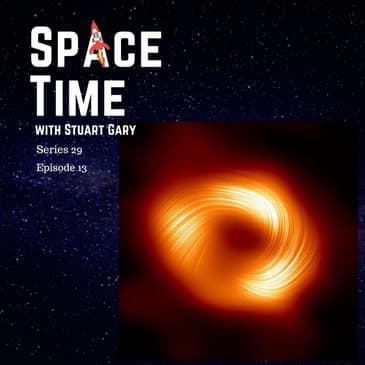
For years, Sagittarius A, the supermassive black hole at the center of our galaxy, has been perceived as a quiet entity. However, new research published in the Astrophysical Journal Letters indicates that it may have experienced dramatic flares in the past. Observations from the CRISM Space Telescope reveal X-ray emissions from a gas cloud near Sagittarius A, suggesting a history of explosive activity that alters our understanding of supermassive black hole evolution and the history of our galaxy.
Water Origins of Jupiter's Galilean Moons
A groundbreaking study has determined that the contrasting water content of Jupiter's four large Galilean moons was established during their formation rather than evolving later. This research sheds light on the stark differences between Io, which is dry and volcanically active, and Europa, believed to have a subsurface ocean. The findings suggest that the primordial environment around Jupiter played a crucial role in shaping these moons' compositions.
Meteor Impacts Trigger Dust Avalanches on Mars
New evidence indicates that meteor impacts on Mars are causing dust avalanches, creating dark streaks on the planet's surface. An analysis of images from the European Space Agency's ExoMars Trace Gas Orbiter reveals that these avalanches occur primarily due to dry processes, driven by seasonal dust and wind activity, rather than water-related phenomena. This discovery enhances our understanding of Martian surface dynamics and the impact of meteor activity.
www.spacetimewithstuartgary.com
✍️ Episode References
Astrophysical Journal Letters
Nature Communications
Become a supporter of this podcast: https://www.spreaker.com/podcast/spacetime-your-guide-to-space-astronomy--2458531/support.
(00:00:00) Sagittarius A's hidden violent past revealed
(00:12:45) Origins of water on Jupiter's Galilean moons
(00:25:30) Meteor impacts causing dust avalanches on Mars
(00:35:00) February night sky highlights and celestial events.
(00:00:00) This is space time series 29, episode 13 for broadcast on 30 January 2026
(00:00:47) X ray emissions from the Crism Space Telescope suggest Sagittarius A flared
(00:07:59) A new study claims dust avalanches caused by meteor impacts are creating Martian streaks
(00:10:22) February is the second month of the year in the Julian and Gregorian calendars
(00:12:03) February's Orion meteor showers usually peak around February 8th
(00:22:18) Blue supergiant Rigel is the second brightest star in the constellation Orion
(00:31:08) Rygel: Sirius is the brightest star in the night sky
(00:35:09) February is a great time to look for bright stars in the night sky
(00:38:04) The night sky is sparse with the old planets at the moment
This Is Spacetime Series twenty nine, Episode thirteen, will broadcast on the thirtieth of January twenty twenty six. Coming up on Space Time, the Milky Way super massive black hole hiding its violent past. A new study shows the water makeup of Jupiter's Galilean moons was set during their birth, and evidence that meteor impacts have been triggering dust avalanches on the red planet Mars. All that and more coming up on space Time. Welcome to space Time with Stuart Gary. Our Milky Way Galaxy's central super massive black hole, Saturtari's A Star, has long been considered a quiet, sedate creature. However, a new study reported in the Astrophysical Journal Letter suggests that may not always have been the case. Sagutari's A Star is located at the center of the milky Way Galaxy, about twenty seven thousand light years away from our Solar system. It's reasonably small by supermassive black hole standards, with a mass of around four point three million times that of the Sun. That makes it a lightweight compared to other supermassive black holes, which often have billions of solar masses. We often think of Sagittari's A star as being quiet and sedate, but rather than being a shy wallflower, X ray emissions observed by the Chrism space telescope and now suggesting that Sagittarius A Star appears to have fled dramatically sometime within the last few hundred to maybe one thousand years. These surprising findings are unfailing new details on how super massive black holes evolve, and they're also teaching astronomers lessons about our own cosmic history. The studies authors measure X rays coming from a giant gas cloud near the galaxy center using chrism's ability to resolve the energy of individual X ray photons. Their findings offer strong evidence that the cloud is glowing in response to a past outburst from Sagittarius A Star. One of the studies authors, Stephen de Kirby from Michigan State University, says, many super massive black holes up bright because the gas around them heats up and emits high energy radiation. In contrast, Sagittarius A Stop barely shines at all. It's one of the dimmest known super massive black holes in the universe, and only visible because it's so close to Earth. There are several large molecular gas and dust clouds floating around Sagittarius, a star, and they can act as sort of cosmic mirrors reflecting past X ray flashes from the black hole. Previous spased telescopes could detect these glimmers, but not with enough energy resolution to examine their fine structure or determine what likely produced them, and that's where chrism comes in. It's changed all that. The telescope was launched in twenty twenty three through a partnership between NASA and the Japanese Aerospace Exploration Agency JACKSA. Its first observations were hardly anticipated because there are vast improvement over existing space telescopes in terms of energy resolution. Most X ray space telescopes can distinguish the energy of a photon to about one part in ten, maybe even one part in one hundred, but chrism can resolve them to one part in one thousand. The authors use this sharp view to zoom in onto extremely narrow X ray emission lines coming from one of the molecular clouds orbiting the central black hole. By measuring their energies in shape with groundbreaking precision, astronomers could determine the cloud's motion and match it to previous radio observations. They also examined subtle features in the spectrum to test two competing theories about the cloud's glow, and those new details have ruled out the idea that cosmic rays were responsible, and instead they showed that the cloud is reflecting an X ray outburst from Sangittary's a star, effectively a light echo from the past. By studying mounible clouds at different distances from the black hole, astronomers can reconstruct a timeline for when these ancient flares occurred, much like using delayed echoes to map the shape of a cave. By resolving the iron lines with such clarity, astronomers could read the galactic center's past activity in unprecedented detail. This is space time still to come. A new study is shown that the differing water content of Jupiter's four large Galilean moons was established as they were being formed, and not from some later evolutionary processes, and scientists have observed how medior impacts on the red planet Mars can trigger dust avalanches. All that and more still to come on space time. A new study has shown that the different water content of Jupiter's four large Galilean moons was established as they were being formed, and not from later evolutionary processes. The new findings reported in the Astrophysical Journal and help explain the striking contrasts between these distant worlds. For example, while Io, the most volcanically active moon in the Solar System, appears completely dry and devoid of all water ice, its near neighbor Europa, is thought to harbor a vast global subsurface ocean of liquid water. In fact, it makes them look like they came from completely different families. So to try and determine what's going on, the authors tested two main hypotheses to try and explain the differences. The first suggest that the extreme conditions preventing close to Jupiter during satellite formation prevented water ice from being preserved, thereby depriving the moon Io of this component from the very outset. The second hypothesis proposes that both Io and Europa initially formed with similar amounts of water, but iOS subsequently lost most of its volatiles over time through atmospheric escape and original processes. The authors reconstructed the earliest evolutionary stages of both Io and Europa assuming that both moon's water originated from hydrated minerals incorporated during formation. Using an advanced numerical modeling framework, the studied coupled the inertial thermal evolution of the moons with volatile escape processes, accounting for all the major heat sources active in the young Jovian system that included accretional heating, radioactive decay, tidal dissipation, as well as Jupid's immense radiation. One of the studies authors, Olivia Mouses from the Southwest Research Institute, says Iowa has long been seen as a moon which lost its water later in life, but when the authors put the idea to the test, the physics refused to cooperate. iOS simply can't get rid of its water that efficiently. For that matter, Europa wouldn't lose its water either, even under extreme conditions. The findings indicate that Io and Europe were already fundamentally different at birth. Io forming from dry materials, while Europa accredited from ice rich building blocks. These models indicate that the compositional contrast between i and Europa isn't the outcome of subsequent evolution, but rather the direct legacy of the primordial environment surrounding Jupiter at the time its moons were formed. This is space time still to come. A new study claims dust avalanches caused by meteor impacts are generating dark, scratched like streaks on the surface of the red planet Mars and the constellation of Iran. The Hunter, the Red super Giant battle Girls, and the Plaides or Seven Sisters open star cluster are among the highlights of the February night skies on SkyWatch. Y study claims that dust avalanches caused by meteor impacts are creating dark, scratch like streaks on the surface of the red planet Mars. The conclusions, reported in the journal Nature Communications, are based on analysis of scratch marks on the edge of Apollinaris Mons, an ancient five kilometa high shield volcano located at the boundary of the Martian northern plains and the planet's southern highlands region. The European Space Agency's Exo Mass Trace gas orbiter captured what appears to be dust avalanches on the slopes of the mountain the night before Christmas in twenty twenty three. The data from the colour and Stereo surface imaging system on board the spacecraft also shows the faint cluster of impact craters in a discolored region at the base of the slopes. Additional imagery helped scientists determine the impact and streek formation occurred sometime between twenty thirteen and twenty seventeen. Scientists believe these streaks occur when layers of fine dust suddenly slide of steep terrain no evidence of water. They've concluded that these features mostly result from dry processes driven by wind and dust activity. The findings, reported in the journal Nature Communications suggest that this is a rare event, with fewer than one in one thousand streaks caused by rock smashing into Mars. The studies lead author Valentine Bickle from the University of bern says in most cases, seasonal changes stirring up dust and wind are to blame for these sorts of streaks. He says dust and wind and sand dynamics appear to be the main seasonal drivers of slope streak formation. He says meteor impacts and mass quakes seem to be locally distinct yet globally relatively insignificant drivers. Beckel used deep learning algorithms to analyze more than two million slope streaks in images from NAAS Mars Reconnaissance orbiter. The resulting streak census located them in five distinct hotspots on Mars between twenty oh six and twenty twenty four. He says the observations could lead to a better understanding of what happens on the Martian surface today. This is space Time. This episode of space Time is brought to you by squarespace, the platform that makes building an incredible online presence not just possible but effortless. Squarespace gives you all the tools you need to create a professional website, claim your perfect domain, promote your brand, and even get paid, all in one easy to use place. Squarespace's design tools give everyone the power to create a website that looks like it came from a top tier design studio, and to make sure people actually find your beautiful site. Squarespace includes SEO tools. That work in the background. Think auto generated site maps, optimized page structures, and customizable meta descriptions so you appear in the search results. Where it matters now. If you want to see how easy it is to bring your ideas to life online, visit squarespace dot com Space Time for a free and when you're ready to launch. Use the code space time at the checkout save ten percent on your first purchase for a website of domain. That's square space dot com, slash space time promo code space time, and of course we have a link in our show notes. You're listening to Spacetime with Stuart Gary. And Time out of turn our eyes to the skies and check out the celestious fifth February on SkyWatch. February is the second month of the year in the Julian Engagorian calendars. It's also the shortest month of the year and the only one which is a length less than thirty days. The month is twenty eight days in common years and twenty nineteen leap years, with a quadronnial twenty ninth day being called a leap day. This additional day every fourth year is needed to keep the calendar year synchronized with the astronomical year. Because seasons and astronomical events don't repeat in whole numbers of days, calendars that are the same number of days in each year tend to drift over time with respect to the event. The year is supposed to track by inserting an additional day every fourth year. This drift can be corrected. The extra days occur in years which are multiples of four, with the exception of years the visible by one hundred, but not by four hundred. Similarly, in the Luney Solar Hebrew calendar Ada Alef, a thirteenth month is added seven times every nineteen years to the twelve lunar months in its common years in order to keep its calendar from also drifting through the seasons, and in the Bahai calendar Aleip days added whenever it's needed in order to ensure that the following year begins on the vernal equinox. The length of the days also occasionally changed by the insertion of leap seconds in a coordinated Universal time or UTC, more often referred to as GMT or Greenwich meantime. This is needed because of the variability in Earth's rotational period, but unlike leap days, leap seconds aren't introduced on a regular schedule since the variability in the length of the day is not entirely predictable. Okay, let's turn our attention to the sky now and throughout most of February. Sky watches in the southern hemisphere may be lucky enough to catch sight of the occasional meteor associated with the alpha and beta Centauris meteor showers. Now. As their names suggest, they appear to radiate out from the direction of the constellation Centaurus as two separate streams, although they really produce more than one or two meteors per hour. They usually peak around February the eighth, and to see them at their best, you really should be looking towards the east a few hours before dawn. Okay, looking north. Now and high in the sky is the famous constellation of Orion, the Hunter. Orion is one of the best known and most recognized constellations in the sky. In Greek mythology, Orion was the son of a Gorgon and Poseidon was also known as Neptune, the god of the Sea. In Roman mythology, Orion was a mighty but egotistical and conceited hunter who once boasted that his skill would have to kill all the world's animals. Sir the earth goddess Guy sent Scorpius to the scorpion to kill him and save the animals. Orion was stung in the shoulder, but then the healer of Feusius intervened to save him and crush the Scorpion. Both Ryan and the Scorpion were then placed in the heavens to play out the story each year, with Scorpius rising in the east as the defeated Orion sets in the west. Now a variation of this fable speaks of Orian getting a little bit too close to Artemis, the goddess of chastity. Now her brother Apollo didn't approve of this relationship and tricked Artemis into testing her skill by shooting an arrow at a distant speck on the ocean. What Atemis didn't know was that that speck was actually Orion, swimming to escape the giant Scorpion created to kill him. When Atemis discovered what she had done, she placed Orion's body in the sky as the stars we see today. Similar variations to this story appear in other cultures, including ancient Egypt, where Orion is known as the Syris, the god of the underworld and of regeneration. The very earliest depiction that's been linked to the constellation of Orion is a prehistoric mammoth ivory carving found in a cave in the arch Valley in West Germany in nineteen seventy nine. Archaeologists have estimated that it would have been fashioned somewhere between thirty two thousand and thirty eight thousand years ago. The distinctive pattern of Orian has been recognized in numerous cultures around the world, including ancient Babylonian star catalogs dating back to the Late Bronze Age. Orion's easily identified by its rectangle of four stars surrounding a central trio of stars in a row which form Orion spilt and hanging from the belt are the stars which make up the sword of Orion. To those of our listeners in the Southern Hemisphere, Orion appears to be upside down with the sword on his belt pointing upwards, and if you look really, really carefully, you'll notice that the middle star in the sword looks a bit fuzzy. That's because it's not a star, but rather a huge star forming region than is MESSI forty two or M forty two. The Great Nebula in Orian, located some oney three hundred and forty four light years away. M forty two, is the nearest large star forming region to Earth, containing hundreds of newly forming stars and protostars. A light year is about ten trillion kilometers. The distance offerred on can travel in a year at three hundred thousand kilometres per second, the speed of light in a vacuum and the ultimate speed limit of the universe. The Uran nebula is. More than twenty four light years across, and it contains as much mass as two thousand suns. It's one of the most scrutinized and photographed objects in the night sky, and is among the most intensely studied celestial features. The Iuryan nebula is revealed much about the process of how stars and planetary systems are formed from collapsing molecular gas and dust clouds. By studying M forty two, astronomers have directly observed protoplanetary discs, brown dwarfs, intense and turbulent motions of gas, and the fertile ionizing effects of nearby massive stars in the nebula. The Iran nebula contains a very young open cluster known as Trapezium due to the asterism of its four primary stars. The Trapezium itself is a component of the much larger Iran Nebula cluster, an association of around two eight hundred stars within a diameter of just twenty light years. The brightest star in the constellation of Orian is the semi regular variable red supergiant Bettlegirls, which represents the scorpion sting on Orion's shoulder, currently known as Bettlegirls, commonly referred to by the public as beetlejuice, don't say it three times the names of birth tortured mispronunciations of the original Arabic name iptal Jauza, meaning the hand of the big man, the big man being Orion, the hunter. Located some six hundred and forty three light years away, bettle Girls. Is the ninth brightest star in the night sky, and. Its big really big. In fact, red giants like Battlegirls are among the largest stars in the universe, at least in terms of volume, although thereby no means the most massive or luminous. Calculations of Bettlegirls as mass range from slightly under ten to a little over twenty times that of the Sun, and it shines with some one hundred thousand times the Sun's brightness. If it were placed at the location of our Sun, at the center of our solar system, its visible surface would extend almost as far out as Jupiter. Engulfing the orbits of the planet's mercury venus, Earth and Mars, as well as the main asteroid belt. Bettlegirls began its life around ten million years ago as a special type O or B blue star. Astronomers describe stars in terms of spectual types, a classification system based on temperature and characteristics. The hardest, most massive, and most luminous stars are spectrotype O blue stars. They're followed by spectrotype B blue white stars, then spectro type A white stars, spectual type F whitish yellow stars, specturotype G yellow stars. That's where our Sun fits in. Then there are spectrotype K orange stars, and the coolest and least massive stars are spectual type M red stars, often referred to as red dwarfs. Each spectral classification system is also subdivided using a numeric digit to represent temperature, with zero being the hottest in nine being the coolest, and then aroman numerals added to represent luminosity. Put them all together, and our Sun is officially classified as a G two V or G two five yellow dwarf star. Also included in the stellar classification system are spectual types LT and Y, which are assigned to failed stars known as brown dwarves, some of which were actually born as spectual type M red stars but became brown dwarves after losing some of their mass. Brown dwarfs fineral category between the largest climates, which are about thirteen times the mass of Jupiter, and the smallest spectual type M red dwarf stars, which are between seventy five and eighty times the mass of Jupiter or about zero point zero eight solar masses. Red supergiants are fascinating objects. After spending billions of years fusing hydrogen into helium in their core, a star's core hydrogen supply eventually runs out, and the balancing act between nuclear fusion pushing outwards and gravity pushing inwards stops, with gravity winning. The entire mass of the star then comes crashing down on the core. This causes a dramatic increase in the couse pressure and consequently temperature. Things get hot enough to trigger what's called a helium flash. This causes the core helium, which has been created in the star to begin fusing into carbon and oxygen. At the same time, the hydrogen rich region around the stellar core has now moved into that region where the temperatures and pressures are high enough for hydrogen fusion into helium to commence in a shell around the core. Now, as all this is going on, the increasing core temperature results in an increasing level of luminosity, and the resulting radiation pressure from the shell burning causes the outer di Feu scasious envelope of the star to expand to hundreds of times its previous radius, and as the now bloated star's chromosphere or visible surface, moves further away from its core, it cools down, turning redder. Hence the star has become a red giant. Small stars like the Sun eventually lose their outer envelopes completely, which continue expanding outwards as planetary nebula. This ultimately exposes the star's white hot stellar core as a white dwarf, which is then left to slowly cool down over the eons of time. However, stars with masses more than around eight times that of the Sun experience a very different fate. Unlike the Sun, their fusion cycle doesn't end with helium in the core fusing into carbon and oxygen. They have enough mass to fuse carbon and oxygen in their core into progressively heavier and heavier elements through a different process, while the shell burning around the core also fuses progressively heavier and heavier elements carbon, nitrogen, oxygen, neon, magnesium, silicon, sulfur, nickel, and eventually iron. These stars have become supergiants. Eventually they'll explode as core collapse supernovae. Ending up is either super dense strange objects called neutron stars, or even stranger objects called black holes singularities of infinite density zero volume. Whether the laws of physics or science understands them no longer apply, it's too early to tell whether Bettlegirls as ultimate fate, will be as a neutron star. Or black hole. As a red supergiant. Bettle Girls is reaching the end of its life, and it's expected to explode as a core collapse or type two super and over any day now. Of course, in astronomical terms, any day now could mean tomorrow, or it could mean a million years from now. When it does explode, Bettle Girls will temperately outshine all the other stars in our galaxy, and it will be clearly visible in the daytime sky on Earth, the last star to be seen by humans to go super and over in our galaxy was Tycho Star that was in fifteen seventy two, and that was before the invention of the telescope. Diagonally opposite Bettle Girls, marking Orion's left foot is the blue super giant star Rigel, the second righter star, and the constellation Ryan Rygel's part of a triple possibly quadruple star system with three or four small companion stars. The primary star, Rigel A, is located some eight hundred and sixty three light years away, and it's about twenty three times the mass of the Sun. The stars already exhausted its core hydrogen supply, and it's swollen out between seventy nine and one hundred and fifteen times the Sun's radius and is somewhere between one hundred and twenty thousand and two hundred and seventy nine thousand times is luminous. Like Bettle Girls, It's now fusing progressively heavier and heavier elements in its core, meaning it too will soon go super and over. Ragulae pulsates quasi periodically and is classified as an alpha Signey variable star. Alpha Signy variables are variable blue or white supergiant stars which exhibit non radial pulsations, meaning some areas of the star's surface are contracting while others are expanding. This causes irregular variations in brightness due to beating of muldible pulsation periods. The pulsations are likely caused by iron opasey variations and typically have periods ranging from several days to a few weeks. Ragula's companion star Rigeill B is some five hundred times fainter than the supergiant, and it's only visible with a telescope. Rygel Be itself is a spectroscopic binary system comprising two main sequence blue white stars. Main Sequence stars are those happily fusing hydrogen to heal him in their core, and spectroscopic binaries are double star systems orbiting each other so closely and at such an angle that they it can only be visually separated, at least from our viewpoint on Earth by this spectroscopic signatures. The two stars making up Rydal B are estimated to be three point nine and two point nine times the mass of the Sun, respectively, and one of those stars, Radial BB, itself, may be a binary. It appears to have a very close visual companion rideal see of almost identical appearance. The third brighter star in Orion is Belatrex, Orion's left shoulder. It's a spectrotype B main sequence blue star with about eight point six times the mass and six times the radius of the Sun. Belatrex is located about two hundred and fifty light years away. It has an estimated age of approximately twenty five million years. Now, that's old enough for a star of this mass to have consumed much of the hydrogen and its core and begin the process of evolving away off the main sequence into a blue giant. One of the most stunning nebula in Orion is the spectacular Horsehead nebula, but I'm thirty three. The horse Head is a dark nebula located just south of the star Almattack, which is the furthest east on Orion's belt and is part of the much larger Orian molecular cloud complex located around fifteen hundred light years away. The Horsehead nebula was first recorded. In eighteen eighty eight. It's one of the most identifiable nebulae simply because of the shape of its swirling clouds of dark dust and gas, which really does bear an incredible resemblance to a Horse's head. To the west of Orion's belt, you'll see a V shaped grouping of stars which represent the head of Taurus, the bull, who in Greek mythology was changed by the god Zeus to carry Princess europaf de Crete. These also part of a large open star cluster known as the Hyades. One of Taurus's eyes is the giant Orine star called alder Baran or the Follower, which is located around sixty five light years away and has about one and a half times the mass of the Sun. Alderbaran is thought to contain a number of Jupiter sized planets order brands already evolved off the main sequence having exhausted its core hydrogen fuel supply. It follows the Plaides or Seven Sisters, a spectacular open star cluster to the northwest of the V located in the constellation Tourists. The Plades is one of the nearest and youngest open star clusters to worth, located just four hundred and forty three light years away. There's a story in Greek mythology which tells us that Orion fell in love with the Seven Sisters and pursued them for a long time. Eventually, Zeus turned both the Ryan and the Plates into stars. Interestingly, a similar story is told in the Aboriginal dream time culture of the Great Victoria Desert region the Old Deer in our back South Australia. Orion's described as a young male hunter who chases but never catches the Plades, who are a group of seven young women. In Orion's right hand is a club filled with magic fire and represented by the red giant start battle Girls. However, the Platees' older sister, represented by the Hades star cluster, taunts. O Ryon standing in front of him. She defensively lifts her foot, which is the star all the Brian and he's also full of fire magic, and this causes a Ryan great humiliation, putting out his fire and allowing the Seven Sisters to escape. Now, one of the interesting facts about this ancient dreamtime story is that it actually describes the variability of battle girls, which brightens and fades over a four hundred day period. The playt e Seven Sisters story is remarkably similar to legends found in many other cultures around the world, and which haven't had any contact with each other for tens of thousands of years. The playt e seven brighter stars can be seen with the unaided eye, hence the seven Sister's nickname. But this spectacular open star cluster actually consists of more than one hundred stars. Now, if you follow Ryan's built to the east, it brings you to Serious, one of the nearest and brightest stars in the sky, Luketted, just eight point seven light years away. Sirius is a binary star system with actual type a white star. Orbited by a white dwarf. It's the brightest star and the constellation Canis major, the Great Dog. In Greek mythology, Sirius was the dog star and the canine companion of Ryan the Hunter. To the ancient Egyptians, Sirius was known as the god Enebis, lord of the underworld, who had the head of a dog and who invented him balming the funeral rites, and who guided one through the underworld to judgment, where he attended the scales during the weighing of the heart that determined one's fate in the afterlife. Later, Anubis was replaced by Asirius as lord of the underworld. Sirius also represented the god Isis, and ancient Egyptians initially based their calendar on the star's yearly motion across the sky. Now, if you look high in the southern sky in February, you'll see the star Canopus, a white super giant located three hundred and thirteen light years away, the second brightest star in the night sky after Sirius. In Greek mythology, Canopus was the helmsman of the Greek king Menelaya, and the brightest one the constellation Carina, which represents the keel of the boat used by Jason and the Argonauts in their quest for the Golden Fleece. Located nearby are the vessels cells, represented by the constellation Vela, and the roof of the birt's rear cabin or poop deck, which is represented by the constellation Papas. Also in the southern skies this time of year, you'll see the large and small Magellanic clouds, which are two dwarf galaxies orbiting our own galaxy, the Milky Way. The Magellanic clouds were known to the Polynesians and mari and served as important navigation markers. They're named in honor of the Portuguese navigator Ferdinand Magellan, who was the first European to cite them during the first circumnavigation of the Earth between fifteen nineteen and fifteen twenty two. Magellan himself didn't complete the circumnavigation. He was killed in the Philippines during the Battle of Mactan. Right now, the large Magellanic Cloud is located almost directly overhead and is about one hundred and sixty three thousand light years away. Oh it looks like an irregular dwarf galaxy. Astronomers have classified it as a disrupted bad spiral. It's around fourteen thousand light years in diameter. It contains about ten billion times the mass of the Sun. Located slightly lower and to the west, you'll see the small Magellanic Cloud, which is located around two hundred thousand light years away. It's classified as an irregular dwarf galaxy about seven thousand light years wide with about seven billion times the mass of the Sun. Astronomers speculated that it too, was once a bad spiral galaxy, but it become disrupted by the gravitational title perturbations of the Milky Way and joining us now for the rist of our tour of the February Night Skies is senior science writer and the Sky and Telescope magazine contributor Jonathan Nally. Can I Stuart yep for every fantastic time of the year to do stargazing at least variightly, But I suppose whereas summertime and the Wedd's really nice, it is a really good time if you like bright stars, because its February brings with it a scattering of the brighter stars, as you can see in the whole night sky effect. Every is the perfect month because ten out of the fifteen brighter stars are all visible at once, at least as seen from the southern hemisphere. So first up, we have Serious, which is the brightest star in the night sky. It's actually a binary system, so it's not a star to binary star system, but you can't see the companion start for those who are stargazing mid southern latitudes. Serious is almost three day overhead at about ten PM daylight saving's time at this time of the year, to the south of Sirius is the second brightest star in the whole sky, and that's called Canopus. Canopus is actually intrinsically brighter than Serious, many many times brighter than Serious, but it's a lot further away. It's about three hundred and ten light years away, compared to Serious that eight point three light years. So Serious does it appear to be brighter, but intrinsically Canopus is much much much brighter. That's often the way with stars. Some of the bright stars you might see in the night sky might not be the brightest intrinsically, but they're just closer, and vice diversity. You can have a star that's very very bright, but it's a long way away, so it appears to be dim. Now, way down near the shot horizon are two bright stars that are known as the Pointers or the two Pointers, and these are Alphison Tauri, which is the third brighter star in the night sky, and Beta Centauri, which is the eleventh brightest. Alphison Touri is a triple star system, and the three components are the closest stars to our solar System's got Alpha cent A and B and then another little tiny one called Props and as to which is actually the closest start to the Earth. Now, if we ever devise away to send a spacecraft to another star like Jupiter two did and lost of space although they got lost, the Alphason Chorai system will be the logical first choice because it is the closest. How did you get lost? That's right next. Door next door? I know, of course, we all know what the reason was for you remember the pay and the pay, the pain, the pain. Yes, the unexpected extra payload on board which threw them out of whack. And the robot going nuts's world didn't help that. Well, they tend to do that. For Pace and hell. Ais are now suffering from mental distress and torments because people are treating them badly. Oh that's Marvin the paranoid android ego. And don't forget the fellow who is the science officer on board the Nostromo in the Furstaylian movie. He is a robot I essentially Yeah, yeah, to worries these things. I hope they don't have any AI things on board. Partems two. Hitting for the Moon. Just happened, and yeah, the countdown for the lunch dates underway. It is it is things cross, everything goes bord for them and Luck it's going to be absolutely magnificent. So getting to the moon's hard enough. I imagine going to ourp centaur. I mean, I hope someone could do something like that in our lifetime, but it must be holding my breath. But anyway, that's that's the nearest star system on the opposite side of the sky. As we look up, we are low down on the northern horizon. Has seen from the southern hemisphere is the sixth brightest star in the sky, and this is one's called Capella. This one's a quadruple star system made up of two gravitationally bound pairs, all of which are about four three light years away from us, which is pretty close in space terms. Now they are halfway between Capella and the points directly overhead. As you're looking up again as things from the southern hemisphere is the Crosslet and Orion. Now you can see a rived in the northern industry as well, So you go about that, you can spot it quite easily. Now this constallation has two very bright stars. You've got rye Gel, which is the seventh brightest star in the sky, and Beetle Juice, which is the camp what we see as the blue or the bright blue. Rye Gel is actually just the brightest of at least four stars in the sistance. That's another quadruple system. Beetlejuice. Hye Gel is blue. Beetle Juice is red, a rich red color, and it was recently confirmed to have a small companion star, which astronomers have been trying to find for years. Oh yes, indeed do we did cover that. It's quite amazing. It's funny, you know that sometimes these little companion stars are so close to what their host stars or the big big brothers or the exists, that they really have the spot. There might be tantalizing things that they are there, but they're going to be very very hard to detempt. Even in twenty twenty six. Anyway, about halfway up the horizon or from the horizon in the northeast is another really bright stars. One's called Prosai and in the eighth brighter star in the night sky, and it's two is a binary system, and it's very close to Earth for the distance of about eleven light years. That's really right next door as as far as stars go. On the opposite side of the star that act. About halfway up from the southwestern horizon is Akinar, which is the ninth brightest star. So decided this is a really good time yet to be footing for bright stars. Akinar is famous sections for having a very high road packing rate. It spins on its axis really really fast, and it's so high in fact, this rotation rate that the star has flattened at its poles and expanded at the equator, so it's an oblate shape rather than spherical. So a squashed circle a squashed from the problem bottom log. But you get a balloon and you're squashed from two opposite sides. It's sort of popes out of the middle and squashed at the top. So yeah, imagine that an entire star spinning so fast that actually changes its shape. Now back up in the northern half of the sky, about halfway up from the northern horizon, we've got al Deveron, which is the fourteenth brightest star in the right sty This is another binary system, but its companion star is a very small and very faint and a fairly long waves and the main star it's about seven hundred times the distance between the Earth and the Sun. Now, those are the bright stars of the February evening Star. But if you're up early in the morning, you'll be able to see another couple of really bright stars. Two about a third of the way up from the northern horizon. Again, as we see it from the southern hendis Fiel where I am. We've got a star called Ark Tourists, and this is the fourth brightest star in the night sky now and about another third of the way up from the horizon again, so about two thirds of the way out from the northern horizon you'll find the shifting the brightest star, which is Spiker our Tourists, the fourth brightest. It's a red giant star that's much much bigger than our sun. Bike out is another one of these binary systems where the two stars are talking about the other one, the Spike. As a binary system, two stars are so close to each other, I mean really really close they are. They all butt each other in just four days. So they're so close that their gravity has pulled each of them not into a sort of o blake shape, I can do an egg shape. Each of them has got is drawing the closest side of the other star awarded, so they're each turned into an egg shape rather than rather than speeders can So can you imagine that two enormous stars orbiting so close, but they can't see them apart. They're so close, and they all were just in four days time, and they've pulled each other into an h show. It really is quite quite amazing. So there you go. There's there's a whole bunch of bright stars to see during February. It's a really good time of you to do that. We've got ten of the fifteenth brighter stars visible in the evening and another couple in the early morning. How So if you get a chance to go out and have a look for some of them, because they're nice and bright, you're not going to miss them. Very easy to see. Now, let's have a look at the planets. It's a bit sparse that the old planets at the moment because Mercury, Venus and Mars, well they're a bit of a right off and afraid being lost in the glare of the sun. So it's really got only two planets to fall back on, which are the two gas giants. As evening begins, you can see Shatten for about an hour or so, only for about an hour low in the west, so as sky's got dark and the sun's gone down and the glow of sunset is disappearing, you'll see a bright thing look looks a bit like a star, fairly low on the western horizon. That's Shatten, and it's only going to be up for about an hour or so before it too gets below the horizon as the Earth turns. On the other side of the sky we've got in the northeast that rising higher as the night goes on is Jupiter. Jupiter. Now, Jupiter is a big and bright, very hard to miss. It's the mood will be up at various times during the month. But Asar from the Moon, which is a pretty recognizable object, Jupiter, which just looks like a bright star, is really really bright, and you really won't be able to mistake it for anything else that's up there in the night sky. So have a look at it if you get a chance. And if you get a chance with both of those planets happened and Jupiter, if you've got a little telescope, or maybe the neighbor's got to tell a scrap or the school or someone you know, try and ever look through because the Saturn you'll see some bit of the rings, even though they're very edge on to us at the moment. And Jupiter you should be able to see some of the little tiny pin pricks of light on either side of the planet that are its biggest moons, the four big moons called the Galilean moons of Jupiter are very easy to see, even even spot them with binoculars. They don't look like a moon. They just look like a tiny pin prick of light. But when you look through something, say a pair of binoculars at Jupiter, you're looking through an optical instrument that's even better than Galileo had, But you get roughly the same sort of view that he had and from which he worked out for these little dots of light or but the planet Jupiter and setting off the long story that are basically helped set off the entire scientific revolution because it overturned the old idea the heavens are perfect and everything revolves around the Earth. Yeah, helps set off the pope at the Catholic Church as world, didn't. It, Yes, well, refusing to believe the or even consider the evidence in some cases, refusing even to look through Gatherway a telescope because I didn't want to have the ideas overcame anyhow, Stewart, that is the nightstime or February, and we'll be that next month or more. That senior science writer and Skye Telescope magazine contributed to Jonathan Nlly, and this is space Time, and that's the show for now. Space Time is available every Monday, Wednesday and Friday through fites dot com, SoundCloud, YouTube, your favorite podcast download provider, and from space Time with Stuart Gary dot com. Space Time's also broadcast through the National Science Foundation, on Science Own Radio and on both iHeartRadio and tune in Radio. And you can help to support our show by visiting the Spacetime Store for a range of promotional merchandising goodies, or by becoming a Spacetime Patron, which gives you access to triple episode commercial free versions of the show, as well as lots of burnus audio content which doesn't go to air, access to our exclusive Facebook group, and other rewards. Just go to space Time with Stewart Gary dot com for full details. You've been listening to space Time with Stuart Gary. This has been another quality podcast production from bytes dot com.