
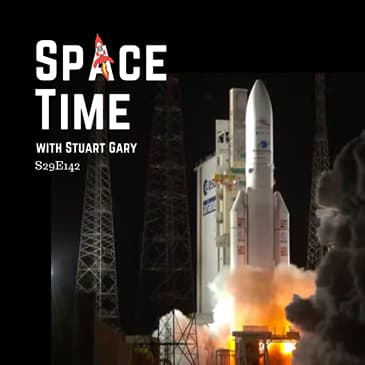



Series 29 Episode 142
BepiColombo arrives at Mercury
After eight years of travelling through the inner Solar System, a gravity assist flyby around the Earth, two around Venus, and six around Mercury, the BepiColombo mission is finally is arriving in orbit at Mercury. The link between volcanoes on the sea floor and a pair of hot zones near Earth's core A new study has linked two enormous hot zone structures at the very bottom of the mantle, near the boundary with Earth's core to giant volcanic seamounts on the ocean floor some two thousand nine hundred kilometres above. America’s latest nuclear missile test The U.S. Air Force Global Strike Command has carried out a test launch of a Minuteman III intercontinental ballistic missile. The Science Report Smoking is becoming more socially acceptable despite its cancer causing poisons. The United States has just lost its measles elimination status. Scientists have developed the first detailed X-ray ageing guide for short-beaked echidnas. Scientists have for the first time directly observed hydrogen in the tiny spaces between atoms. Skeptics guide to monoliths on the Moon. Our Guests This Week Dr. Michael Hotchkis from the Australian Nuclear Science and Technology Organisation – ANSTO BepiColumbo Project Scientist Johannes Benkhoff from ESA Planetary Scientist Jorn Helbert from DLR Mathiew Domeier from the University of Oslo Our regular guests: Alex Zaharov-Reutt from techadvice.life Tim Mendham from Australian Skeptics
Become a supporter of this podcast: https://www.spreaker.com/podcast/spacetime-with-stuart-gary--2458531/support.
00:00:00 --> 00:00:02 Stuart Gary: This is Space Time Series 29 episode
00:00:03 --> 00:00:05 142 for broadcast on 27
00:00:05 --> 00:00:08 November 2026. Coming up on
00:00:08 --> 00:00:11 Space Time, the BepiColomo spacecraft
00:00:11 --> 00:00:13 arrives at Mercury. The link between
00:00:13 --> 00:00:15 volcanoes on the seafloor and a mysterious
00:00:15 --> 00:00:18 pair of hot zones near the Earth's core.
00:00:18 --> 00:00:21 And America's latest nuclear missile test.
00:00:21 --> 00:00:24 All that and more coming up on
00:00:24 --> 00:00:25 Space.
00:00:26 --> 00:00:29 Stuart Gary: Welcome to Space with Stuart
00:00:29 --> 00:00:29 Gary.
00:00:45 --> 00:00:47 Stuart Gary: After eight years of travelling through the
00:00:47 --> 00:00:50 inner solar system, a gravity assist flyby
00:00:50 --> 00:00:52 around the Earth, two more around Venus, and
00:00:52 --> 00:00:54 then six around Mercury, the BepiColombo
00:00:54 --> 00:00:57 mission has finally arrived into orbit at
00:00:57 --> 00:01:00 Mercury. The nine separate gravity assists
00:01:00 --> 00:01:02 were needed to safely reach Mercury. Rather
00:01:02 --> 00:01:05 than overshooting the tiny planet and instead
00:01:05 --> 00:01:06 getting grabbed by the giant gravitational
00:01:07 --> 00:01:10 field of the nearby sun. Mercury
00:01:10 --> 00:01:12 is the closest planet to the sun, orbiting at
00:01:12 --> 00:01:15 an average distance of 58 million kilometres
00:01:15 --> 00:01:17 every 88 Earth days. It's the
00:01:17 --> 00:01:19 smallest planet in the solar system, with a
00:01:19 --> 00:01:22 diameter of just 4880 kilometres. That
00:01:22 --> 00:01:24 makes it only slightly larger than the
00:01:24 --> 00:01:27 Earth's moon. Mercury has no moons of its
00:01:27 --> 00:01:30 own. It has a grey, heavily created surface,
00:01:30 --> 00:01:31 much like the Earth's moon, with cliff like
00:01:31 --> 00:01:34 fault scarps. As the planet's interior cooled
00:01:34 --> 00:01:36 and shrank, there are volcanic plains across
00:01:36 --> 00:01:39 its surface and the massive Caloris Planetia
00:01:39 --> 00:01:42 basin, which is some 1
00:01:42 --> 00:01:44 kilometres wide. But this barren
00:01:44 --> 00:01:47 craggy world isn't completely devoid of water
00:01:47 --> 00:01:49 ice, exists in permanently shadowed craters
00:01:49 --> 00:01:52 near its poles. It lacks a thick atmosphere
00:01:52 --> 00:01:55 and instead has a very thin exosphere made of
00:01:55 --> 00:01:57 trace gas elements. Because it's, uh, so
00:01:57 --> 00:01:59 close to the sun, it has a daytime surface
00:01:59 --> 00:02:02 temperature of some 430 degrees Celsius
00:02:03 --> 00:02:05 that drops to minus 180 degrees Celsius on
00:02:05 --> 00:02:08 the nighttime side. A day on Mercury lasts
00:02:08 --> 00:02:10 58.7 Earth days.
00:02:11 --> 00:02:13 BepiColoma's arrival sequence at Mercury
00:02:13 --> 00:02:15 began back in September when the cruise
00:02:15 --> 00:02:18 section known as the Mercury Transfer Module,
00:02:18 --> 00:02:19 separated from the remainder of the
00:02:19 --> 00:02:22 Spacecraft stack about 3.3 million kilometres
00:02:22 --> 00:02:24 from Mercury. Mercury entering a stable orbit
00:02:24 --> 00:02:27 around the sun and today the rest of the
00:02:27 --> 00:02:29 spacecraft stack, comprising the European
00:02:29 --> 00:02:31 Space Agency's Mercury Planetary Orbiter and
00:02:31 --> 00:02:34 the Japan Aerospace Exploration Agency's
00:02:34 --> 00:02:36 Mercury Magnetospheric Orbiter, uh, will be
00:02:36 --> 00:02:38 captured into orbit around Mercury using the
00:02:38 --> 00:02:40 Mercury Magnetospheric Orbiter's chemical
00:02:40 --> 00:02:43 thrusters. The next month, Mercury's
00:02:43 --> 00:02:45 planetary orbiter and Mercury's
00:02:45 --> 00:02:47 Magnetospheric orbiter will separate from
00:02:47 --> 00:02:49 each other and move into their own respective
00:02:49 --> 00:02:51 independent orbits. Then the Mercury
00:02:51 --> 00:02:53 Planetary Orbiter sun shield and interface
00:02:53 --> 00:02:55 structure will be jettisoned and the two
00:02:55 --> 00:02:57 spacecraft will begin their independent
00:02:57 --> 00:02:59 commissioning phases before beginning their
00:02:59 --> 00:03:02 scientific observations of the planet nearest
00:03:02 --> 00:03:03 the sun in April next year.
00:03:05 --> 00:03:07 So what will each of these spacecraft be
00:03:07 --> 00:03:09 doing? Well the Mercury Planetary Orbiter
00:03:09 --> 00:03:12 will circle Mercury in a 2.3 hour polar
00:03:12 --> 00:03:15 orbit ranging from around 480 up to around
00:03:15 --> 00:03:18 1 kilometres. It'll
00:03:18 --> 00:03:20 map the planet's surface, its composition,
00:03:20 --> 00:03:23 temperature, topography and surface
00:03:23 --> 00:03:25 morphology, creating detailed digital terrain
00:03:25 --> 00:03:28 models. It'll test Mercury's interior
00:03:28 --> 00:03:30 structure and also Einstein's general theory
00:03:30 --> 00:03:32 of relativity to an unprecedented level of
00:03:32 --> 00:03:34 accuracy. It will measure the planet's
00:03:34 --> 00:03:36 magnetic field and its interaction with the
00:03:36 --> 00:03:39 solar wind, a constant stream of charged
00:03:39 --> 00:03:41 particles flowing out from the sun. The
00:03:41 --> 00:03:43 spacecraft will also determine Mercury's
00:03:43 --> 00:03:46 elemental surface and subsurface compositions
00:03:46 --> 00:03:48 in order to identify the distribution of
00:03:48 --> 00:03:50 volatile ices in the permanently shadowed
00:03:50 --> 00:03:53 polar craters. It'll study the surface
00:03:53 --> 00:03:55 geology. It'll study the planet's volcanism,
00:03:55 --> 00:03:57 its global tectonics, if there is any, and
00:03:57 --> 00:04:00 its surface age. It'll also try to
00:04:00 --> 00:04:02 determine Mercury's gravity field and the
00:04:02 --> 00:04:05 size and physical state of its core.
00:04:05 --> 00:04:08 And it will monitor the flux of X rays and
00:04:08 --> 00:04:10 particles of solar origin as they flow around
00:04:10 --> 00:04:13 Mercury. The other spacecraft, the
00:04:13 --> 00:04:15 Mercury Magnetospheric Orbiter, uh, will
00:04:15 --> 00:04:17 circle the planet in an equatorial orbit
00:04:17 --> 00:04:19 ranging from around 590 to
00:04:19 --> 00:04:22 1 11 kilometres,
00:04:22 --> 00:04:24 focusing on the planet's magnetic field, a
00:04:24 --> 00:04:27 magnetosphere. It's equipped with a
00:04:27 --> 00:04:29 magnetometer for measuring magnetic fields, a
00:04:29 --> 00:04:31 plasma particle experiment for observing ions
00:04:31 --> 00:04:34 and electrons, a plasma wave experiment for
00:04:34 --> 00:04:36 studying electric and magnetic plasma waves,
00:04:36 --> 00:04:39 a sodium atmospheric spectral imager for
00:04:39 --> 00:04:41 studying Mercury's thin sodium exosphere and
00:04:41 --> 00:04:43 ah, a dust monitor for measuring the local
00:04:43 --> 00:04:46 cosmic dust content. This report from
00:04:46 --> 00:04:47 ESA TV
00:04:47 --> 00:04:50 Stuart Gary: images from the NASA MESSENGER mission are
00:04:50 --> 00:04:53 the best we have of Mercury. It has
00:04:53 --> 00:04:55 highlands and lowlands like other planets.
00:04:56 --> 00:04:58 But unlike Earth, Mercury
00:04:58 --> 00:05:00 rotates on an axis
00:05:01 --> 00:05:03 perpendicular to its orbit.
00:05:03 --> 00:05:06 Johannes Benkoff: Due to the fact that Mercury is not tilted,
00:05:06 --> 00:05:08 there are some craters on the poles,
00:05:08 --> 00:05:11 uh, where the sun never shines into it.
00:05:11 --> 00:05:14 And uh, inside these craters
00:05:14 --> 00:05:17 MESSENGER found water ice. It
00:05:17 --> 00:05:19 was detected even earlier in the 80s,
00:05:20 --> 00:05:22 uh, from ground that there were rather bright
00:05:22 --> 00:05:25 spots and there were some hints that it might
00:05:25 --> 00:05:27 be water ice. But now from messenger, uh, we
00:05:27 --> 00:05:30 are pretty sure that we have water ice in
00:05:30 --> 00:05:33 craters and that's uh, pretty much
00:05:33 --> 00:05:35 surprising. Think about if you have a planet
00:05:35 --> 00:05:38 on the surface 450 degrees and then you
00:05:38 --> 00:05:41 have water ice at the poles, it's kind of
00:05:41 --> 00:05:42 unbelievable.
00:05:43 --> 00:05:45 Stuart Gary: Fortunately there's an instrument on board
00:05:45 --> 00:05:48 called mirtis which can measure the surface
00:05:48 --> 00:05:50 temperature directly to see if it's cold
00:05:50 --> 00:05:52 enough for water ice.
00:05:53 --> 00:05:55 Knowing the makeup of the planet's dark
00:05:55 --> 00:05:58 surface is also important. A team
00:05:58 --> 00:06:01 at dlr, the German space agency,
00:06:01 --> 00:06:04 have built a special chamber to heat up
00:06:04 --> 00:06:07 samples to examine how they behave for
00:06:07 --> 00:06:10 at high temperatures. These can then be
00:06:10 --> 00:06:12 compared with what will be found on the
00:06:12 --> 00:06:15 planet. Planetary scientists are uh,
00:06:15 --> 00:06:18 unsure how it formed. It could have
00:06:18 --> 00:06:21 originated beyond Mars with an impact
00:06:21 --> 00:06:24 pushing it closer to the sun. Or it
00:06:24 --> 00:06:26 could have formed at lower temperatures in
00:06:26 --> 00:06:29 its current position. If so, uh,
00:06:29 --> 00:06:32 current theoretical models will need
00:06:32 --> 00:06:33 a rethink.
00:06:33 --> 00:06:35 Speaker E: One of the things why I like working on
00:06:35 --> 00:06:38 Mercury is uh, we need to understand
00:06:38 --> 00:06:40 Mercury in order to understand how planets
00:06:40 --> 00:06:43 form. Uh, if we have a model that
00:06:43 --> 00:06:46 forms all planets but not Mercury, that
00:06:46 --> 00:06:48 model is basically useless because you need
00:06:48 --> 00:06:49 to get that one as well.
00:06:50 --> 00:06:53 Stuart Gary: NASA's MESSENGER mission did a great job.
00:06:53 --> 00:06:55 But BepiColombo consists of two
00:06:55 --> 00:06:58 orbiters using complementary orbits
00:06:58 --> 00:07:01 with more combined instruments.
00:07:01 --> 00:07:04 Plus unlike MESSENGER, it will
00:07:04 --> 00:07:07 obtain high resolution images of the
00:07:07 --> 00:07:10 entire planet. The planet is
00:07:10 --> 00:07:13 also shrinking in size, possibly due to
00:07:13 --> 00:07:15 cooling. Plus there may be active
00:07:15 --> 00:07:18 volcanoes. So there is much more to
00:07:18 --> 00:07:18 learn.
00:07:19 --> 00:07:22 Johannes Benkoff: Mercury is a very mysterious planet.
00:07:22 --> 00:07:24 Every time we went there we found new
00:07:24 --> 00:07:27 surprising results. And uh, that is
00:07:27 --> 00:07:29 the reason why we do BepiColamo. And we hope
00:07:29 --> 00:07:32 with Bepicolamo on one hand we are able to
00:07:32 --> 00:07:35 answer many of these new questions. But
00:07:35 --> 00:07:37 I'm pretty sure we found a lot of new
00:07:38 --> 00:07:40 surprising results which raise
00:07:41 --> 00:07:44 new and other questions which we then
00:07:44 --> 00:07:45 need to follow up.
00:07:45 --> 00:07:47 Stuart Gary: And in that report from ESA TV, we heard from
00:07:47 --> 00:07:50 BepiColombo project scientist Johannes Benkov
00:07:50 --> 00:07:52 from ESA and planetary scientist Johan
00:07:52 --> 00:07:55 Hilbert from the German Space Agency
00:07:55 --> 00:07:56 dlr.
00:07:56 --> 00:07:59 Uh, this is space time still to
00:07:59 --> 00:08:02 come. A link between volcanoes on the
00:08:02 --> 00:08:04 seafloor and a pair of mysterious hot zones
00:08:04 --> 00:08:07 near the Earth's core. And America conducts a
00:08:07 --> 00:08:09 nuclear missile test flying a rocket across
00:08:09 --> 00:08:12 the Pacific. All that and more still to come
00:08:12 --> 00:08:13 on uh, space time.
00:08:19 --> 00:08:22 A new study has linked two enormous hot zone
00:08:22 --> 00:08:24 structures located at the very bottom of the
00:08:24 --> 00:08:26 mantle near the boundary with the Earth's
00:08:26 --> 00:08:28 core to giant volcanic sea mats on the ocean
00:08:28 --> 00:08:31 floor some 2 kilometres above.
00:08:32 --> 00:08:34 The findings reported in the journal Nature
00:08:34 --> 00:08:37 Geoscience, suggest the mantle plumes
00:08:37 --> 00:08:39 rising from these two large low seismic
00:08:39 --> 00:08:41 velocity provinces are interacting with the
00:08:41 --> 00:08:44 seafloor, generating volcanic activity on the
00:08:44 --> 00:08:47 seamounts. One of the study's authors, Clint
00:08:47 --> 00:08:49 Conrad from the University of Oslo, says the
00:08:49 --> 00:08:51 Ocean covers around 70% of the Earth's uh,
00:08:51 --> 00:08:54 surface, but large parts of the seafloor
00:08:54 --> 00:08:56 remain largely unexplored. Among the
00:08:56 --> 00:08:58 unexplored regions hidden in the depths are
00:08:58 --> 00:09:01 numerous seamounts, often the remains of
00:09:01 --> 00:09:03 ancient extinct volcanoes. They can
00:09:03 --> 00:09:06 form long mountain ranges on the seafloor and
00:09:06 --> 00:09:09 can rise as much as 4 metres above it.
00:09:09 --> 00:09:11 Conrad says many seamounts are hidden because
00:09:11 --> 00:09:14 they never reach the surface. But they can be
00:09:14 --> 00:09:16 detected using satellites which sense small
00:09:16 --> 00:09:18 localised variations in gravity due to
00:09:18 --> 00:09:20 increased mass and density at specific points
00:09:20 --> 00:09:23 on the planet's crust. Conrad
00:09:23 --> 00:09:25 and colleagues focused on large seamounts
00:09:25 --> 00:09:27 that lie out in the deep ocean far from land,
00:09:27 --> 00:09:29 which often have enormous dimensions.
00:09:30 --> 00:09:33 Beneath the seafloor crust lies the Earth's
00:09:33 --> 00:09:35 mantle, a thick layer of solid by
00:09:35 --> 00:09:37 viscoelastic hot rock where large structures
00:09:37 --> 00:09:39 and heat flows influence where volcanic
00:09:39 --> 00:09:42 activity occurs on, um, the seafloor. The
00:09:42 --> 00:09:44 authors examined two enormous structures
00:09:44 --> 00:09:47 located in the lowest part of the mantle. One
00:09:47 --> 00:09:49 beneath Africa, the other under the Pacific.
00:09:49 --> 00:09:51 These are located near the boundary with the
00:09:51 --> 00:09:54 Earth's core and are referred to as low
00:09:54 --> 00:09:56 seismic velocity provinces, huge regions
00:09:56 --> 00:09:59 where seismic S waves travel more slowly.
00:09:59 --> 00:10:02 The authors found that volcanic activity on
00:10:02 --> 00:10:04 seamounts is more extensive on seafloor than
00:10:04 --> 00:10:06 had previously passed over these provinces.
00:10:06 --> 00:10:09 Conrad says they're like two huge island
00:10:09 --> 00:10:12 hot zones near the Earth's core, enigmatic
00:10:12 --> 00:10:13 but important structures that may have
00:10:13 --> 00:10:16 existed for billions of years. These
00:10:16 --> 00:10:18 zones are hotter than their surroundings,
00:10:18 --> 00:10:21 therefore less rigid. The authors say the
00:10:21 --> 00:10:23 mantle plumes they generate appear to be
00:10:23 --> 00:10:25 especially strong in the Pacific region
00:10:25 --> 00:10:27 because the mantle rocks there can be hotter
00:10:27 --> 00:10:29 and wetter and therefore more dynamic.
00:10:30 --> 00:10:32 Seamounts are important because they create
00:10:32 --> 00:10:35 special habitats in the ocean. They provide
00:10:35 --> 00:10:37 hard substrate, shelter, sometimes favourable
00:10:37 --> 00:10:40 currents and often rich nutrients. They
00:10:40 --> 00:10:42 therefore become important stopovers for
00:10:42 --> 00:10:45 migratory species. When water flows over
00:10:45 --> 00:10:47 and around these structures, both circulation
00:10:47 --> 00:10:49 and the mixing of nutrients in the ocean are
00:10:49 --> 00:10:52 altered. Currents that are forced upwards
00:10:52 --> 00:10:54 along the seamounts bring nutrients towards
00:10:54 --> 00:10:56 the surface, creating rich feeding grounds
00:10:56 --> 00:10:59 for fish, marine mammals and seabirds. And
00:10:59 --> 00:11:01 seamounts also provide scientists with key
00:11:01 --> 00:11:03 data, uh, on how Earth has developed as a
00:11:03 --> 00:11:06 planet and how it may continue to develop in
00:11:06 --> 00:11:08 the future. The work by Conrad and colleagues
00:11:08 --> 00:11:10 are showing that the plan plumes transporting
00:11:10 --> 00:11:12 heat from the large low seismic velocity
00:11:12 --> 00:11:15 provinces are likely responsible for most of
00:11:15 --> 00:11:17 the volcanic activity within the ocean
00:11:17 --> 00:11:19 plates, including scattered seamounts.
00:11:20 --> 00:11:22 This connection to the deep mantle means
00:11:22 --> 00:11:25 volcanism on seamounts is sensitive to and
00:11:25 --> 00:11:27 can help us understand how the dynamics of
00:11:27 --> 00:11:29 the Earth's deep mantle may have changed
00:11:29 --> 00:11:32 over, uh, geological time. One of the
00:11:32 --> 00:11:34 study's co authors, Matthew Daumier, also
00:11:34 --> 00:11:37 from the University of Oslo, says it's all
00:11:37 --> 00:11:39 part of a bigger picture, trying to
00:11:39 --> 00:11:42 understand how and why the tectonic
00:11:42 --> 00:11:44 plates that make up the Earth's crust move
00:11:44 --> 00:11:45 the way they do.
00:11:45 --> 00:11:47 Stuart Gary: We've been working on this particular problem
00:11:47 --> 00:11:49 for, uh, the last year or so, but we have
00:11:49 --> 00:11:51 been working on lots of other related
00:11:51 --> 00:11:53 problems trying to figure out the tectonic
00:11:53 --> 00:11:54 history of the Earth. So really we want to
00:11:54 --> 00:11:57 understand how and why the tectonic plates,
00:11:57 --> 00:11:59 the continents, the oceans, how they have
00:11:59 --> 00:12:01 moved to where they have been through Earth's
00:12:01 --> 00:12:03 history. So this is one small piece of a much
00:12:03 --> 00:12:05 bigger puzzle of putting together Earth's
00:12:05 --> 00:12:07 tectonic history. Hawaii is special because
00:12:07 --> 00:12:10 it's a hot spot. And through time this hot
00:12:10 --> 00:12:13 spot has left a track of volcanoes behind
00:12:13 --> 00:12:15 Hawaii which go all the way up to
00:12:15 --> 00:12:18 Kamchatka. And there is a bend. And
00:12:18 --> 00:12:20 the reason for this bend is very
00:12:20 --> 00:12:22 controversial. People have been working on
00:12:22 --> 00:12:24 trying to figure out why the Pacific plate
00:12:24 --> 00:12:26 seems to have changed direction as it was
00:12:26 --> 00:12:28 passing over this mantle plume, this hot
00:12:28 --> 00:12:31 spot, for a very long time. We
00:12:31 --> 00:12:33 know the age of this bend, it's about 50
00:12:33 --> 00:12:35 million years, because we have dates from
00:12:35 --> 00:12:37 rocks coming from seamounts on either side of
00:12:37 --> 00:12:40 the bend. And we now think we have solved the
00:12:40 --> 00:12:43 mystery as to why the Pacific plate changed
00:12:43 --> 00:12:44 direction at, uh, 50 million years ago. And
00:12:44 --> 00:12:47 that is that a big piece of Kamchatka, as
00:12:47 --> 00:12:49 well as what is now stuck in northern Japan
00:12:49 --> 00:12:52 collided with that margin at, uh, 50 million
00:12:52 --> 00:12:55 years ago. Seismic vote maps
00:12:55 --> 00:12:57 which were put together by Grace Shepard
00:12:57 --> 00:12:58 beneath the North Pacific, in the mantle
00:12:58 --> 00:13:01 beneath the North Pacific. And this band of
00:13:01 --> 00:13:03 colours is showing us subducted lithosphere,
00:13:03 --> 00:13:06 subducted tectonic plates from the past. And
00:13:06 --> 00:13:08 what this is specifically telling us in the
00:13:08 --> 00:13:10 context of our story is that there was a
00:13:10 --> 00:13:13 subduction zone active here between 80 and 50
00:13:13 --> 00:13:15 million years ago, which is exactly the time
00:13:15 --> 00:13:17 that these rocks which we find in Kamchatka
00:13:17 --> 00:13:19 and in northern Japan where they were
00:13:19 --> 00:13:20 located. So they were sitting on top of this
00:13:20 --> 00:13:22 subduction zone 80 to 50 million years ago.
00:13:22 --> 00:13:25 And after this time they collided. And that
00:13:25 --> 00:13:27 was why the Pacific plate changed its
00:13:27 --> 00:13:28 direction at 50 million years ago.
00:13:28 --> 00:13:30 Stuart Gary: That's Matthew Daumierre from the University
00:13:30 --> 00:13:31 of Oslo.
00:13:32 --> 00:13:35 And this is space time still
00:13:35 --> 00:13:37 to come. America tests a nuclear missile.
00:13:38 --> 00:13:40 Later in the Science Report, a new study
00:13:40 --> 00:13:42 warns that smoking is becoming more socially
00:13:42 --> 00:13:44 acceptable despite its cancer causing
00:13:44 --> 00:13:47 properties. All that and more still to come
00:13:47 --> 00:13:49 on, um, space time,
00:13:54 --> 00:13:54 Foreign,
00:14:03 --> 00:14:06 The United States air Force Global Strike
00:14:06 --> 00:14:08 Command has carried out a test launch of a
00:14:08 --> 00:14:10 Minuteman III intercontinental ballistic
00:14:10 --> 00:14:13 missile. The mission, designated Glory Trip
00:14:13 --> 00:14:16 257, was launched from the Vandenberg Space
00:14:16 --> 00:14:18 Force Base in California. Glory
00:14:18 --> 00:14:21 Trip257 was designed to evaluate the missile
00:14:21 --> 00:14:23 system's readiness, effectiveness and
00:14:23 --> 00:14:26 accuracy. These Glory Trip tests
00:14:26 --> 00:14:28 randomly select missiles from an operational
00:14:28 --> 00:14:30 silo, remove the nuclear warhead and then
00:14:30 --> 00:14:32 transport it to California for the test
00:14:32 --> 00:14:35 flight. The LGM
00:14:35 --> 00:14:38 30G Minuteman III missile is a component
00:14:38 --> 00:14:40 of America's land based nuclear deterrent.
00:14:41 --> 00:14:43 Boeing built the three stage Intercontinental
00:14:43 --> 00:14:45 Ballistic Missile to carry either a 350
00:14:45 --> 00:14:47 kiloton W78 or a
00:14:47 --> 00:14:50 475 kiloton W87
00:14:50 --> 00:14:53 thermonuclear warhead over a range of at
00:14:53 --> 00:14:54 least 14 kilometres.
00:14:55 --> 00:14:58 Minuteman III missiles are deployed in silos
00:14:58 --> 00:15:00 around Malmstrom Air Force Base in Montana,
00:15:00 --> 00:15:02 the Minnow Air Force Base in North Dakota and
00:15:02 --> 00:15:04 the Francis E. Warren Air Force Base in
00:15:04 --> 00:15:07 Wyoming. This is space.
00:15:23 --> 00:15:25 And time now to take another brief look at
00:15:25 --> 00:15:26 some of the other stories making news in
00:15:26 --> 00:15:28 Science this week with a Science report.
00:15:29 --> 00:15:32 Well, despite its long known association with
00:15:32 --> 00:15:33 a range of illnesses, including deadly
00:15:33 --> 00:15:36 cancers, smoking is becoming more socially
00:15:36 --> 00:15:39 acceptable in society. At the same time,
00:15:39 --> 00:15:41 the new findings reported in the Journal of
00:15:41 --> 00:15:43 Nicotine and Tobacco Research also show an
00:15:43 --> 00:15:46 increased disapproval of vaping. The research
00:15:46 --> 00:15:48 by scientists from the University of
00:15:48 --> 00:15:51 Queensland examined smoking and vaping Trends
00:15:51 --> 00:15:53 among almost 20 adults who smoke daily.
00:15:55 --> 00:15:57 The United States has just lost its measles
00:15:57 --> 00:16:00 elimination status. The downgrading by
00:16:00 --> 00:16:03 the Pan American Health Organisation followed
00:16:03 --> 00:16:05 the reporting of some 5 cases of measles
00:16:05 --> 00:16:08 this year. A country is considered to have
00:16:08 --> 00:16:10 eliminated measles if there are no locally
00:16:10 --> 00:16:13 transmitted measles infections or outbreaks
00:16:13 --> 00:16:16 over a 12 month period. The large number of
00:16:16 --> 00:16:18 cases in America has led to over 590
00:16:18 --> 00:16:21 hospitalizations and at least six measles
00:16:21 --> 00:16:23 related deaths. Measles is a highly
00:16:23 --> 00:16:26 contagious viral illness. It initially
00:16:26 --> 00:16:28 infects the respiratory tract for spreading
00:16:28 --> 00:16:30 throughout the body. It can easily be
00:16:30 --> 00:16:33 prevented with a simple two part vaccine, but
00:16:33 --> 00:16:36 pseudoscientific campaigns for anti vax
00:16:36 --> 00:16:38 groups has lowered vaccination rates, leaving
00:16:38 --> 00:16:41 more people exposed and consequently more
00:16:41 --> 00:16:44 fatalities. Scientists
00:16:44 --> 00:16:46 have developed the first ever detailed X ray
00:16:46 --> 00:16:49 ageing guide for Australia's rare short
00:16:49 --> 00:16:52 beaked echidnas. Researchers from
00:16:52 --> 00:16:54 Murdoch University and Sydney's Taronga Park
00:16:54 --> 00:16:57 Zoo analysed X rays of known age echidnas
00:16:57 --> 00:17:00 in order to help map how their bones develop
00:17:00 --> 00:17:02 from tiny puggles to young adults.
00:17:02 --> 00:17:05 The findings reported in the Journal of The
00:17:05 --> 00:17:07 Royal Society Open Science claims the guide
00:17:07 --> 00:17:10 could help vets and wildlife carers estimate
00:17:10 --> 00:17:12 the age of young echidnas with unknown
00:17:12 --> 00:17:14 histories, thereby allowing them to develop
00:17:14 --> 00:17:17 more informed decisions about nutrition
00:17:17 --> 00:17:19 treatment, rehabilitation and release.
00:17:21 --> 00:17:23 Scientists have for the first time directly
00:17:23 --> 00:17:26 observed hydrogen in tiny spaces between the
00:17:26 --> 00:17:29 atoms in metal alloys. The findings reported
00:17:29 --> 00:17:31 in the journal Nature show hydrogen
00:17:31 --> 00:17:33 dissolving in these metal crystal lattices.
00:17:34 --> 00:17:36 The research offers fresh clues into why
00:17:36 --> 00:17:38 hydrogen can weaken metals and how more
00:17:38 --> 00:17:40 hydrogen resistant materials could be
00:17:40 --> 00:17:40 developed.
00:17:42 --> 00:17:45 A well known UFO believer, Luis Elizondo,
00:17:45 --> 00:17:48 claims he has evidence of a bunch of 2001
00:17:48 --> 00:17:50 Space Odyssey style monoliths on the moon.
00:17:50 --> 00:17:52 And of course he says the government know
00:17:52 --> 00:17:55 about it and are covering it all up. He also
00:17:55 --> 00:17:57 describes military encounters with mysterious
00:17:57 --> 00:17:59 coloured orbs which he claims could be
00:17:59 --> 00:18:02 autonomous alien surveillance platforms. But
00:18:02 --> 00:18:04 as the sceptics Timms Mendham points out, uh,
00:18:04 --> 00:18:06 he hasn't been able to provide any evidence
00:18:06 --> 00:18:07 to support his claims.
00:18:07 --> 00:18:09 Tim Mendham: Louis Elizondo is a fellow, used to be a, um,
00:18:09 --> 00:18:11 working in the Defence Department. I think
00:18:11 --> 00:18:13 supposedly in some places that were searching
00:18:13 --> 00:18:16 for UFOs or anomalous phenomena. There's been
00:18:16 --> 00:18:17 some discussion about where he actually
00:18:17 --> 00:18:18 worked and how long he worked there and the
00:18:18 --> 00:18:20 position he had. But ever since he's become a
00:18:20 --> 00:18:22 bit of a leading figure in the UFO, uh,
00:18:22 --> 00:18:25 conspiracy market. He always publishing
00:18:25 --> 00:18:26 books, always appearing everywhere. If you
00:18:26 --> 00:18:28 look at any documentary in quotes about the
00:18:28 --> 00:18:30 UFO cover ups and things, he will appear
00:18:30 --> 00:18:32 almost guaranteed. And he's made some very,
00:18:32 --> 00:18:34 very strange um, statements in the past, some
00:18:34 --> 00:18:36 of which are really off the beam and some of
00:18:36 --> 00:18:38 which are easily counted. I think he had a
00:18:38 --> 00:18:40 picture before of some flying saucers or
00:18:40 --> 00:18:42 something in the sky and it turned out to be
00:18:42 --> 00:18:44 nothing like it. People knew. Even the UFO
00:18:44 --> 00:18:47 community thinks he's drawing a long bow in a
00:18:47 --> 00:18:48 lot of the things he's saying now. He's
00:18:48 --> 00:18:50 saying that he has seen or they have seen or
00:18:50 --> 00:18:53 something has seen mysterious objects on the
00:18:53 --> 00:18:55 moon that are of, are angular monoliths as in
00:18:55 --> 00:18:58 2001, they're probably squarer than that.
00:18:58 --> 00:19:00 2001s were pretty sort of flat. The avid UFO
00:19:00 --> 00:19:02 supporters who were writing up this whole
00:19:02 --> 00:19:04 conspiracy theories tend to take him a bit
00:19:04 --> 00:19:06 seriously. Others don't. And he's repeating
00:19:06 --> 00:19:07 the same things over and over again.
00:19:07 --> 00:19:09 Government conspiracy, secret alien craft,
00:19:09 --> 00:19:12 alien bodies, all without evidence. And the
00:19:12 --> 00:19:14 evidence he does put forward, like seeing
00:19:14 --> 00:19:15 monoliths on the moon are uh, really
00:19:15 --> 00:19:18 unsupported. He will grab any sort of plane
00:19:18 --> 00:19:20 and run with it for a while and then drop it.
00:19:20 --> 00:19:22 It's always the same problem with UFO
00:19:22 --> 00:19:24 evidence or something. Either the photos of a
00:19:24 --> 00:19:26 blurry or the witnesses, uh, be misled
00:19:26 --> 00:19:28 easily, regardless of what positions the
00:19:28 --> 00:19:29 witnesses hold in society.
00:19:30 --> 00:19:32 Stuart Gary: Making money out of books and things like
00:19:32 --> 00:19:33 that. Is that what it.
00:19:33 --> 00:19:35 Tim Mendham: Yeah, I mean, is that his motive? Fame. Fame
00:19:35 --> 00:19:37 is. Fame is a good motive for people as well.
00:19:37 --> 00:19:38 It goes to your head a bit. So you think
00:19:38 --> 00:19:40 you're very important and therefore you think
00:19:40 --> 00:19:41 what you're saying must be true.
00:19:41 --> 00:19:43 Stuart Gary: That's the sceptics. Tim Mendham and this is
00:19:43 --> 00:19:44 Space Time.
00:20:00 --> 00:20:02 And that's the show for now. Space Time is
00:20:02 --> 00:20:05 available every Monday, Wednesday and Friday
00:20:05 --> 00:20:07 through bytes.com soundcloud,
00:20:07 --> 00:20:10 YouTube, your favourite podcast download
00:20:10 --> 00:20:11 provider, and from
00:20:11 --> 00:20:13 spacetimewithstuartgarry.com
00:20:13 --> 00:20:15 Space Times also broadcast through the
00:20:15 --> 00:20:18 National Science foundation on Science Zone
00:20:18 --> 00:20:20 Radio and on both iHeartradio and
00:20:20 --> 00:20:23 TuneIn radio. And you can help to support our
00:20:23 --> 00:20:26 show by visiting the Space Store for a range
00:20:26 --> 00:20:29 of promotional merchandising goodies, or by
00:20:29 --> 00:20:31 becoming a Space patron, which gives you
00:20:31 --> 00:20:33 access to triple episode commercial free
00:20:33 --> 00:20:35 versions of the show, as well as lots of
00:20:35 --> 00:20:37 bonus audio content which doesn't go to air,
00:20:38 --> 00:20:40 access to our exclusive Facebook group and
00:20:40 --> 00:20:42 other rewards. Just go to
00:20:42 --> 00:20:45 spacetimewithstuartgarry.com for full
00:20:45 --> 00:20:45 details.
00:20:46 --> 00:20:48 Stuart Gary: You've been listening to Space Time with
00:20:48 --> 00:20:51 Stuart Gary. This has been another quality
00:20:51 --> 00:20:53 podcast production from bytes.com.